
Potential Sovereign-Level Risk for the Dollar—A Warning from Buffett

At Berkshire Hathaway's annual shareholders meeting, Warren Buffett made an unusually direct statement: "Some things that could happen in the United States might make us want to hold a lot of currency in other countries."
This is not Buffett's usual investment pep talk.
Buffett rarely discusses currency exposure so openly, let alone hints at internal U.S. conditions potentially triggering a strategic flight from the dollar. Given Berkshire's record-high cash reserves of nearly $350 billion and the company's avoidance of large new investments, his statement deserves close attention.
Buffett is quietly warning of one of the most serious risks he has ever implied for the U.S.: a loss of confidence in American monetary or political stability.
Unlike past U.S. market declines or economic recessions, this is not about U.S. inflation or recession—it's about the integrity of American sovereignty as a financial pillar. Otherwise, why would the CEO of one of the world's most dollar-dependent companies suddenly talk about buying "large amounts of other countries' currencies"?
The signal Buffett may be sending is of sovereign-level risk to the dollar. He may believe that Trump's policy decisions—fiscal, monetary, or political—are posing a structural threat to the dollar's credibility. This could include: an impending U.S. Treasury market crisis or loss of foreign confidence in U.S. debt, weaponization of U.S. monetary policy leading to implicit devaluation, U.S. political instability or regulatory dysfunction leading to capital control risks.
This suggests Buffett sees America's greatest danger as institutional fragility, not merely inflation. This isn't a replay of 1970s-style inflation hedging strategies; Buffett isn't recommending gold. He's saying that holding dollars itself might not be safe in all scenarios anymore. This is a fundamental shift. Such concerns typically trigger sovereign portfolio rebalancing, not just corporate hedging.
As BRICS nations accelerate de-dollarization and U.S. trade tensions escalate, Buffett may be preparing for a world of fragmented global reserve and trade pricing. In this scenario, holding other countries' currencies isn't opportunistic investing, but a necessary condition for maintaining purchasing power and operational sovereignty—a strategic repositioning for a multipolar financial system.
Buffett has never made similar comments in previous crises: In 2008, he bought into the U.S. stock market and reaffirmed dollar strength. During the covid period, he remained cautious but never questioned the dollar. Even during the dot-com bubble burst, he focused on overvaluation, not currency integrity.
Now it's 2025, U.S. GDP is contracting, Treasury yields are soaring, forex markets are volatile, Berkshire is still hoarding cash—and Buffett suddenly mentions currency flight risk.
This is more than market commentary. It's a warning from America's most trusted capital allocator: the dollar may no longer be unquestionable. It suggests Berkshire is preparing for: multi-currency balance sheets, global realignment of sovereign financial trust, and potentially unstable periods where the U.S. itself becomes a source of global financial risk.
Buffett didn't say this casually. His company is at historic highs, holding unprecedented cash. Yet instead of celebrating U.S. system strength, he raises the idea of holding foreign currencies to hedge against U.S. risks.
Buffett's comments can be interpreted as an early reminder that the U.S. is losing its privilege to unilaterally dominate global currency flows. For decades, dollar dominance allowed the U.S. to export inflation, suppress foreign forex, and absorb global capital without consequences. But if Trump's tariff system now doubles as a forex reset mechanism, forcing other countries to stop suppressing their currencies, those foreign currencies suddenly become more honest, scarcer, and potentially more valuable. Buffett may just be preparing for a world where the dollar can't cheat anymore.
Buffett's announcement that he will no longer serve as Berkshire Hathaway's CEO in 2025, and his choice to say something beyond the usual in what might be his last shareholders meeting before stepping down, is completely understandable. Some may even think Buffett is completely cashing out and handing control to Greg.
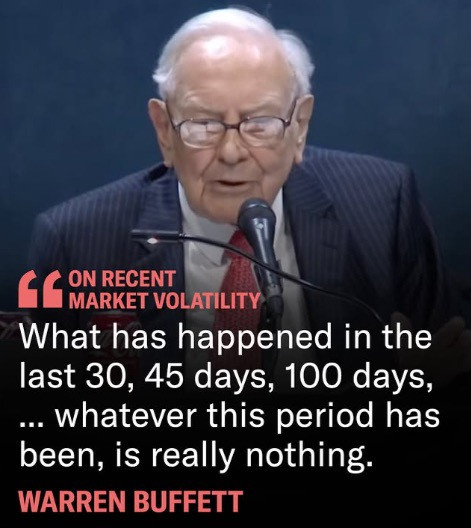
As Buffett said at the meeting: "What has happened in the last 30, 45 days, 100 days, ... whatever this period has been, is really nothing."
At such a moment, at the end of the Buffett era, Buffett's choice to question the dollar in his final shareholders meeting speech is like Trump photoshopping himself as the Pope—they only say such things when something sacred is no longer safe.