
Bessent Trapped by Declining U.S. Sovereign Credit

Recently, Bessent made a significant statement at the Milken Institute Global Conference. He said, "If we could eliminate the credit risk of the U.S. government, U.S. Treasury yields would fall."
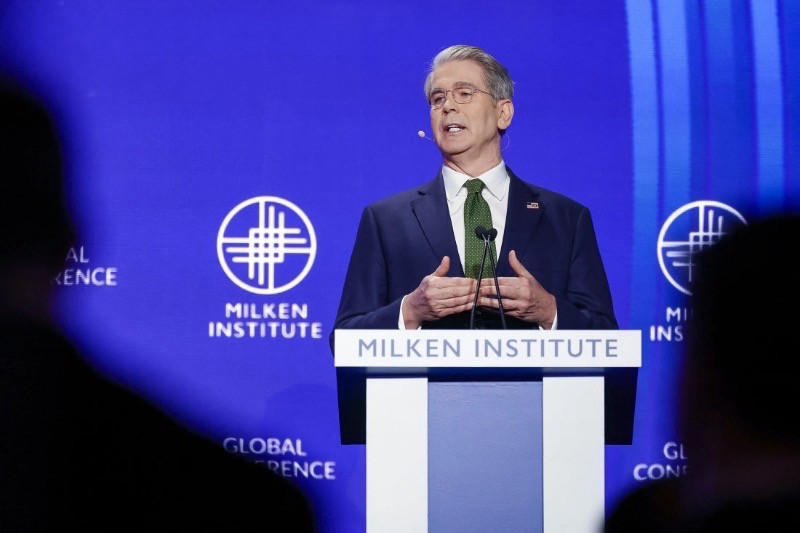
Bessent isn't saying "the U.S. will default like an ordinary company," but pointing out a crucial change: for the first time since World War II, the market perceives credit risk in U.S. Treasuries. Current U.S. Treasury rates/yields no longer just reflect inflation and Fed policy, but also imply concerns about:
1. U.S. debt pressure: Over $9 trillion in debt matures in the next 12 months, requiring refinancing.
2. Foreign capital flight: Japan, EU countries reportedly reducing U.S. debt holdings; Japan's Finance Minister openly threatened using U.S. debt as "trade negotiation" leverage.
3. Budget chaos in Trump's second term: Soaring budget deficits, political deadlock between Democrats and Republicans.
4. Fed's credibility damaged: Central bank balance sheet used to manipulate markets.
5. Most importantly: Trump is the biggest negative factor for U.S. sovereign credit.
Simply put: U.S. Treasury yields are so high because Trump's series of reckless actions since taking office have made investors feel lending to the U.S. government is now risky, and the risk is significant.
Yes, the bigger the waves, the more fish, so investors now demand more "fish," keeping interest rates high.
Clearly, Bessent is troubled by this, as the U.S. market has fully reflected these risks, which the Treasury can't conceal. The SOFR spread has plummeted, with the 30-year SOFR spread falling to -90 basis points (May 5, 2025), indicating market concerns about insufficient U.S. sovereign collateral and credit deterioration. In the credit default swap (CDS) market, investors are betting that the U.S. might not directly default but could alleviate debt through currency devaluation or implicit money printing. So the term premium has turned from negative to positive; in 2020, the market was willing to buy U.S. long-term bonds, but now demands higher returns.
Finally, gold's performance: Gold has returned to $3,300 per ounce, indicating that at least emerging market countries are increasing gold holdings, reducing dollar assets, and losing trust in the traditional safe-haven asset—U.S. Treasuries.
U.S. sovereign credit isn't being questioned for the first time. In recent instances, Fed Chairman Volcker aggressively raised rates in 1979, sacrificing the U.S. economy to suppress inflation. The IMF system was established in 1947 to help the world collectively absorb U.S. debt. But now the situation is reversed; the world is reducing dependence on U.S. debt, and unless the U.S. can forcibly restore market confidence, past methods are unlikely to work.
Restoring confidence is easier said than done. Every time Trump opens his mouth, the U.S. sovereign credit "health bar" drops at least one notch.
Fiscal tools available to the U.S. include launching fiscal reform (legislating deficit limits, enforcing balanced budgets, reforming Social Security and Medicare, reducing future debt pressure), re-anchoring the dollar (e.g., partially pegging it to gold or other physical assets), re-drawing boundaries between the Fed and Treasury (avoiding arbitrary money printing and spending), violently forcing allies to share risks (providing some "insurance" for U.S. debt or directly buying century bonds as penance), but none are easy.
The simplest solution would be for Trump to kneel down and kowtow, canceling arbitrary tariffs, even using tax incentives to attract overseas capital back, establishing state-guaranteed infrastructure investment tools, and launching long-term projects—essentially Roosevelt's 3R approach.
But you know that's even less likely; the possibility of Trump's premature demise might be higher. The post-Roosevelt U.S. system is mainly designed to prevent a second Roosevelt.
So Trump: Just issue some air coins.
The consequence is, if the U.S. can't catch its breath now, the U.S. market will continue to push up interest rates, capital will flee U.S. debt, turning to gold, commodities, and other hard assets. If inflation returns (e.g., an energy crisis), credit risk will persist long-term, the world will completely lose confidence in the dollar, and even major U.S. fiscal reforms might be ineffective—especially if the whole world is accelerating de-dollarization.
Bessent's idea remains "To restore market trust, the U.S. needs fundamental fiscal, monetary, and global policy reforms. If not, the U.S. market will eventually force reform through higher interest rates or abandoning the dollar." Is the U.S. preparing for "inflationary default"—implicitly reducing debt through currency devaluation? Is Bessent hinting at this?
Is it possible that the global market and supply chains are also thinking, "Worst case, we'll let you play in your own little black room; reform or not, we don't care"?
Anything is possible.
Ironically, Bessent quoted Buffett in his speech at the Milken Institute Global Conference.
And Buffett, just days ago, described Trump's tariff policy as "a big mistake," stating that "using trade as a weapon is detrimental to international relations and will destabilize global markets."
Bessent is suffering inside, but Bessent still has to lie with his eyes wide open.