
What Does the U.S. Treasury's Symbolic $4 Billion Buyback Portend?

The U.S. Treasury conducted its first official debt buyback in decades. The numbers tell the story: The U.S. Treasury received $30.022 billion in buyback offers (provided by the market) but only accepted $4 billion.
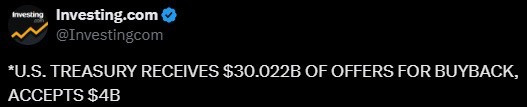
On paper, this appears to be a small-scale action, just a minor operation targeting obscure bonds maturing from mid-2025 to mid-2027, but the signal is quite serious.
The market's intention to sell $30 billion in U.S. Treasuries is far more than traders simply seeking to close out positions. It reflects the entire market's rush to sell short-term U.S. Treasuries—indicating that these bonds no longer have smooth liquidity in the secondary market, a hidden liquidity crunch. For bonds maturing within two years, this performance is highly unusual, suggesting that dealers' positions are saturated, and even short-term bonds struggle to take on more duration risk. Foreign holders may also be cashing out, turning to gold, foreign exchange, or other liquid assets, while asset management institutions are trying to reduce risk before volatility returns.
So, demand for U.S. Treasuries still exists, but only if institutions are willing to act as counterparties.
The U.S. Treasury is also in a difficult position.
If it were to accept all $30 billion in buyback offers, it would essentially announce the start of a disguised quantitative easing, which would certainly trigger both political and market shocks. But if it does nothing, the liquidity crisis of U.S. short-term Treasuries unable to clear smoothly in the secondary market can no longer be concealed—at least they need to keep up appearances.
Therefore, the U.S. Treasury ultimately chose a symbolic $4 billion buyback, walking a tightrope between "stabilizing the market" and "avoiding accusations of monetization." This also means that the U.S. Treasury's role must shift from a pure debt issuer to a market backstop.
But what does the U.S. Treasury have to back the liquidity of the tens of trillions of dollars in the U.S. debt market?
So, although the Federal Reserve hasn't formally implemented QE, the U.S. Treasury's balance sheet management this time has actually produced QE-like effects. Currently, 95% of newly issued Treasuries are concentrated in the short-term, and the U.S. Treasury is facing unprecedented risks, with dramatically increased rollover risks, worsening duration mismatches, and declining market confidence. The U.S. Treasury must conduct similar functional shadow QE to provide liquidity insurance for the era of surging U.S. debt.
So, what's the cost?
If the buyback expands, it will evolve into invisible QE. If operations are suspended, U.S. credit, stock market, and dollar financing markets may face disruptions. If foreign holders view this as soft monetization of U.S. debt, then gold, commodities, and foreign exchange markets will come under pressure.
In short: The tipping point for high-interest QE in the U.S. is just around the corner.