
America Just Lost Its Last AAA Rating—Why That Matters More Than You Think

So, it finally happened. Moody’s has cut the U.S. government’s credit rating, stripping America of its last remaining AAA rating from the big three agencies.
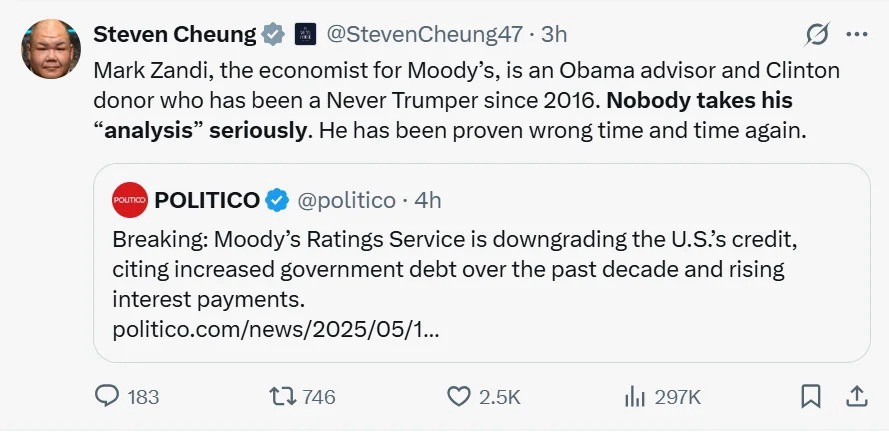
The White House fired back, accusing Moody’s of making a political move. Trump’s spokesman even named Moody’s chief economist Mark Zandi, calling him a long-time “anti-Trump guy” who shouldn’t be taken seriously.
But regardless of the politics, this downgrade is a big deal. For the first time ever, the U.S. is no longer rated AAA by any major agency.
Let’s take a step back and unpack what this actually means—for the markets, for investors, and for the global financial system.
What’s a Credit Rating and Why Should Anyone Care?
Moody’s, along with S&P and Fitch, is one of the world’s top three credit rating agencies. Their job is to assess how likely a country or company is to pay back its debt—basically, how trustworthy they are as a borrower.
A AAA rating is the gold standard: it means “extremely low risk.” When that rating drops, it signals to the world that there’s some concern about the borrower’s finances.
This week, Moody’s said the U.S. government’s growing debt load and rising interest costs are the key reasons for the downgrade. While the U.S. still has massive economic advantages, those aren’t enough to outweigh the long-term fiscal deterioration.
This isn’t coming out of nowhere. The other two agencies—S&P and Fitch—had already downgraded the U.S. in previous years. Moody’s was the last holdout. Now it’s official: there’s no longer a single AAA rating left.
So What Happens When the U.S. Loses AAA?
1. Borrowing gets more expensive
When a country’s credit rating goes down, investors demand higher yields to compensate for the added risk. That means the U.S. government might have to pay more to borrow, even if just by a little.
Given that the U.S. borrows trillions every year, even a small increase in rates can snowball into hundreds of billions over time.
2. The idea of “risk-free” U.S. debt takes a hit
U.S. Treasuries have long been treated as “risk-free” assets. Banks, insurers, pension funds—everyone builds their portfolios around that assumption.
Now? That narrative is showing cracks. Not a collapse, but definitely erosion. And some global institutions may start to rethink their exposure to U.S. debt over time.
3. Trump’s economic agenda just got harder to justify
Here’s where the timing gets interesting: Moody’s issued the downgrade just as Congress debates a new round of tax cuts aligned with Trump’s economic plan.
Trump’s team argues tax cuts will spur growth. But Moody’s is basically saying, “You already can’t afford your current spending. More cuts? Good luck.”
That creates real tension for investors—because if these policies pass, the near-term economy might benefit, but long-term debt risks will get worse.
My Take
Sure, some of the pushback from Trump’s camp isn’t surprising. The timing does look a little suspicious, landing just before a key vote on budget policy.
But let’s not pretend this downgrade came out of nowhere. The U.S. has been running $2 trillion deficits annually, and interest payments alone are approaching $1 trillion a year. That’s more than the defense budget.
And the worst part? No one’s really slowing down. Congress is gridlocked, and the two parties can’t even agree on whether the debt is a problem or not.
Moody’s didn’t tank anything. It just said out loud what many already knew: “This isn’t sustainable.”
Why This Matters for Markets
The real impact isn’t that the U.S. suddenly can’t borrow. It’s about perception. For decades, investors could treat Treasuries as the safest place to park money.
That trust is slowly eroding—and markets are starting to notice. Here’s what to watch:
• Some sovereign funds or central banks may quietly reduce U.S. bond holdings
• Assets seen as “outside the system”—gold, Japanese yen, maybe even Bitcoin—could gain favor at times of stress
• Hard assets like energy, manufacturing, and infrastructure might look more attractive to investors focused on long-term value
Moody’s downgrade isn’t a shockwave, but it is a deep crack in the wall of what we thought was unshakeable.
America still has the largest, most liquid markets in the world—but even empires get credit limits. This may not change things overnight, but it’s one of those turning points that markets only understand in hindsight.
If you’re watching the long game, it’s time to ask: What happens when the world stops taking U.S. credit for granted?
If you find this kind of market breakdown useful, follow along. I’ll be diving deeper into how shifts like this shape investment strategy, capital flows, and long-term opportunity.