
Moody’s Downgrade Shakes Markets: Gold Surges, Treasury Yields Climb, and Stocks Future Slide

Shearing sheep
May 19, 2025
GoGPT Summarizes Articles
Looks like this week’s market action is off to a rocky start — and this time, it's not tariffs, but America's swelling debt that's spooking investors.
On last Friday evening, Moody’s downgraded the US government’s credit rating from Aaa to Aa1, citing persistent budget deficits and a lack of meaningful fiscal reform. According to Moody’s, decades of expanding deficits under successive presidents and Congresses show no signs of slowing — and that’s becoming a real problem.
Wall Street reacted fast. On Monday:
-
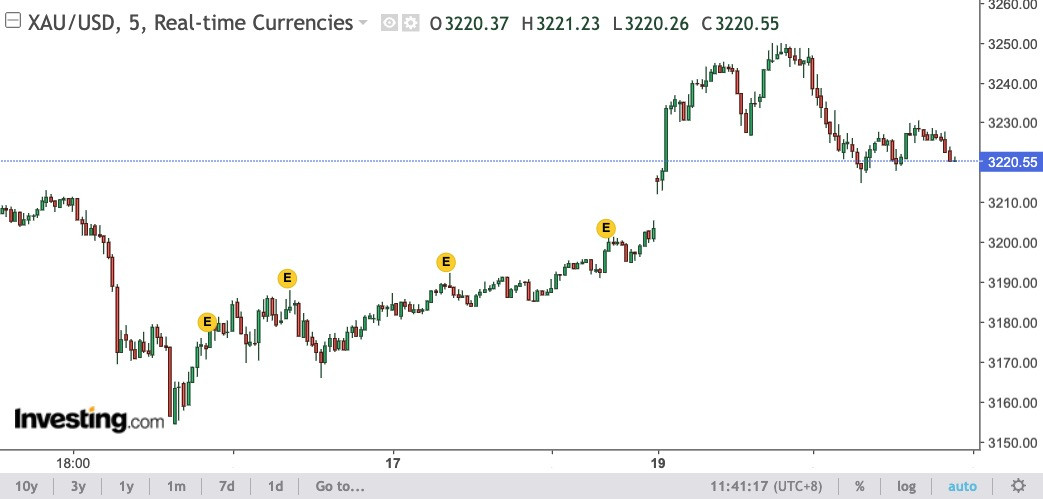
Spot gold surged at the open, briefly touching nearly $3,250/oz, but has since pulled back to around $3,220 — still up 0.53% as of writing.
-
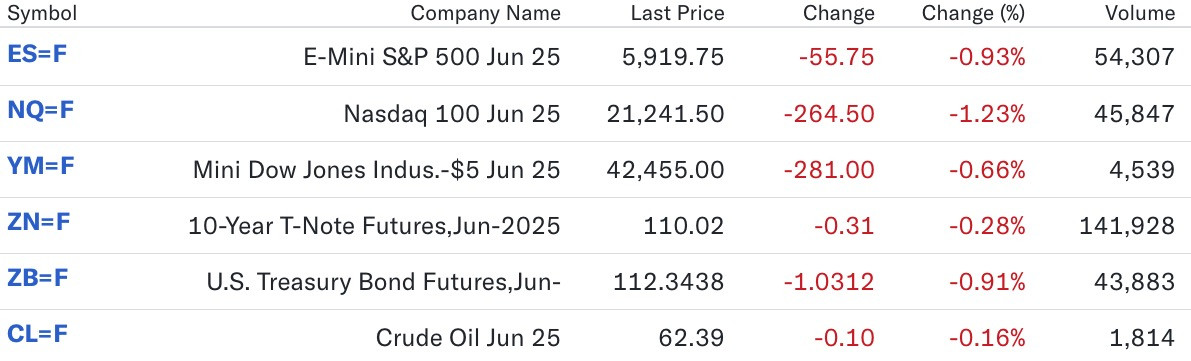
US stock futures opened lower: S&P 500 futures (ES=F) dropped 0.93%, and Nasdaq 100 futures (NQ=F) fell 1.23%.
-
US 10-year (ZN=F) and 30-year (ZB=F) Treasury futures declined, with the 30-year dropping 1.03 points, or 0.91%.
-
WTI crude (CL=F) slid 1% intraday.
Franklin Templeton’s Max Gokhman summed it up bluntly: “A Treasury downgrade is unsurprising amid unrelenting unfunded fiscal largesse that’s only set to accelerate,"
"Debt servicing costs will continue creeping higher as large investors, both sovereign and institutional, start gradually swopping Treasuries for other safe haven assets. This, unfortunately, can create a dangerous bear steepener spiral for US yields, further downward pressure on the greenback, and reduce the attractiveness of US equities.”
Wells Fargo strategists expect yields on the 10- and 30-year Treasuries to climb another 5–10 basis points in response. If the 30-year crosses 5%, it’ll hit levels last seen in November 2023 — inching closer to the 2007 pre-crisis highs.
But rising yields aren’t always bullish for the dollar — especially when they’re driven by concerns over solvency. The Bloomberg Dollar Index is flirting with April lows, and options traders haven’t been this bearish on the greenback in five years.
Even ECB President Christine Lagarde weighed in, noting that the dollar’s recent weakness against the euro “reflects market uncertainty and a loss of confidence in US policy.”
Here’s the deeper issue: rising yields mean higher government interest payments, which could force spending cuts or increase borrowing costs on mortgages and credit cards — adding pressure to an already fragile economy.
US Treasury Secretary Bessent downplayed Moody’s move, calling the agency a “lagging indicator.” He insisted that the Trump administration is focused on spending cuts and growth — though few specifics were given.
Meanwhile, Trump said he plans to speak with President Putin Monday morning about ending the war in Ukraine — potentially softening some of the negative market mood.
But with the federal deficit hovering near $2 trillion a year (over 6% of GDP), few were surprised by Moody’s downgrade. The CBO warned in January that US debt could hit 107% of GDP by 2029 — a post-WWII record.
Moody’s projects that by 2035, the deficit could balloon to 9% of GDP, thanks to rising interest and entitlement spending, along with relatively weak revenue growth.
Despite that, lawmakers are still discussing a massive tax-and-spending package that could add trillions to the debt over the next decade. The Joint Committee on Taxation puts the cost at $3.8 trillion, though analysts warn the true number could be even higher if temporary provisions are extended.
Not everyone’s panicking. Barclays analysts say the downgrade likely won’t shift Congressional behavior, won’t trigger forced selling of Treasuries, and won’t shake money markets much. After all, Treasuries often rally after ratings cuts.
They wrote: “Since the S&P downgrade in 2011, US credit rating cuts have largely lost their political punch. Even if there’s impact, it’s likely to be modest.”
For now, despite fiscal chaos and international tensions, foreign demand for Treasuries remained strong in March, according to the US Treasury. So far, there is no sign of a buyer strike. #bond #xauusd #Futures
#Breaking Macro Events: Market Impact & Analysis#bond#xauusd#Futures