
NVIDIA at COMPUTEX 2025: Building the $Trillion AI Infrastructure of the Future

Shearing sheep
May 19, 2025
GoGPT Summarizes Articles
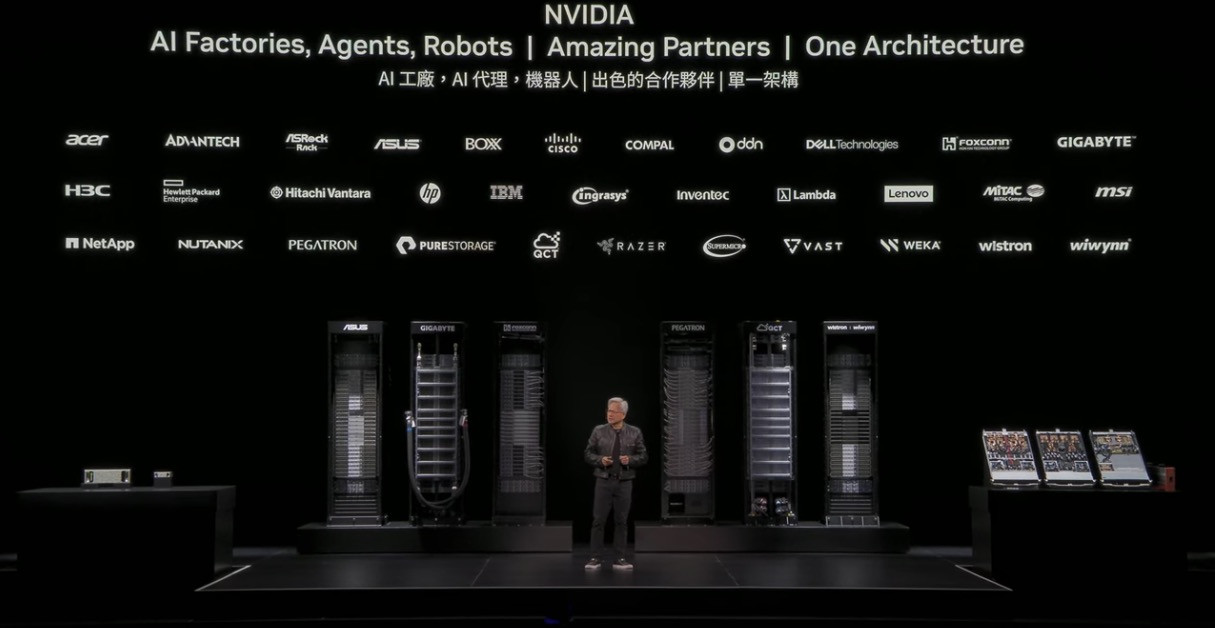
At Monday’s COMPUTEX 2025 keynote, NVIDIA CEO Jensen Huang didn’t just unveil new hardware—he outlined a sweeping vision for an AI-powered industrial revolution. The key message? NVIDIA is evolving beyond its role as a chipmaker, positioning itself as the foundational infrastructure provider in a world where AI is as essential as electricity or the internet.
The AI Factory: Data Centers Reimagined
Huang introduced the concept of the “AI factory”—next-generation data centers designed not just to store data, but to mass-produce AI “tokens” (intelligent outputs) in real-time. These facilities aim to deliver scalable intelligence on demand.
To power this future, NVIDIA unveiled the Blackwell GB300 systems, scheduled for Q3 2025 production, promising 1.5x faster AI inference and significant bandwidth upgrades, tailored for the high-throughput demands of generative AI.
Huang also introduced the next-generation AI personal computing devices, including DGX Spark and DGX Station workstations, alongside the Blackwell RTX Pro6000 motherboard, now moving into mass production. Powered by NVLink CX8 interconnect technology, these systems support 800Gbps communication bandwidth, enabling ultra-fast GPU cluster performance.
In a major leap for supercomputing, NVIDIA revealed that a single GB200 cluster with 72 GPUs can reach 130 TB/s of interconnect bandwidth—surpassing peak global internet traffic. This makes it one of the most powerful AI computing platforms in existence.
If global AI adoption scales as forecasted, demand for these hyper-efficient “factories” could skyrocket. NVIDIA’s full-stack strategy—combining chips, networking, and software—offers a strong competitive moat in this emerging landscape.
AI Agents: The New Digital Workforce
NVIDIA is betting big on AI agents—autonomous digital systems capable of reasoning, tool use, and collaboration. These go far beyond simple chatbots. They’re envisioned as digital employees performing a range of enterprise tasks, from coding and research to customer support.
To bring this to life, NVIDIA launched several enterprise-grade solutions:
-
RTX Pro enterprise servers with 800 Gbps bandwidth, ideal for deploying AI agents within conventional IT environments.
-
NVIDIA IQ, a natural language query engine for navigating unstructured enterprise data (think: a custom ChatGPT for internal files).
-
AIOps software, allowing businesses to deploy and manage AI agents at scale—essentially treating them like a new category of workforce.
With persistent labor shortages—especially in sectors like tech and manufacturing—even modest efficiency gains from AI agents (say, 10–20%) could make the ROI extremely attractive for enterprises.
Physical AI and Robotics: The Next Frontier
NVIDIA’s robotics and physical AI ambitions are ramping up fast. Key developments include:
-
Newton Physics Engine (to be open-sourced in July): A GPU-accelerated simulation tool that allows robots to be trained in ultra-realistic virtual environments.
-
Isaac Groot platform: Integrates Jetson Thor processors (as robotic brains) with Omniverse (for digital twins), accelerating the development pipeline from simulation to deployment.
-
Strategic partnerships with Mercedes (for self-driving fleets) and Foxconn, which plans to deploy 10,000 Blackwell GPUs to power its AI-driven factories.
NVIDIA is building not just robots, but the simulation-based ecosystem to train and deploy them—making robotics more accessible and scalable across industries.
Ecosystem Expansion: NVLink Fusion and Strategic Openness
In a move to broaden its influence, NVIDIA introduced NVLink Fusion—allowing partners to integrate their own CPUs and ASICs directly into the NVLink interconnect fabric. This move retains NVIDIA’s core role in the system while giving partners more flexibility.
Highlighted collaborations include:
-
Foxconn: Building Blackwell-based supercomputing infrastructure.
-
MediaTek, Marvell, Qualcomm: Co-developing custom AI chips.
-
Cisco: Jointly developing quantum-optimized AI systems for next-gen 5G/6G networks.
This signals a strategic pivot: rather than competing with every chipmaker, NVIDIA is offering a platform that others can build upon—while keeping its interconnect and software at the center.
Investment Implications
1. Infrastructure Play: NVIDIA is no longer just selling hardware. By monetizing the full AI stack—from silicon to software—it’s unlocking higher-margin, recurring revenue streams.
2. Robotics & Automation: Companies adopting NVIDIA's robotics stack (like Mercedes and Foxconn) could gain significant efficiency advantages, positioning them ahead in the AI-driven industrial race.
3. Risks: Execution remains key. Scaling this vision is complex, and competition from AMD, custom ASIC vendors, and open-source AI frameworks is intensifying.
Final Thought
Jensen Huang’s message couldn’t be clearer: AI is the new industrial revolution, and NVIDIA is building its railroads. Whether this becomes reality depends on execution—but for now, NVIDIA is clearly in the lead. #nvidia $NVDA
#nvidia#$Nvidia Corp(NVDA)