
Hedge Funds Bet Against US Stocks While Retail Investors Dive In

Shearing sheep
May 21, 2025
GoGPT Summarizes Articles
As U.S. stock markets continue to rise with retail investors buying the dip, hedge funds are taking the opposite stance, aggressively shorting stocks.
According to the latest Commitments of Traders (COT) report covering May 6 to May 13, a massive short-sell position of $11.1 billion was recorded, alongside $4.2 billion in long positions. However, the net long positions saw a notable drop, down by $6.9 billion overall.
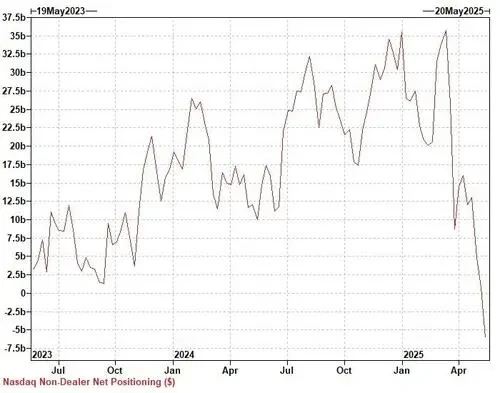
The most significant players in this bearish move are Hedge funds. Their net sell-off reached $7.3 billion, with short positions skyrocketing to $9.4 billion.
To put things into perspective, the past three COT reports reveal that hedge funds have accumulated $25 billion in short positions, the highest level in at least a decade.
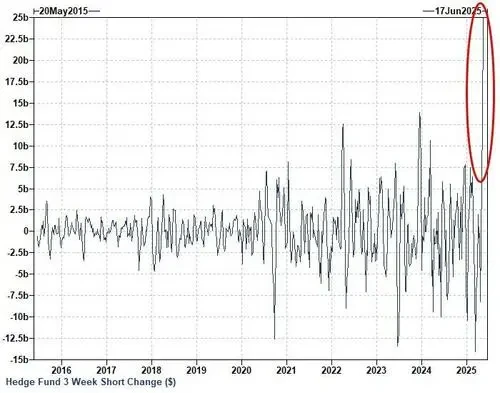
Goldman Sachs’ trader Robert Quinn has pointed out an interesting paradox: despite the Nasdaq’s strong performance in recent weeks, the new short positions have far outpaced the new long positions during the same period. This goes against the common wisdom that hedge funds typically position themselves to capitalize on an upward trend after a period of strong market performance.
However, it’s important to note that this spike in short positions doesn’t necessarily signal a dire market outlook. There’s a possibility that hedge funds are engaging in hedging strategies, taking short positions to offset the risks of long positions they may have elsewhere. This kind of arbitrage strategy is fairly common when the markets show signs of volatility.
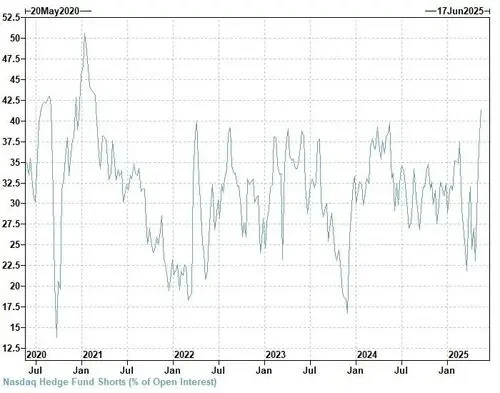
Still, the sheer size of these short positions is hard to ignore. Hedge funds are increasingly skeptical about the sustainability of the current market rally, as reflected in their unprecedented short positions. According to the latest data, hedge funds now hold 41% of all open short positions, the highest proportion since February 2021. This shows a considerable divergence in sentiment compared to the overwhelmingly bullish stance taken by retail investors.
While hedge funds are betting against the market, retail investors have been on an unprecedented buying spree. Their optimism has been so strong that even a downgrade from Moody’s on the U.S. credit rating failed to deter them. In fact, retail investors set a new record for buying, with net purchases soaring to a staggering $5.4 billion on a single day, contributing to a V-shaped market reversal.
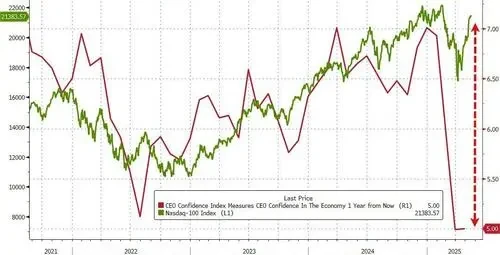
This contrasts sharply with the actions of CEOs, whose confidence usually correlates with the stock market’s direction. Today, however, some of their statements seem to align more with the hedge funds’ skepticism than with the exuberance of the retail crowd. Typically, CEO sentiment is a strong signal for where the market might go, but these days, it’s been sending mixed signals.
Looking at the broader economic picture, the latest data presents a mixed bag. On the one hand, the hard data, such as GDP growth, continues to support the bullish outlook, giving investors hope for sustainable growth. On the other hand, the soft data, like the University of Michigan’s Consumer Sentiment Index, paints a more worrying picture, with a sharp decline in consumer confidence and rising inflation expectations.
The market’s volatility has also been influenced by expectations around the Federal Reserve’s interest rate policies. After a period of heightened speculation about rate cuts, those expectations have started to ease. This adds an element of uncertainty, further complicating the decision-making process for institutional investors.
In conclusion, we’re seeing an intriguing standoff between retail investors and hedge funds. With retail investors charging ahead and hedge funds preparing for a potential downturn, the market is set for a battle between the ‘dumb money’ and the ‘smart money.
As always, the question remains: who will be proven right? For retail investors, the current market environment feels like an ideal opportunity to buy low and ride the waves of optimism. For hedge funds, the risks are apparent, and they seem to be positioning themselves for a potential correction.
#usmarket#hedgefund