
Are Treasuries Becoming the Centerpiece of Global Financial Drama?

In the wake of Moody’s downgrade of the United States sovereign credit rating to Aa1, tonight’s auction of sixteen billion dollars of twenty year Treasury notes has assumed blockbuster status. With twenty and thirty year yields flirting with five percent, investors from Tokyo to London are riveted. The results, to be revealed in Beijing time just after one in the morning on Thursday, will offer an unprecedented window into global demand for long maturities and the resilience of the dollar’s exceptional role.
Twenty Year Auction as the Ultimate Market Barometer
This is the first long-term sale since Moody’s joined Fitch and S&P in lowering America’s rating from the hitherto unassailable AAA. Market stress has rippled outward: earlier this week the thirty year yield briefly topped five percent, after sinking to around 4.4 percent in early April amid recession concerns. If institutional buyers such as life insurers and public pension funds balk at the new rates, the auction will signal serious doubts about America’s fiscal standing. By contrast, a strong bid would underscore the enduring depth of global Treasury demand even in the face of mounting debt burdens and rising interest costs.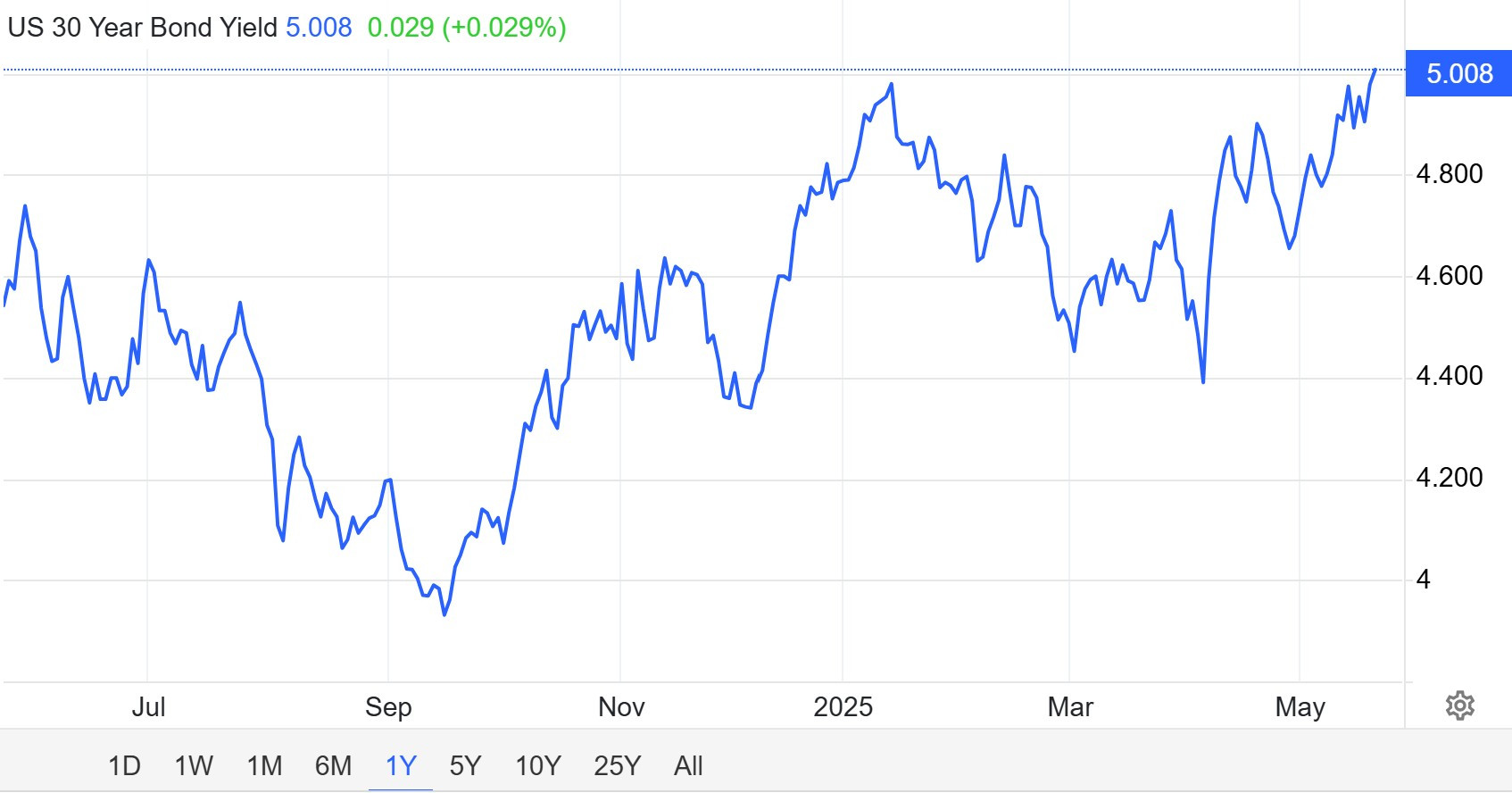
Can Corporate Profit Growth Rekindle the U.S. Equity Outperformance?
After a six week rebound, U.S. stocks still lag global peers. Data from Bloomberg Intelligence show that through December, U.S. firms led other developed market companies by thirteen percentage points in earnings growth. That edge has narrowed to nine points under the drag of tariffs and cost pressures. Meanwhile the fraction of S&P 500 companies issuing upward revisions to guidance has plunged to its lowest since at least 2010. Even as equities trade at a forward P/E of twenty two times—well above historical norms—corporate caution remains high. Unless earnings accelerate anew, sustaining the rally will prove difficult and may force investors to reconsider whether U.S. exceptionalism can endure.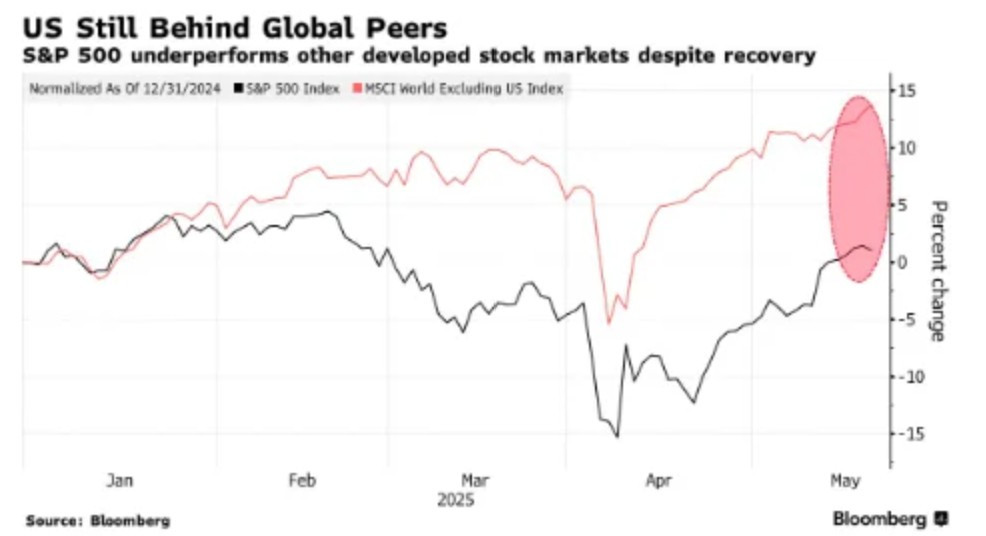
Is a Weaker Dollar Inevitable, Yet U.S. Assets Still the Only Game in Town?
Morgan Stanley’s latest midyear strategy argues that the dollar’s era of dominance is drawing to a close. They project a nine percent slide in the DXY index to ninety one by mid-2026, driven by the erosion of America’s growth and yield advantages relative to other G ten economies. Yet despite the currency outlook, the bank endorses an overweight in U.S. equities and Treasuries. Their analysis forecasts the S&P 500 climbing nine percent to 6500 by Q2 2026, while the ten year yield falls toward 3.45 percent—creating roughly thirteen percent total return for fixed income. The rationale rests on easing trade tensions that reduce recession risk, the prospect of genuine monetary easing not fully priced into markets, and regulatory loosening that may bolster corporate profit margins. But they caution that timing around trade deadlines, fiscal legislation and central bank pivots will be crucial.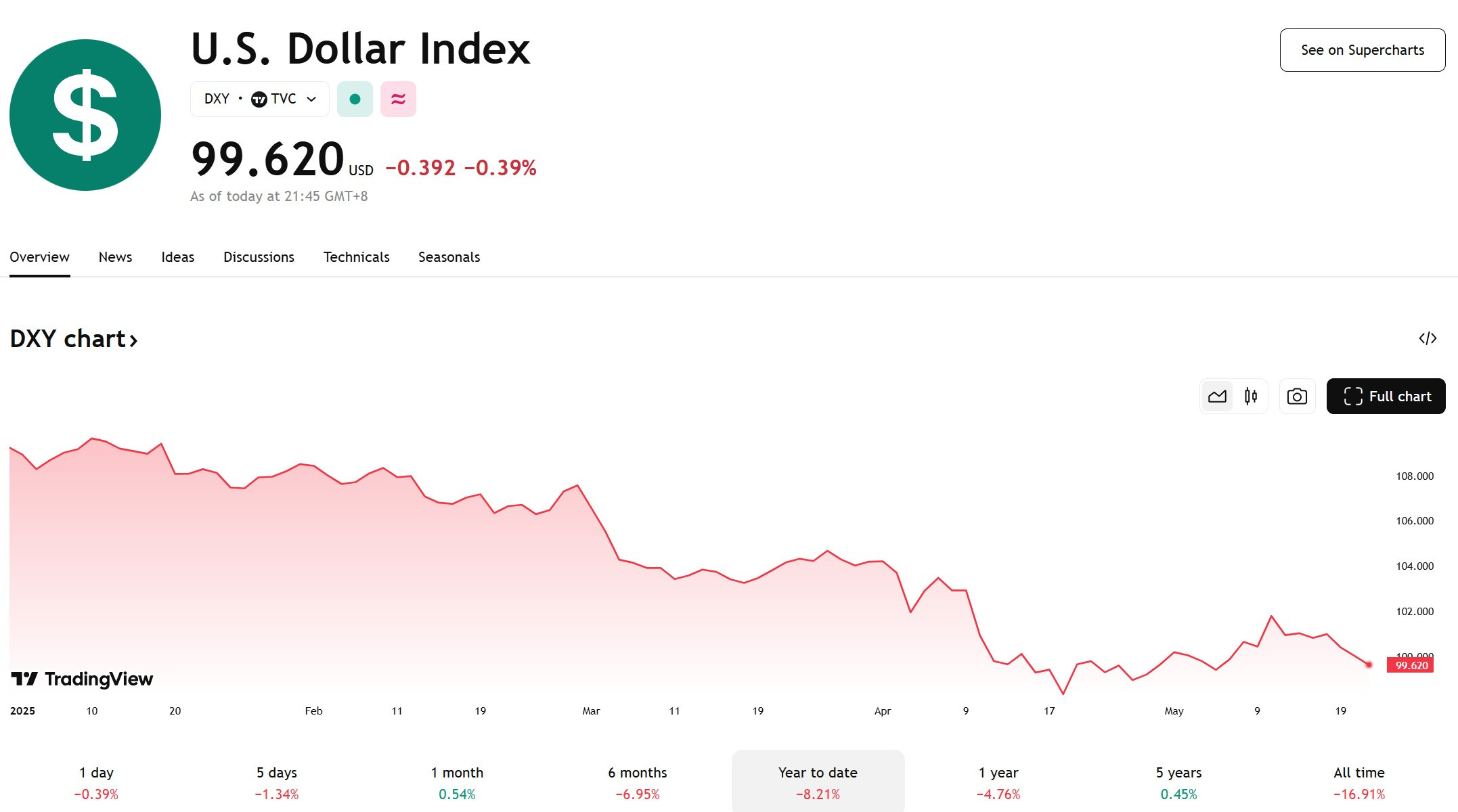
Why Bonds at Five Percent Could Be a Golden Opportunity
As equity markets grapple with uneven profit momentum, strategists such as Michael Darda of Roth view rising yields as a rare buy signal. He advises treating four percent as a sell threshold and five percent as a buy entry point, arguing that fears of budgetary gridlock make sustained moves beyond those levels unlikely. April’s equity bounce coincided with higher yields as markets repriced Federal Reserve policy, suggesting that bond strength reflects more than just inflationary angst. Goldman Sachs adds that spiking long-end yields driven by global selling pressures and funding strains could steepen the curve further, even as international holders reduce their allocations to Treasuries. For diversifiers, they suggest exploring emerging market local assets, Japanese equities and other undervalued global stocks.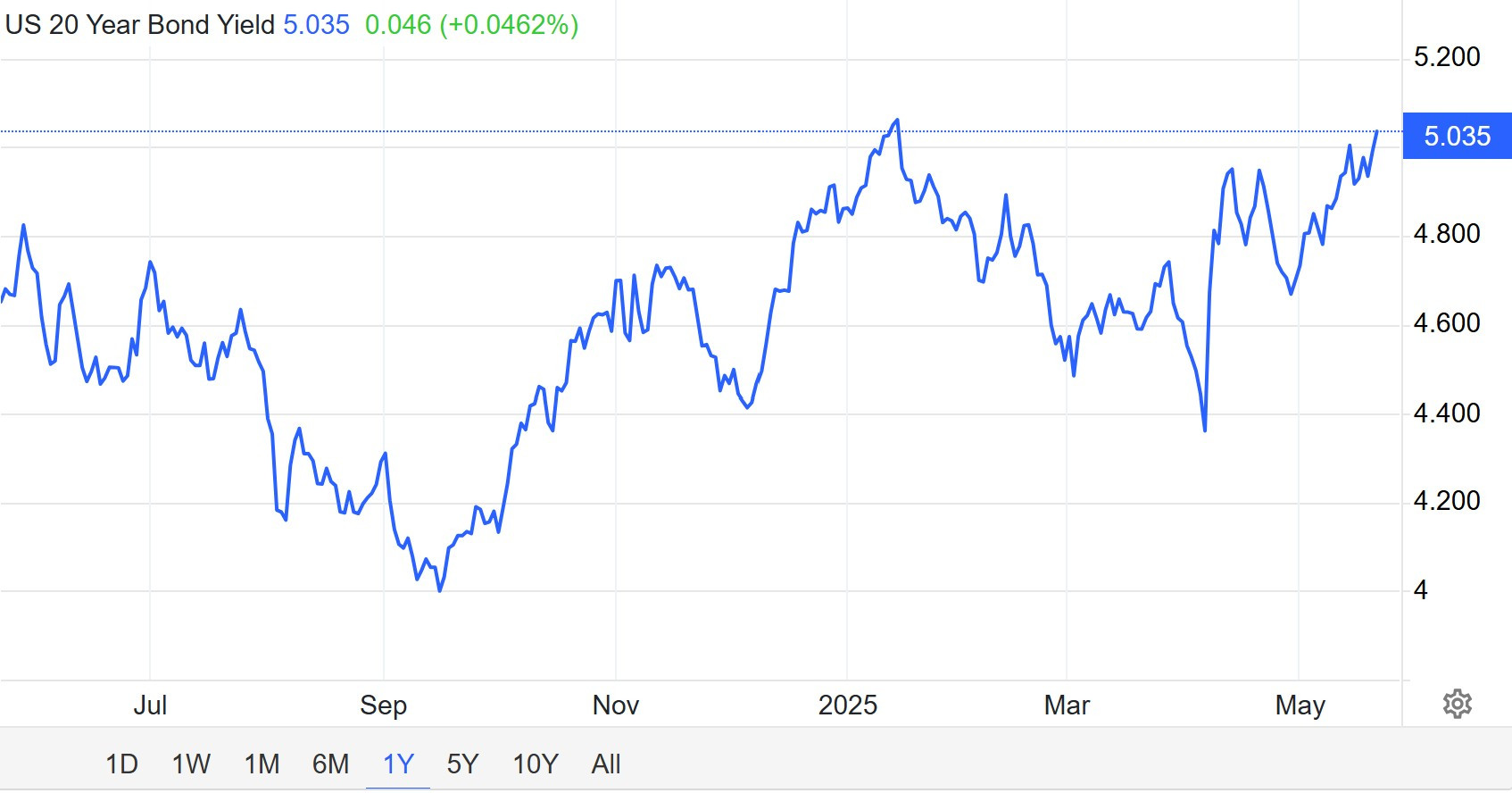
The TINA Narrative Versus Structural Shifts
Despite the noises of dollar weakness, the “there is no alternative” narrative endures. U.S. markets remain unmatched in scale—investable equity capitalization nearly five times larger than Europe’s and over half of global high quality liquid bonds denominated in dollars. Even if capital shifts gradually, replacing such depth will take years. Yet prudence demands watching more than auction results. It requires gauging how tariff policy evolves, how swiftly fiscal debates resolve and when the Fed commits to rate cuts—not merely because these events affect yields, but because they will redefine the very dynamics of global safe haven demand.
Tonight’s twenty year auction thus transcends a routine financing exercise. It stands as a live test of America’s credit and currency centrality. For investors, the question is whether Treasuries at five percent mark the zenith of stress or the threshold of a new era of opportunity.
This content is provided for informational or educational purposes only and does not constitute investment advice.