
Bitcoin Breaks $110,000, What’s Fueling This Historic Surge?

Bitcoin has once again rocked global markets, smashing past the $110,000 mark for the first time in history.
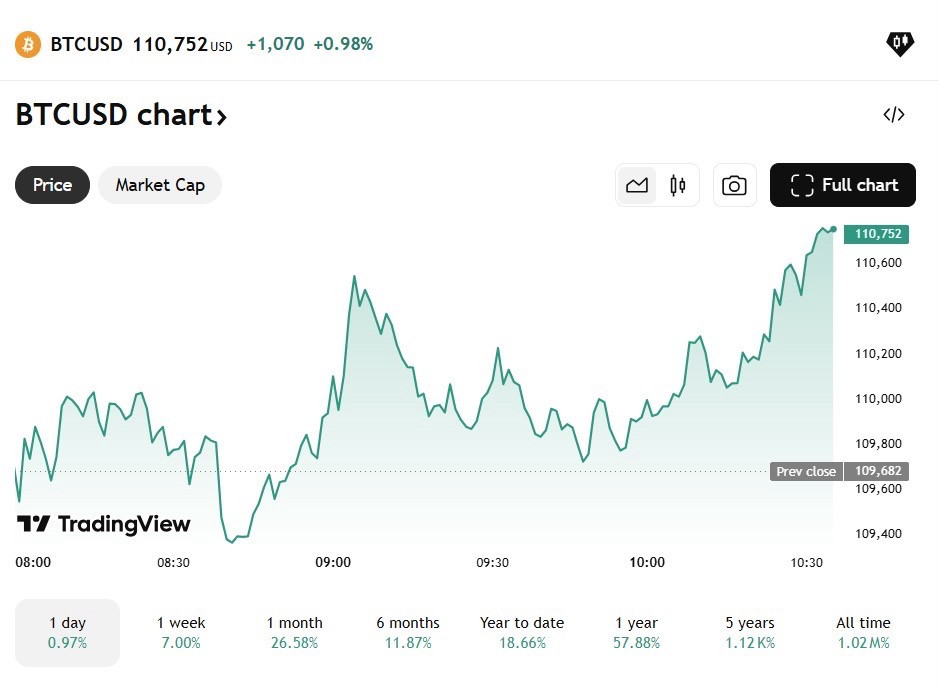
This all-time high not only reflects the cryptocurrency market’s strong momentum but also signals Bitcoin’s growing role in the global financial system.
Why Is Bitcoin Hitting New Highs?
As of May 21, 2025, Bitcoin’s price reached $110,524, pushing its market cap above $2.1 trillion—ranking it the fifth largest asset globally, right behind gold, Microsoft, NVIDIA, and Apple. Several key factors are driving this surge:
1. Regulatory Tailwinds in the U.S.
The U.S. Senate is moving forward with the GENIUS Act, which aims to establish a clear regulatory framework for stablecoins—digital assets pegged to traditional currencies like the U.S. dollar.
The act could bring much-needed legitimacy and stability to the crypto space, opening the doors for broader institutional adoption.
2. Growing Institutional Interest
Institutions are diving deeper into Bitcoin.
MicroStrategy, for instance, just purchased another $765 million worth of BTC, pushing its total holdings to over $63 billion.
JPMorgan has also begun offering Bitcoin access to clients—further validating its role as a mainstream asset.
3. Rising Demand as a Hedge
In times of macro uncertainty, investors are increasingly turning to Bitcoin as a digital hedge, similar to gold.
With the U.S. debt rating under pressure and the dollar weakening, Bitcoin’s appeal as a store of value is rising rapidly.
The Stablecoin Legislation
The GENIUS Act (short for Guarding Effective National Issuance of Uniform Stablecoins) is the first serious federal attempt at regulating stablecoins. The proposed law outlines:
• All stablecoin issuers must obtain approval from federal or state regulators.
• Stablecoins must be fully backed 1:1 by cash or safe liquid assets.
• Algorithmic stablecoins would be banned to prevent collapses like Terra/Luna.
If passed, the bill could provide critical infrastructure for stablecoin growth and boost confidence across the crypto ecosystem.
Corporate & Institutional Moves
Beyond MicroStrategy, other major players are entering the Bitcoin space:
• Galaxy Digital CEO Mike Novogratz recently declared that crypto is entering a “golden era,” driven by institutional inflows.
• Coinbase’s inclusion in the S&P 500 signals broader acceptance of the industry.
• New firms like Twenty One Capital and Strive Enterprises are reportedly exploring adding BTC to their balance sheets.
These moves are laying the groundwork for sustained long-term growth.
What’s Next for Bitcoin?
With regulatory clarity on the horizon and growing institutional adoption, Bitcoin’s future looks increasingly bright.
Some analysts now forecast Bitcoin could reach $160,000 by the end of 2025, with long-term projections of $1 million by 2030.

$
That said, volatility remains high, and investors should stay cautious as the market continues to evolve.
Quick Explainer: What Is a Stablecoin?
Stablecoins are cryptocurrencies designed to maintain a fixed value, usually pegged to fiat currencies like the U.S. dollar.
They are typically backed 1:1 by reserves such as cash or short-term government bonds, offering price stability.
Use cases include cross-border payments, decentralized finance (DeFi), and on-chain trading.
Bitcoin’s record-breaking run is more than just a headline—it’s a signal of deeper structural shifts in how money, markets, and technology are converging. With global institutions, regulatory bodies, and investors all taking notice, crypto’s next chapter is just beginning.