
Why the Euro Jumped When Trump Threatened the EU

When Trump said he was considering a 50% tariff on EU cars, markets braced for impact. Many expected the euro to take a hit. But what happened was the exact opposite—EUR/USD surged nearly 0.8%, hitting a two-week high.
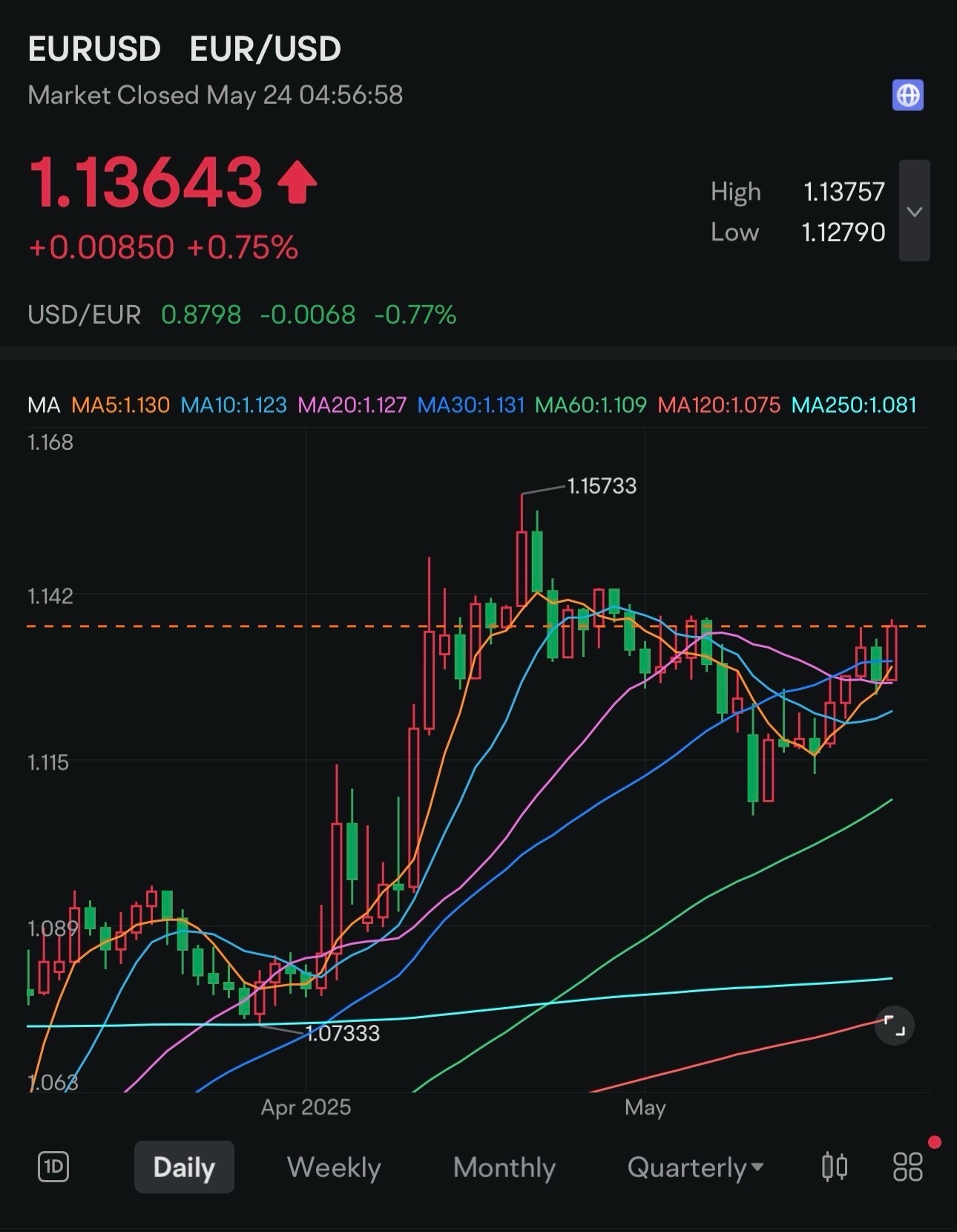
This might look strange at first glance, but it actually makes a lot of sense once you understand how the FX market thinks.
Let’s break it down.
This wasn’t just a threat—it was the start of a fight
Right after Trump’s comment, the EU didn’t back down. They quickly fired back, threatening tariffs on $107 billion worth of US goods—everything from aircraft to agriculture to tech.
That was the turning point. Traders realized this wasn’t a one-sided pressure play. It was a full-on trade war scenario.
So instead of asking who started it, the market began asking: Who gets hurt more?
The answer wasn’t great news for the US. America is already juggling high inflation, slower growth, and political noise. A trade war on top of that? Not ideal.
The euro suddenly looked like the safer bet.
The safe-haven status of the dollar doesn’t work if the risk comes from the US
Usually, when uncertainty hits, money flows into the dollar. But this time, the uncertainty came from Washington itself. That flipped the usual script.
If the threat is American-made, the dollar doesn’t look so safe anymore.
Traders also started to think: If this trade war gets serious, the Fed might be forced to cut rates sooner than expected. That would weigh even more on the dollar.
The euro gained not because it’s strong, but because the dollar looked shaky
Yes, Europe’s economy isn’t exactly booming. But the European Central Bank has been relatively stable in its messaging—no surprise rate cuts, no political interference.
Meanwhile in the US, Trump is back in power and already pressuring the Fed. If investors think rate cuts are coming, that narrows the interest rate gap between the euro and the dollar.
In currency markets, it’s rarely about who looks great. It’s more often about who looks less bad.
Technical bounce and emotional relief gave the euro an extra push
The euro had been falling for a while, and charts were showing signs it was oversold. All it needed was a spark.
Trump’s threat, strangely enough, provided that. And when he later added that he was willing to talk if the EU moved production to the US, markets took it as a sign the situation might not escalate immediately.
That hint of “it’s not as bad as it sounds” was enough to trigger a rally.
What this teaches FX traders about market psychology
The most important lesson from this episode is simple:
Markets don’t trade the news—they trade what the news means for expectations.
Here’s what’s worth remembering:
• Don’t focus only on the headline. Always ask: Was the market already expecting this?
• It’s not about who looks hurt. It’s about who looks more fragile at the margin.
• Currency moves are driven less by absolute fundamentals and more by relative strength and weakness.
• Rates, policy direction, and investor sentiment are the three key drivers of short-term FX moves.
So no, the euro didn’t rise because Europe is suddenly booming. It rose because the US looks increasingly unstable, and traders saw the euro as the lesser evil.
If this breakdown helped you understand the mechanics behind the move, feel free to follow along. If you got a question, drop it in the comments and I’ll break it down for you.