
What to Expect from NVIDIA’s Earnings Report Next Week

Next week, all eyes in the U.S. stock market will turn to NVIDIA ($NVDA ). The company is set to report its fiscal Q1 2026 earnings after the bell on May 28. And this isn’t just another earnings call—it’s more like a midterm exam for the entire AI investment narrative.
Analysts expect revenue to hit $43.3 billion, up 65% year-over-year, with EPS around $0.87. That’s a sky-high bar. But this quarter won’t be easy. Between short-term accounting noise and soaring market expectations, investor sentiment has turned more cautious.
One-time inventory charge weighs on profits but isn’t a long-term issue
Let’s start with the bad news: NVIDIA is taking a $5.5 billion inventory writedown this quarter, mostly related to its H20 chips destined for China.
What’s an inventory writedown?
It’s an accounting adjustment when a company expects certain products may not sell well (or at all). It doesn’t mean NVIDIA lost real cash—it’s more of a paper hit to earnings.
In my view, this is a one-off adjustment and shouldn’t affect NVIDIA’s medium-term outlook. The company is already pivoting to its next-gen Blackwell architecture, so this writedown looks more like a temporary growing pain than a red flag.
Data center remains the cash cow
Blackwell shipments are the real story.
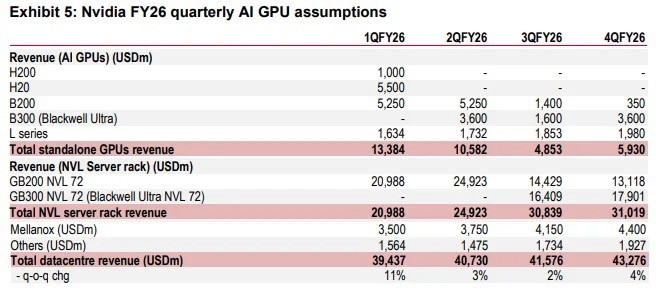
The biggest driver for NVIDIA remains its data center business. This quarter, Wall Street expects nearly $39.2 billion in revenue from the segment—up 74% year-over-year. That growth is being fueled by Blackwell-based AI servers entering mass production.
Quick recap:
Blackwell is NVIDIA’s new AI chip architecture. It’s faster and more efficient than the previous Hopper generation, especially for inference tasks (what AI does when answering questions, generating text, or interpreting images).
Taiwanese ODMs reportedly shipped over 1,500 Blackwell servers in April alone, a 50% jump from March. This suggests supply is scaling faster than expected, and full-year shipments may easily beat previous bearish estimates.
Blackwell’s ramp-up will be the foundation of NVIDIA’s growth in 2024. As long as supply chains hold up, customers aren’t going anywhere.
Inference demand is exploding
And that’s changing the game.
Compared to training large models, AI inference is now driving most of the demand for compute.
Models like DeepSeek-R1 require massive compute power every time they run. These long-context inference tasks are even more resource-intensive than what tools like ChatGPT handle.
NVIDIA says over 40% of its data center revenue already comes from inference—and that number is rising fast.
That’s great news for Blackwell. It delivers 25x better inference performance and 20x lower cost than the previous generation. This chip was built for the age of AI at scale. As the industry shifts toward high-volume inference, NVIDIA is positioned right in the center.
China demand cools but geopolitics bring new buyers
The Middle East is stepping in.
U.S. restrictions on AI chip exports to China have taken a toll on NVIDIA’s business there. But there’s a silver lining—massive new demand is emerging in the Middle East.
For example, the UAE plans to buy over 1 million Blackwell chips through 2027. Saudi Arabia and others are also building sovereign AI infrastructure, with NVIDIA as their go-to partner.
This is more than just business—it’s geopolitics. In today’s world, compute power is becoming a form of national infrastructure. Whoever builds faster wins the AI race.
From closed systems to flexible platforms
NVIDIA is quietly reshaping the ecosystem.
At the upcoming Computex event in Taipei, NVIDIA will unveil NVLink Fusion—a new platform that lets customers mix and match NVIDIA GPUs with third-party CPUs and AI chips in custom configurations.
In short, NVIDIA is moving from closed systems to semi-open collaboration. It wants to be the backbone of a broader AI ecosystem—not just a chip vendor.
This shift also addresses growing competition from ASICs—custom AI chips developed by big cloud players. With Fusion, NVIDIA is making sure its GPUs remain central, even in mixed environments.
To me, this is both a technical move and a strategic play. NVIDIA wants to defend its dominance in the data center by building the biggest tent.
Valuation is still reasonable
But the market is getting nervous.
NVIDIA currently trades at around 27x forward earnings—below its five-year average of 30x. That’s actually not expensive, given its growth.
But the options market tells a more cautious story:
• Implied post-earnings move: ±7.75%
• Implied volatility: ~54%, lower than recent quarters
Investors aren’t worried about bad numbers. They’re worried about “good” not being good enough. Expectations are sky-high, and the market wants another blowout.
Can NVIDIA keep delivering record results?
Here’s my take heading into earnings:
• Blackwell shipments will be the headline number to watch
• Inventory writedown will hurt margins (Q1 gross margin likely 58%, Q2 could rebound to 71%)
• Inference growth, Middle East orders, and ecosystem strategy all support the long-term case
The stock might swing on the day of the report. But unless something goes wrong with Blackwell’s rollout, NVIDIA’s growth story remains firmly intact.
I’m watching Will customers keep spending big on AI infrastructure? Will cloud giants keep going all-in?
If you’re tracking AI chip plays like I am, this earnings report is worth your full attention.
I’ll be breaking down the results and key takeaways—follow along for more insights as the story unfolds.