
Trump Wants Apple to Build iPhones in America But Here’s Why That’s Not So Simple

Apple’s in the hot seat again — and this time, it’s not about AI, privacy, or product launches. It’s politics.
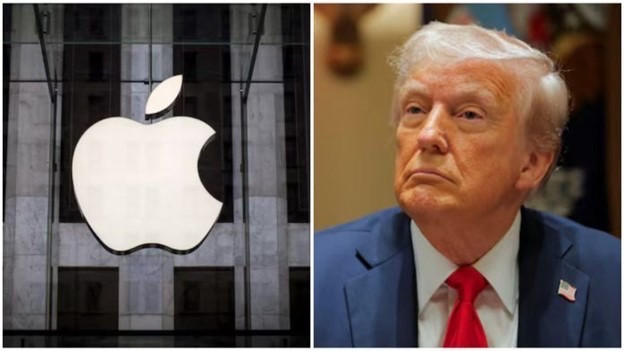
President Donald Trump has issued a bold threat: Apple should make iPhones in the United States, or face a 25% import tariff on phones made abroad. That message alone sent Apple’s stock down 3% on Friday — and the company’s shares are already down more than 20% this year.
But here’s the big question: Can Apple actually move iPhone production to the US?
Short answer: Not without massive cost, disruption, and a total rethinking of how global supply chains work.
Let’s unpack why this is such a big deal.
What exactly did Trump say this time
Posting on his social media platform Truth Social, Trump said he told Apple CEO Tim Cook years ago that iPhones sold in America should be made in America — not in India or anywhere else. Now, he’s doubling down on that expectation with a warning: if Apple doesn’t comply, a 25% tariff is coming for all imported iPhones.
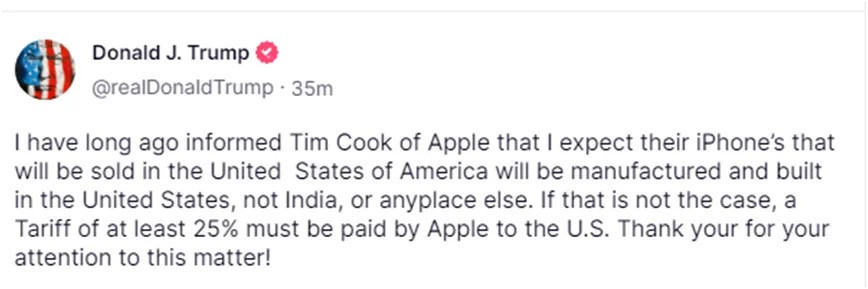
This isn’t the first time Trump’s pushed Apple to shift its supply chain. But this time, with the 2024 election heating up and protectionist sentiment rising again, the threat carries weight — and Wall Street is paying attention.
Why doesn’t Apple just build iPhones in the US
One word: cost.
Right now, about 80% of iPhones are assembled in China, with India and Vietnam picking up some of the rest. Moving all that back to the US sounds patriotic, but it’s incredibly expensive and technically complicated.
Here’s why:
• Sky-high costs: Analysts estimate that a US-assembled iPhone could cost over $2,000 due to labor and equipment expenses. That’s double today’s retail price.
• No supply chain support: Making iPhones involves hundreds of specialized suppliers — for displays, chips, cameras, and more. Most of these don’t exist in the US. China, on the other hand, has built a complete ecosystem around this.
• Labor mismatch: China offers flexible, large-scale factory labor that can work around the clock. The US doesn’t have that kind of workforce structure — and wages are much higher.
Apple tried building some Macs in Texas back in 2013. It didn’t go well. They ran into supply chain delays, workforce issues, and inconsistent production quality. The lesson? Bringing manufacturing home is much harder than it sounds.
Why is Apple moving some production to India instead
That shift actually started years ago, for three main reasons:
1. To reduce dependency on China, especially after the US-China trade war and COVID lockdowns exposed supply chain risks.
2. To access India’s massive consumer market, which imposes high tariffs on imported electronics but rewards local manufacturing.
3. To lower costs, since India offers cheaper labor and government incentives.
But let’s be clear: India mainly handles final assembly, not the advanced components. Those still mostly come from China, Japan, and South Korea. India is just a new piece in Apple’s complex global puzzle — not a full replacement.
How serious is this threat for Apple
It’s serious enough to rattle investors. If Trump wins in 2024 and follows through on tariffs, Apple has three choices — and none of them are great:
• Absorb the cost and shrink profit margins.
• Raise iPhone prices, possibly pricing out some consumers.
• Rethink its entire supply chain, which could take 5 to 10 years and billions of dollars.
That’s why Apple is caught between politics and practical reality. And it’s not just Apple — this is a warning shot to every global company with overseas operations.
This is bigger than Apple It’s a global supply chain reckoning
Trump’s move might sound like it’s just about “bringing jobs back,” but it’s really a challenge to how the global economy has worked for decades.
The reason iPhones are sleek, powerful, and relatively affordable is because Apple spent years building an incredibly efficient international supply chain — with China as the hub. Disrupting that system doesn’t just mean higher prices. It means tearing down a model that helped create the modern tech industry.
There’s also a timing issue: supply chain experts are already wondering how long iPhones will even be around. As AI-driven devices emerge over the next decade, some believe the iPhone could gradually be replaced. So why spend billions re-engineering a system for a product that may be past its peak?
This isn’t just a business decision anymore. It’s political. And when politics meets production, the results are rarely smooth.
Would you pay $2,000 for a Made in America iPhone?
Apple could technically shift some production to the US. But that would come with trade-offs — lower margins, slower production, and possibly higher prices for everyone.
The real question is: Are consumers ready to pay more for a phone that’s made closer to home?
Or are we still going to chase the best price, no matter where it comes from?
Either way, Apple’s next move just got a lot more complicated.