
Long Time No See: Examining the Triple Whammy of Stocks, Bonds, and Currency

EasyMoneySniper
May 26, 2025
GoGPT Summarizes Articles
Long time no see. Let's talk about the triple whammy of stocks, bonds and currency.
Last week, there was something that didn't get much attention but had a significant impact on the financial markets: the 20-year U.S. Treasury bonds actually sold poorly. Then, the 10-year Treasury yield also broke through 4.5%, and of course, the 30-year yield exceeded 5%.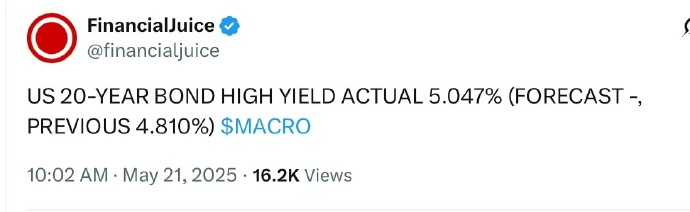
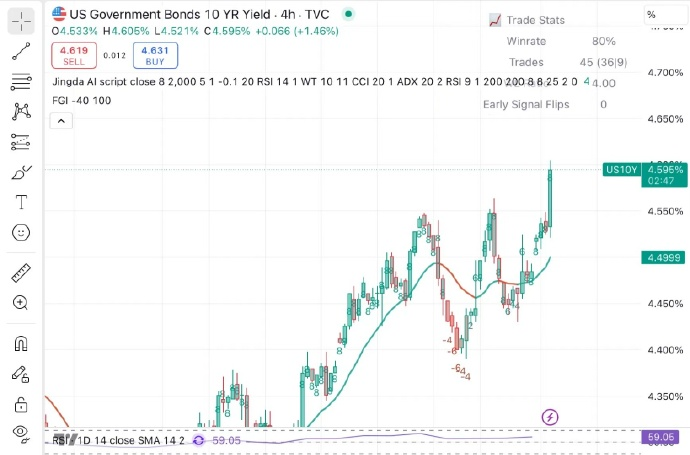
So the U.S. stock market immediately got scared, and then we saw a situation similar to April 9th, with a "triple kill" of U.S. stocks, bonds, and the dollar. This triple kill situation suddenly reminds me of the British Prime Minister Liz Truss, who was called the "lettuce PM". She was called the lettuce PM because British media used easily perishable lettuce to bet on whether the lettuce would rot first or Truss would step down first. Unfortunately, the lettuce won.
So what did the lettuce PM do? She wanted to implement large-scale tax cuts when there was no way to cut budgets and increase revenue. This immediately angered the market, causing a loss of confidence in the British government, resulting in a triple kill in the stock, bond, and currency markets.
Now, look at Trump's One Big Beautiful Bill Act - isn't it somewhat similar? You don't dare to cut welfare for real spending cuts; those small cuts are just for show. And with such tax cuts, you're adding several trillion dollars to the fiscal deficit. It's like when it rains, it pours - finally, Moody's also lowered the U.S. government debt credit rating. For Treasury bonds with terms over 2 years, it's basically impossible to find sovereign wealth funds and large funds that are not so sensitive to yields to buy. The remaining retail investors, mutual funds, and insurance companies are willing to buy, if you pay more.
So how do we look at the debt burden? If the total U.S. debt is about $37 trillion now, and if $1 trillion in interest is paid annually, the average yield is about 2%. If you want to restructure the debt now, everyone knows the trick is simple: replace short-term debt with long-term debt, replace high-interest debt with low-interest debt. If your current debt is at 2%, and you're refinancing at 5%, are you restructuring debt or committing suicide?
So, look at the Mar-a-Lago agreement, which wants to convert all debt into 100-year bonds, with no interest and non-tradable. Of course, people will say, why are you dreaming so beautifully when you're so ugly? Do you think changing the wording can hide the fact of your debt default?
What does 5% mean? Using the Rule of 72, which is 72 divided by 5, it means your debt will double in about 14.4 years (14.2 years if calculated accurately using logarithms). However, empires collapsing due to fiscal issues is nothing new.
But Trump has another self-defeating problem: recklessly waging tariff wars, resulting in major financial backers like Japan and Europe not participating in U.S. long-term Treasury auctions (unless all tariffs are removed, they don't even want the basic 10%). Anyway, the extension period will end in July, and if Trump talks tough, others might just pull on the Treasury market, and we'll see what happens.
What's funny now is that in Washington, whether it's Capitol Hill or the White House, a bunch of fools are talking tough all day, then trying to find a way to back down from their own tough talk, causing unrest throughout the world.
As a result, the tariff war may have made many people realize that the world's largest economy is actually China. Then the India-Pakistan brothers had another fight, which may have made many people realize that the world's top military power might also be China.
If Americans had known this would happen, they might as well have elected Harris as president back then.
#Breaking Macro Events: Market Impact & Analysis