
Japan May Face a Debt Market Crisis

EasyMoneySniper
May 26, 2025
GoGPT Summarizes Articles
Last week, there were no buyers bidding for Japan's 30-year and 40-year government bonds for two consecutive days. The yields on these two bonds rose sharply, with the 40-year bond yield jumping over 3.63% and the 30-year bond yield reaching 3.16%.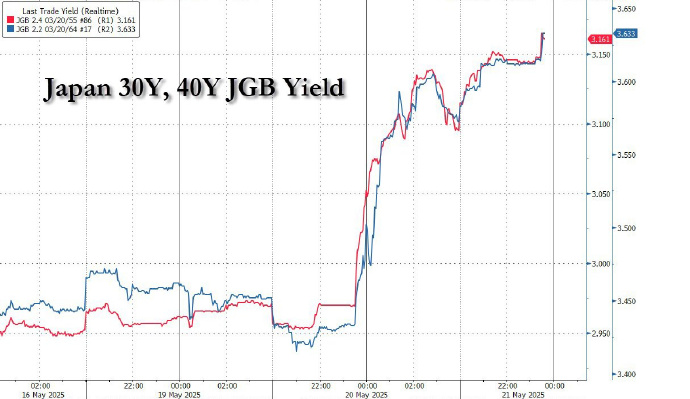
To repeat: The Japanese bond market had no bids for two consecutive days, with both 30-year and 40-year Japanese government bond yields hitting record highs.
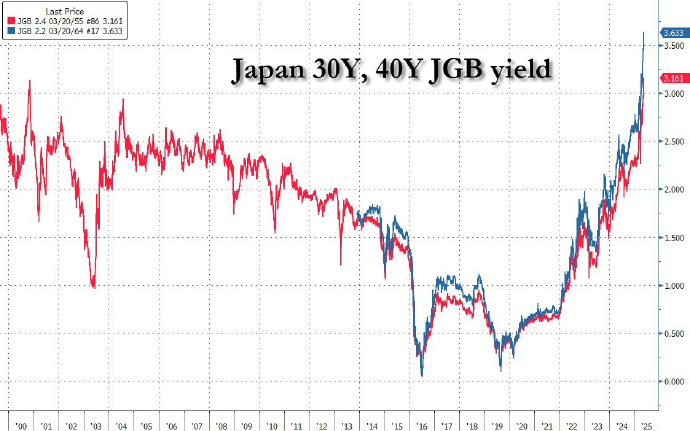
As a mature market long known as the "zero interest rate kingdom," Japan is currently experiencing the combined impact of three pressures: continuously rising inflation data has completely changed the deflationary expectations maintained for twenty years, the monetary policy framework faces a fundamental shift, and the government debt-to-GDP ratio has ballooned to an astounding 260%—a figure sufficient to invalidate the theoretical models of any traditional economics textbook. The Japanese sovereign credit system, once viewed as a "safe haven," is facing a severe test.
The Bank of Japan's policy dilemma stems from the failure of the Yield Curve Control (YCC) mechanism. For the past thirty years, even while bearing the world's heaviest debt burden, Japan maintained a low-volatility market ecosystem by artificially suppressing long-term borrowing costs. This policy essentially set a cap on interest rates for shorter-term bonds, which once worked effectively and was a pillar of Japan's deflationary, low-interest-rate world.
However, now the long-term portion of the Japanese bond market, where investors are most sensitive to risk and inflation, is breaking free from this control. While short-term rates are trapped in a liquidity trap due to economic fragility, the uncontrolled breakthrough in long-term rates reveals deep market doubts about Japan's fiscal sustainability—this is not conventional pricing based on Japan's economic growth or inflation expectations, but a confirmation of the demise of the myth of Japanese sovereign credit immunity.
Japanese policymakers face a fatal choice: If they choose to raise rates to defend the yen exchange rate or curb inflation, Japan's annual interest payments of 53 trillion yen could instantly double, triggering a domino effect of Japanese fiscal collapse. If they continue to maintain an ultra-loose stance, the spontaneous adjustment of the Japanese bond market will lead to a violent repricing of duration risk, and this market-driven liquidation could be more destructive than Japanese government policy errors. This dilemma is essentially a confrontation between the Bank of Japan's credibility and market forces, with the market voting with real money, questioning whether a country bearing the world's highest debt burden can still maintain fiscal discipline.
As the largest foreign holder of U.S. Treasuries, the turmoil in Japan's financial markets already has significant global contagion effects. Shigeru Ishiba's warning that the current situation is "worse than the Greek crisis" highlights the accumulating systemic risks.
Shigeru Ishiba: I said I wanted to resign, who elected me again?
The Japanese bond market is the world's second-largest bond market. These bonds are used for global financing strategies and as collateral in other financial systems. When they lose stability, the impact goes beyond Japan. It will affect the broader financial system, including foreign exchange markets, swap quotas, and global liquidity.
If Japanese financial institutions are forced to sell their $1.1 trillion U.S. Treasury holdings to address domestic financing pressures or curb disorderly yen depreciation, it will directly shake the overseas demand pillar of the U.S. Treasury market. When U.S. Treasury yields turn negative after foreign exchange hedging, and when the Japanese government bond volatility index spikes beyond historical extremes, insurance institutions and pension funds will be forced to initiate emergency plans—they are not actively adjusting asset allocations, but are forced to sell foreign assets amidst margin calls and Value at Risk (VaR) model alarms.
This selling behavior is essentially an instinctive response to the collapse of the arbitrage trading infrastructure: the once-stable Japan-U.S. interest rate differential cushion is disappearing, and the "borrow yen to buy U.S. Treasuries" arbitrage model that has persisted for thirty years is starting to reverse. More dangerously, this forced deleveraging process has strong self-reinforcing characteristics and could trigger a chain reaction of global dollar liquidity tightening.
The technical stabilization of the USD/JPY exchange rate at the 144 level has been misinterpreted by some market participants as a signal of the yen bottoming out. However, this may only be a brief calm before the storm. The real warning comes from the bizarre changes in capital flows: against the backdrop of rising long-term government bond yields, domestic Japanese capital has not flowed back into the bond market as theoretically expected, but instead continues to pour into non-traditional safe-haven assets such as gold.
So, everyone saw gold suddenly surge.
This anomaly reveals a more severe reality—market doubts about Japan's sovereign credit have transcended conventional currency value reassessment and evolved into fundamental questioning of Japan's fiscal governance capabilities. Facing this crisis of confidence, Japanese authorities may restart "invisible yield curve control," injecting liquidity into specific-term bonds through undisclosed market operations. Foreign institutions (especially Japan) have traditionally been pillars of the U.S. debt market.
But this advantage is disappearing, and the Federal Reserve may emulate this "shadow intervention" strategy, forced to take invisible support actions through unconventional means such as swap lines, backdoor quantitative easing, and repurchase programs to prevent U.S. Treasury auction failures and maintain market order. The essence of this strategy is not to solve problems, but to extend the life of the traditional system through complex financial engineering means.
The greater crisis lurking beneath the surface is the potential collapse of global arbitrage trades triggered by violent fluctuations in the Japan-U.S. government bond yield differential.
The most dangerous "fault line" in the current global financial system is the trillions of dollars in foreign exchange hedging positions built on the Japan-U.S. interest rate differential. When this interest rate cushion is suddenly removed, fund managers will be forced to make painful choices between dollar liquidity tightening and rapid capital repatriation—whichever path is chosen will trigger violent shocks in cross-border capital flows, potentially triggering a domino effect in global arbitrage trades—from forced liquidation of foreign exchange-hedged U.S. Treasury positions to liquidity tightening in the dollar financing market, ultimately evolving into a chain reaction of emerging market debt crises and U.S. Treasury auction failures.
Historical experience shows that the conduction of such crises often begins with a spike in Japanese government bond volatility, impacts offshore dollar markets through arbitrage trade deleveraging, and ultimately forms a perfect storm at the U.S. Treasury liquidity level.
The potential risk of uncontrolled long-end U.S. Treasury yields currently stems more from adjustments in overseas holding structures and the systemic failure of global sovereign debt suppression, rather than being driven purely by inflation expectations. If a country like Japan, which has strict domestic ownership of its debt and has practiced financial repression for decades, can lose control over its long-term bonds, what does this mean for the United States, which faces record deficits, declining foreign demand, and greater reliance on domestic investors to absorb its growing debt?
The United States has already felt the backlash. Look at U.S. Treasury yields across the entire curve: The 2-year rate is about 3.97%, almost unchanged. But the 10-year and 30-year have climbed to 4.515% and 4.997% respectively, which is not a growth signal. It's about scarcity of long-end buyers.
In plain terms, this is not just about volatility. It's about lack of liquidity and loss of credibility.
For a long time, Japan's bond market has been seen as a place where monetary policy could bend to its will. But now, we may be witnessing what happens when these rules no longer apply.
#Breaking Macro Events: Market Impact & Analysis