
Stablecoins vs. Banks: How Will TradFi Cope?

In the coming months, the rise of U.S. dollar–pegged stablecoins is poised to upend both traditional banking and the U.S. Treasury market.
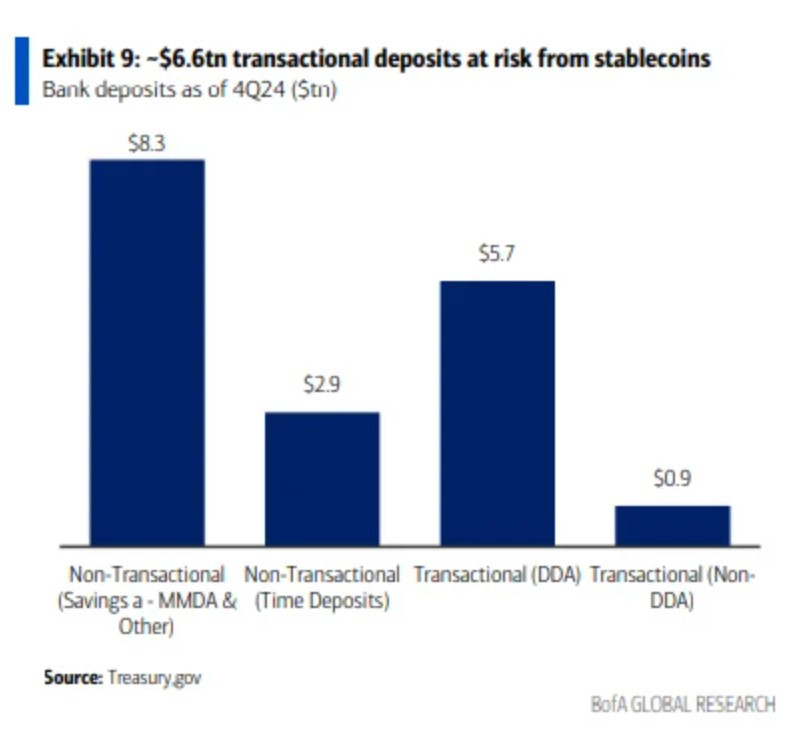
Bank of America Securities (BofA) warns that up to $6.6 trillion in bank transaction deposits could shift into stablecoins, and that every $1 migrating out of banks may generate $0.90 of additional Treasury demand.
Meanwhile, bipartisan legislation is accelerating, with the GENIUS and STABLE Acts laying a federal regulatory foundation for stablecoins. On the crypto frontier, Bitcoin has shattered $110,000, buoyed by institutional inflows, landmark stablecoin laws, and even a proposed “1 million BTC reserve” bill backed by President Trump.
What’s the big picture for banks and Treasuries?
Stablecoins—blockchain-based tokens pegged 1:1 to the dollar—must hold reserves in cash, bank deposits, or short-dated U.S. government securities.
BofA calculates that if $1 of bank deposits shifts into stablecoins, issuers will need to park $0.90 in Treasuries to back those tokens. Should the full $6.6 trillion of at-risk deposits migrate out, that implies nearly $6 trillion in fresh Treasury demand—enough to steepen the yield curve and shorten its duration dramatically.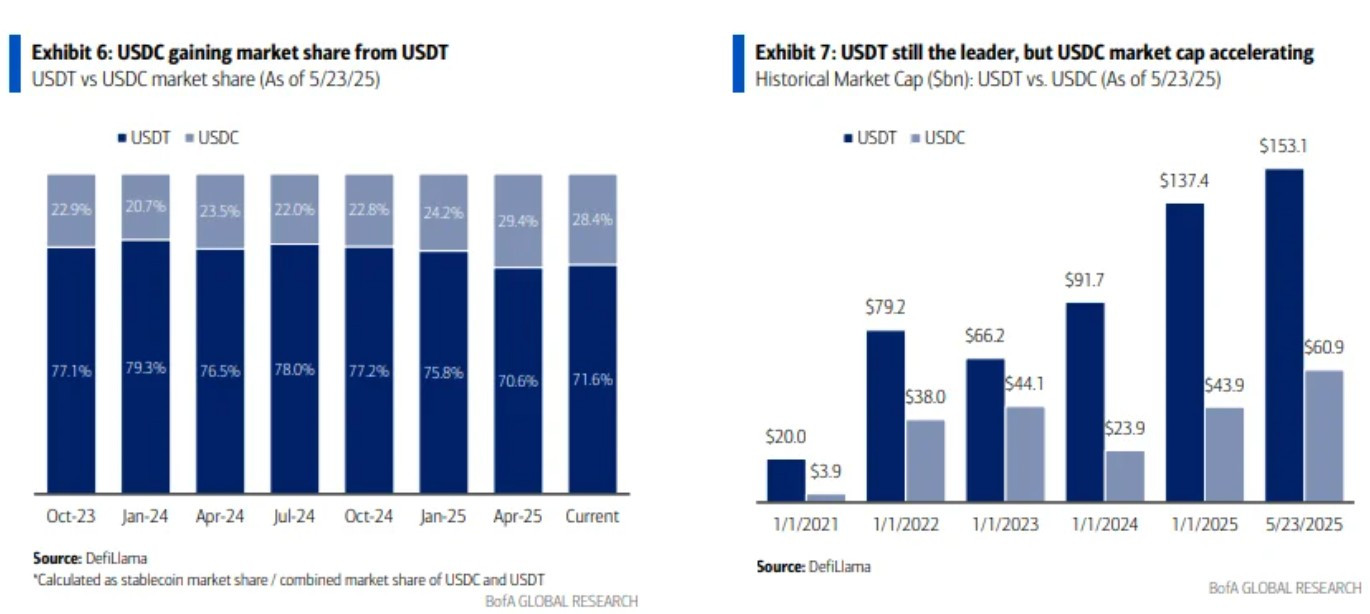
How are U.S. lawmakers shaping the rules?
Congress is racing to clarify stablecoin rules.
- GENIUS Act: Passed procedural hurdles in the Senate; upon enactment it requires stablecoin issuers to hold 100% reserves in high-quality, short-dated assets and submit audited financials if they exceed $50 billion in market cap. It would take effect 18 months after passage or 120 days after final regulation.
- STABLE Act: Cleared the House Financial Services Committee; mandates regulators to issue stablecoin rules within 180 days of enactment.
Regulators are signaling support: the SEC says qualifying stablecoins aren’t securities; the FDIC confirms banks can engage in stablecoin business without pre-approval; and Fed Governor Michelle Waller advocates a clear federal framework.
Stablecoin reserves reshape Treasury demand
Under proposed rules, stablecoin issuers must back tokens with dollar cash, bank deposits, Treasuries maturing within 93 days, or repo agreements maturing within 7 days.
As of March 31, USDT held 66% of its $153 billion reserves in Treasuries and 10.1% in overnight repos; USDC had 41.4% in Treasuries and 51.3% in repos, totaling $609 billion in market cap.
If these reserve ratios hold, stablecoins will account for roughly $687 billion of Treasury holdings between USDT and USDC alone—further amplified as new entrants emerge.
Banks face a depositor exodus threat
BofA cites U.S. Treasury research showing $5.7 trillion of transactional deposits and $0.9 trillion of non-transactional deposits are vulnerable to stablecoin migration. As deposit outflows mount, banks’ valuation multiples could shrink, echoing the premium markets now assign to private credit and direct-lending firms. In response, major banks are not standing still:
- JP Morgan has long operated its blockchain payments rail “Kinexys.”
- Bank of New York Mellon recently launched an on-chain/off-chain data insights product.
Yet the specter of trillions fleeing bank balance sheets looms large.
Bitcoin’s surge: What’s driving the rally?
Bitcoin topped $110,000 in May, fueled by structural tailwinds: stablecoin legislation clearing U.S. Congress corridors, back-to-back regulatory breakthroughs in Hong Kong, and the “Bitcoin 2025” conference in Las Vegas, featuring speakers from U.S.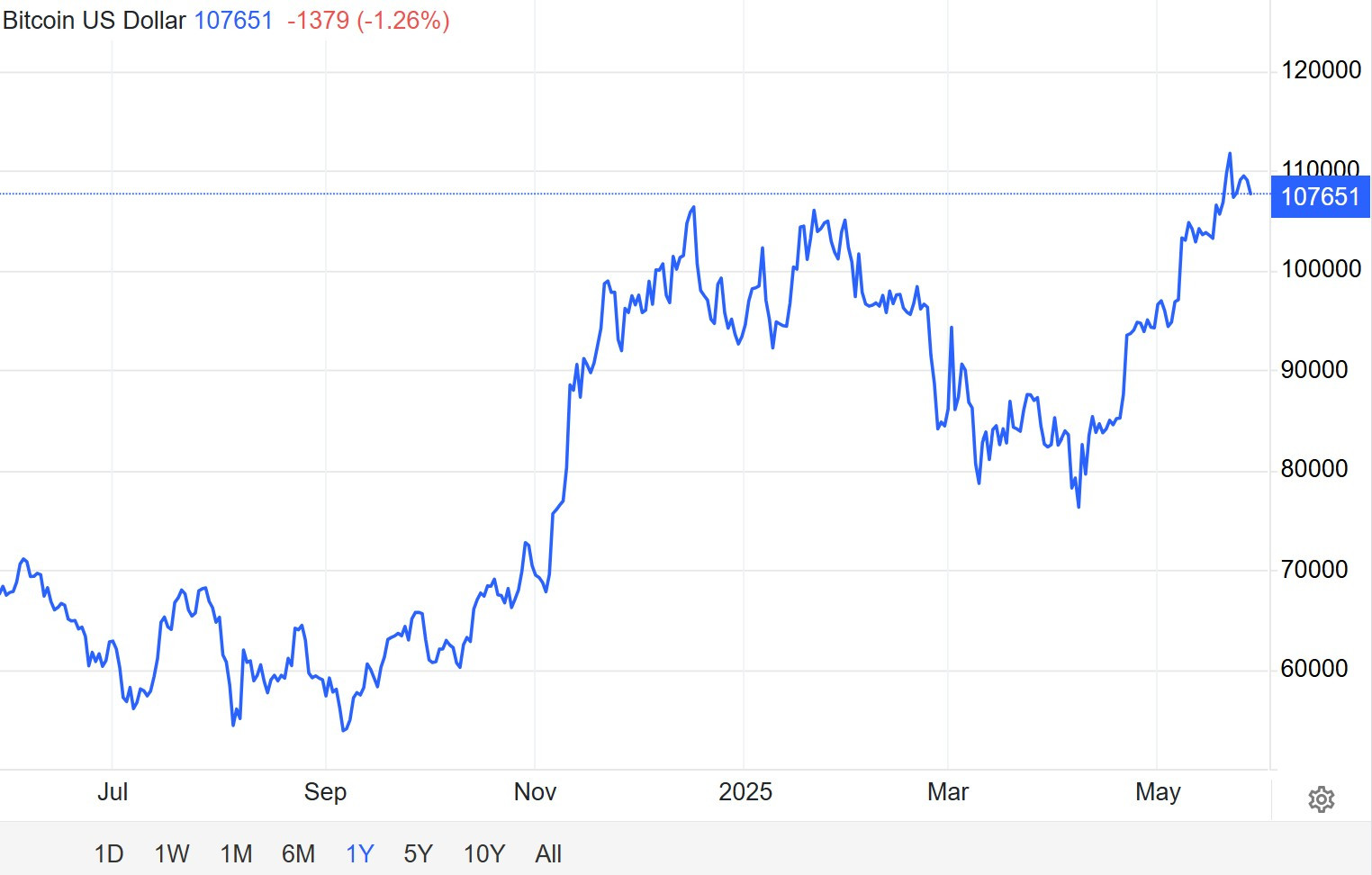
Trump publicly endorsed the “1 million BTC reserve” bill, calling for the federal government to allocate existing Fed and Treasury reserves to Cisco-like acquisition of one million Bitcoin—a symbolic but attention-grabbing proposal.
Institutional bids are mounting: Bitwise forecasts $120 billion of inflows into Bitcoin by end-2025 and $300 billion by 2026, equating to over 4.2 million BTC under management by diversified entities from sovereign wealth funds to public Bitcoin reserve companies.
Major corporates and funds—MicroStrategy, Marathon Digital, Riot Platforms, Galaxy Digital, Tesla, and Coinbase—continue to add Bitcoin to their treasuries.
Can crypto bulls sustain the momentum?
Analysts are divided. CryptoPotato sees consolidation below $110,000, awaiting fresh catalysts. QCP Capital points to large buyers—MicroStrategy and Metaplanet—as future price drivers: if they pause purchases, profit-taking may ensue; if they push the envelope, a leg higher could ignite fresh inflows.
HashKey’s Ding Zhaofei predicts $150,000–$180,000 by year-end, citing sustained monetary easing, institutional demand, and a structurally bullish implied volatility skew in Bitcoin options.
As stablecoins reshape TradFi and institutional coffers fatten their crypto positions, market watchers brace for paradigm shifts: will banks reclaim deposits, or will treasuries grapple with chronically stronger demand? And can Bitcoin’s equity-linked momentum carry it to new plateaus? Only time—and regulatory rulings—will tell.
This content is provided for informational or educational purposes only and does not constitute investment advice.