
Nvidia's Q1 Earnings Overall Beat Expectations, but H20 Restrictions Expected to Cause $8 Billion Loss in Q2

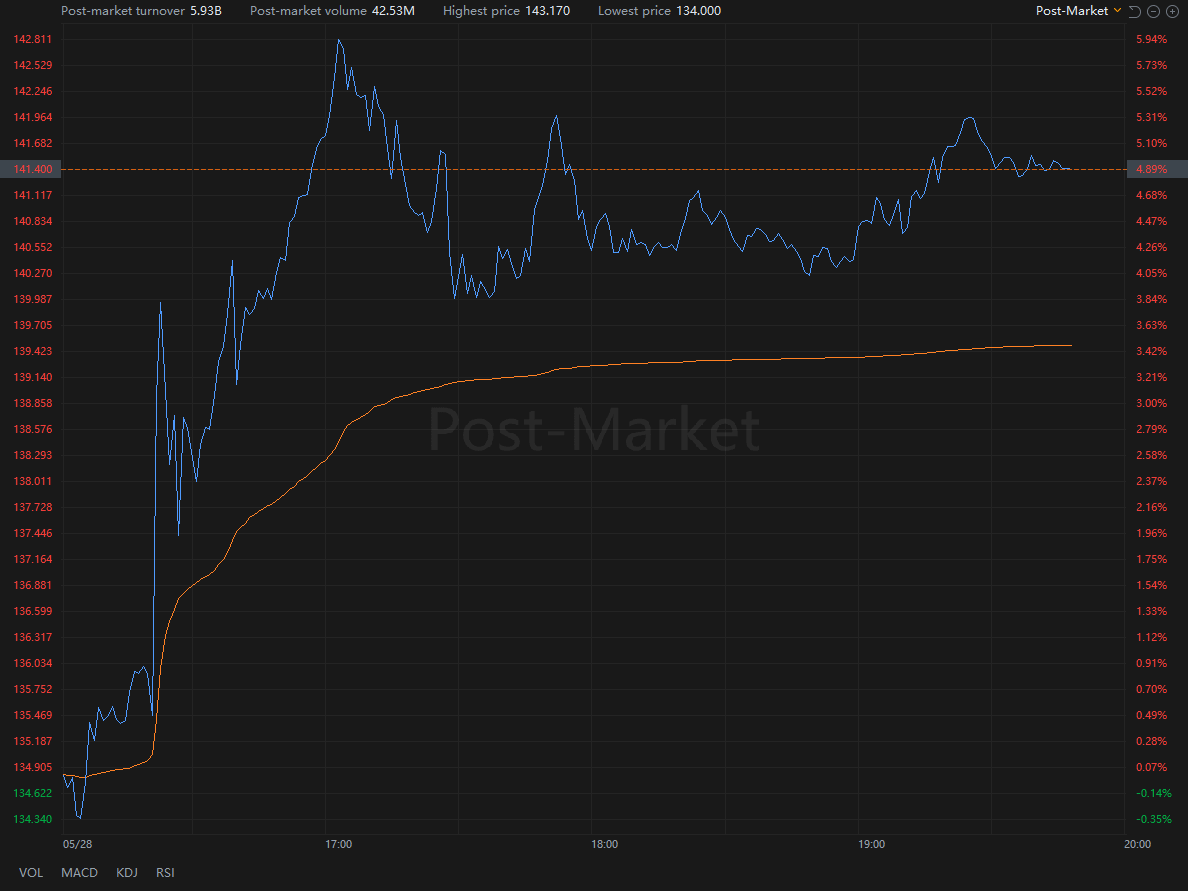
On Wednesday local time, Nvidia, the leading company in artificial intelligence (AI), released its fiscal first-quarter report for 2026 (ending April 27). Despite pressure from U.S. government export restrictions, its performance overall exceeded expectations. Nvidia's stock price rose nearly 5% in after-hours trading on the U.S. market.
Financial reports show that Nvidia's total revenue in the first fiscal quarter increased by 69% year-on-year to $44.1 billion, higher than the market expectation of $43.1 billion; net profit was $18.775 billion, compared with a market expectation of $20.767 billion; adjusted earnings per share were $0.96, versus a market expectation of $0.93.
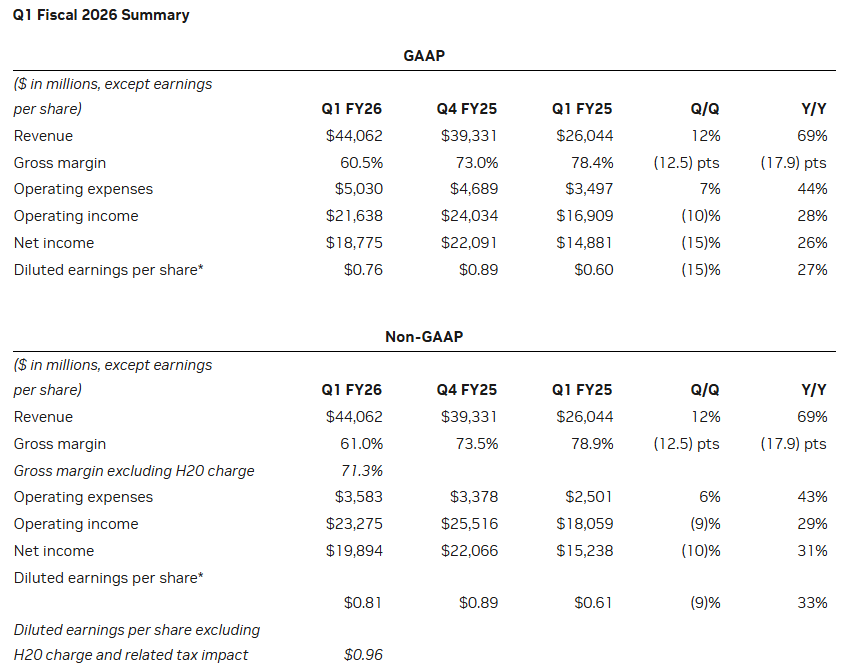
The key data center business saw revenue increase by 73% year-on-year to $39.1 billion, slightly lower than the market expectation of $39.3 billion.
One of the biggest concerns for investors is whether U.S. trade restrictions on China will hinder Nvidia's long-term growth. The U.S. government announced a virtual ban on its "China-specific" H20 chips in April, leading the company to record a $5.5 billion asset impairment charge.
Nvidia further revealed that excess H20 chip inventory in the first quarter generated a $4.5 billion expense, and the company would have recorded an additional $2.5 billion in sales without the restrictions.
Nvidia CEO Jensen Huang had earlier predicted that revenue impacts related to H20 export restrictions would amount to approximately $15 billion.
In terms of performance guidance, Nvidia expects second-quarter revenue to be $45 billion, with a 2% margin of error, while the market had anticipated $45.9 billion. The company noted that the Q2 guidance takes into account the impact of H20 export restrictions, expecting H20-related revenue to decline by $8 billion in the quarter.
Nvidia also expects operating expenses in Q2 to be approximately $5.7 billion, a significant increase from $3.6 billion in the previous quarter and $3.9 billion in the same period last year.
Uncertainties surrounding tariffs and trade policies, along with investors' sharp questions about the return on spending, have cast a shadow over the AI industry. However, Huang explicitly stated in the earnings release: "Global demand for Nvidia's AI infrastructure remains exceptionally strong."
During the conference call, Huang told investors that China's $50 billion AI market is effectively closed to U.S. industries, and the U.S. government's export ban has ended the company's Hopper data center business in China.
He said: "China is one of the world's largest AI markets and a springboard for global success. Half of the world's AI researchers are in China, and winning the Chinese platform will lead the world."
Noting that current U.S. policy is based on the assumption that China cannot manufacture its own AI chips, Huang pointed out that this assumption has always been flawed and is now clearly wrong. "The question is not whether China will have AI, but whether one of the world's largest AI markets will operate on U.S. platforms."
Thomas Monteiro, a senior analyst at Investing.com, said that even amid intense industry competition and complex external environments, Nvidia has demonstrated its ability to focus on the right operational areas. He added that the impact of H20 restrictions has been less than expected, highlighting Nvidia's adaptability to market changes.
Jacob Bourne, an analyst at Emarketer, said in a report: "A broader concern is that trade tensions and potential tariffs could negatively impact demand for AI chips in the coming quarters."
Earlier this month, Nvidia signed a series of new agreements in the Middle East, including building a 10-square-mile data center in the UAE, where Nvidia will provide its state-of-the-art Blackwell GB300 systems.