
Circle’s Big Debut: Is USDC’s IPO Poised to Transform Crypto Finance?

On June 5, Circle Internet Corp. is set to list on the New York Stock Exchange. The IPO aims to raise nearly $896 million at $27–28 per share. Strong demand has pushed the offering 25% above its range. High-profile backers like BlackRock and Ark Invest signal market confidence.

Circle has raised its IPO target from $600 million to $896 million by increasing share count to 32 million. Pricing reflects bullish sentiment as USDC sits firmly as the second-largest stablecoin. Beyond fundraising, the IPO marks a milestone for crypto finance, bridging regulatory acceptance and institutional appeal.
With USDC’s market capitalization at $59 billion, Circle controls roughly a quarter of a $233 billion stablecoin market. Ethereum is the primary network for USDC, where $39.1 billion circulates—67% of total USDC supply. This dominance underpins Circle’s valuation and revenue potential.
As stablecoins become integral to digital asset ecosystems, Circle’s listing could reshape investor access and liquidity. Stakeholders view this IPO as a litmus test for regulatory clarity and broader institutional adoption of stablecoins. Outcomes here may set benchmarks for future crypto issuers.
Key Takeaways
USDC ranks as the second-largest stablecoin, with $59 billion in market value. Combined with USDT’s $151 billion, they capture nearly 89% of the $233 billion stablecoin sector. On Ethereum, USDC holds $39.1 billion of circulation—67% of its total—affirming Ethereum’s role as its primary blockchain.
Circle’s revenue in 2024 reached $1.676 billion, driven predominantly by reserve asset interest. From 2022 to 2024, total income grew from $772 million to $1.676 billion—an increase of 117%. Interest revenue accounted for 99% of earnings, highlighting Circle’s dependency on U.S. Treasury yields and macroeconomic conditions.
In 2023, Circle reported $271 million in net profit and $167 million in operating income. The company achieved profitability despite high operating expenses of $492 million in 2024, which rose just 8.5% year-over-year. Continuous profitability for two consecutive years underscores operational efficiency.
Circle co-founded the CENTRE consortium with Coinbase in 2018 to govern compliant stablecoins. As of August 2023, Circle acquired Coinbase’s CENTRE stake and entered a collaboration agreement. Under this deal, Coinbase earns 100% of reserve yields from USDC on its platform, while other distributions split yields 50/50.
Earlier investors like China Everbright and IDG Capital have benefited: Everbright’s stock surged 39% over five trading days. Major firms such as BlackRock and Ark Invest also joined the IPO, indicating broad institutional interest and potential secondary winners. Coinbase stands to gain from distribution revenues.
Circle’s revenue relies on U.S. Treasury yields. At 4.75% yields, $60 billion in reserves produces $2.85 billion. A drop in rates would squeeze margins, pressuring Circle to assume more risk or cede share to competitors.
Circle’s past includes a $768.8 million loss in 2022 following Terra’s collapse and significant USDC sell-offs after Silicon Valley Bank’s 2023 failure. These events halved USDC’s market value and tested Circle’s resilience, highlighting volatility risks tied to broader crypto market dynamics.
The GENIUS Act’s Senate passage on May 21, 2025 offers regulatory clarity. Tianfeng Securities projects $2.42 billion and $2.99 billion revenue in 2025 and 2026, with $430 million–$590 million net profit. A 30X P/E multiple implies a $17.7 billion valuation by 2026.
Competition and Collaboration: Who Benefits?
Stablecoin competition is highly concentrated, dominated by USDT and USDC with 63.9% and 25.06% market share respectively. USDS ranks third at 3.19%. Together, the top three control 92% of the market, limiting room for smaller competitors. Circle’s USDC thus benefits from network effects and regulatory endorsement.
On Ethereum, USDT leads with 54% share, followed by USDC at 31%. Meanwhile, TRON hosts 49% of USDT’s $74.4 billion supply. As Ethereum remains the largest USDC network, Circle’s partnership with infrastructure providers strengthens its ecosystem positioning against USDT-centric blockchains.
Circle’s collaboration with Coinbase through the CENTRE consortium underscored a symbiotic relationship: Circle issues USDC while Coinbase’s platform drives distribution. Post-2023, the collaboration agreement entitles Coinbase to half of reserve yields from non-Coinbase platforms, while keeping all yields generated on its own exchange.
Beyond Coinbase, Circle counts strategic investors such as BlackRock (10% stake lead investor) and Ark Invest (potential $150 million commitment). Early backers like China Everbright, via a 2016 IDG co-investment, reaped significant stock gains. Their involvement boosts Circle’s credibility and expands its distribution network globally.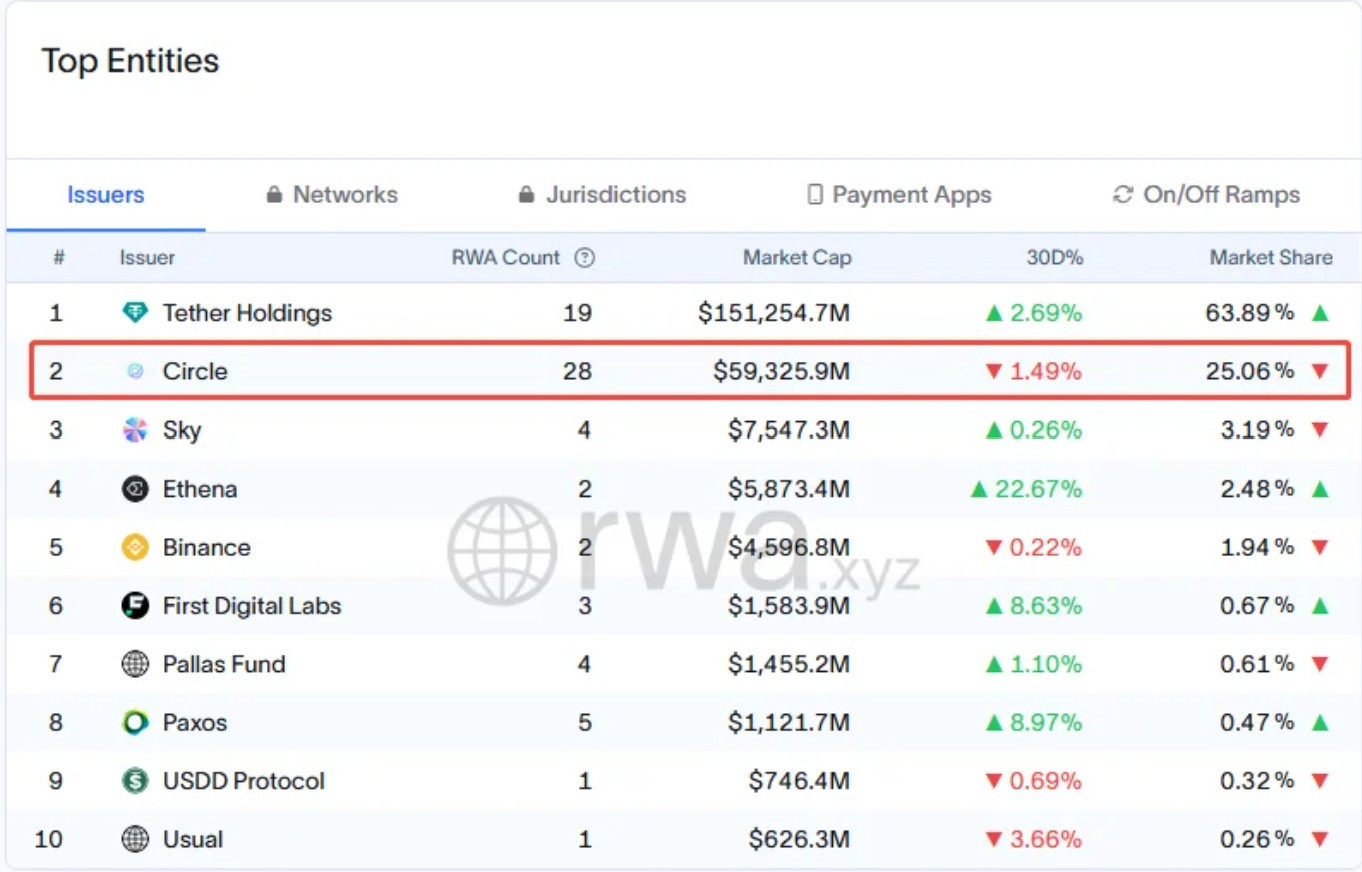
Future Outlook: Opportunities and Obstacles
Circle’s IPO arrives at a pivotal moment for U.S. stablecoin regulation. The GENIUS Act’s Senate approval signals potential for clearer federal oversight. This framework could encourage institutional adoption by reducing legal ambiguity and spurring banks to hold or distribute USDC as part of treasury management.
Analysts at Tianfeng Securities forecast Circle’s revenue could reach $2.42 billion in 2025 and $2.99 billion in 2026. Net profits may hit $430 million and $590 million respectively, assuming stable reserve yields and controlled distribution costs. A 30X P/E multiple by 2026 would imply an approximate $17.7 billion valuation.
Nonetheless, risks remain. Interest rate cuts could compress reserve yields, pressuring Circle to take on more market risk or surrender margins to maintain share. Competitors may undercut pricing to gain traction, challenging Circle’s market share and profitability in a rapidly evolving ecosystem.
Macroeconomic shocks, such as banking crises or crypto market crashes, can trigger abrupt USDC sell-offs. Circle’s 2022 loss and 2023 valuation hit illustrate vulnerability to contagion. Maintaining robust capital buffers and transparent reserves will be crucial to fend off market turbulence and regulatory scrutiny.