
Why Big Pharma Is Betting on China’s Biotech Breakthroughs

Lately, several biotech stocks in the US have seen huge rallies. At first glance, the reasons seem different—but they actually have two big things in common:
• They’re tied to a new class of cancer drugs called bispecific antibodies
• And the companies behind the stock surges aren’t making these drugs themselves—they’re partnering with Chinese biotechs that did.
In short, Chinese drugmakers have become Wall Street’s newest goldmine.
Three Huge Deals That Got Everyone’s Attention
Let’s look at three standout cases where US-listed companies made big moves thanks to China-developed drugs—and saw their stock prices explode.
BioNTech and BMS team up on a Chinese drug worth over $1.1 billion
BioNTech $BNTX , best known as Pfizer’s COVID vaccine partner, spent $950 million in 2023 to acquire Biotheus, a biotech firm based in Zhuhai, China.
Then in 2025, BioNTech announced it would co-develop one of Biotheus’s bispecific antibody drugs, BNT327, with Bristol Myers Squibb $BMY in a deal worth up to $1.1 billion.
The market loved it—BioNTech’s stock jumped 18% in a single day.
Instil Bio and Pfizer ride the China wave
In May 2025, Pfizer $PFE paid $1.25 billion to license a PD-1/VEGF bispecific antibody from 3SBio, another Chinese biotech.
That deal triggered a 51% spike in the share price of Instil Bio $TIL , which was already linked to another Chinese bispecific drug from ImmuneOnco.
Pfizer’s move signaled this wasn’t a one-off—it’s a growing trend.
Summit Therapeutics goes from penny stock to biotech star
Back in 2022, Summit Therapeutics $SMMT licensed global rights to a promising bispecific antibody called ivonescimab (AK112) from Akeso, a Chinese firm.
The day the deal was announced, Summit’s stock doubled. As more clinical data came out from China and trials began in the US, the hype built.
By 2025, Summit shares had rocketed from $1 to a high of $35—driven by hopes that ivonescimab could challenge Merck’s mega-blockbuster Keytruda.
What Makes Bispecific Antibodies So Exciting
In simple terms, bispecific antibodies are engineered to hit two cancer targets at once.
Take the hot PD-(L)1/VEGF class. These drugs both:
• Activate the immune system to attack cancer cells (PD-1 pathway)
• Block the blood supply that tumors need to grow (VEGF pathway)
That combo could mean better results with fewer side effects. And in some trials, they’ve even outperformed today’s best-selling cancer drugs.

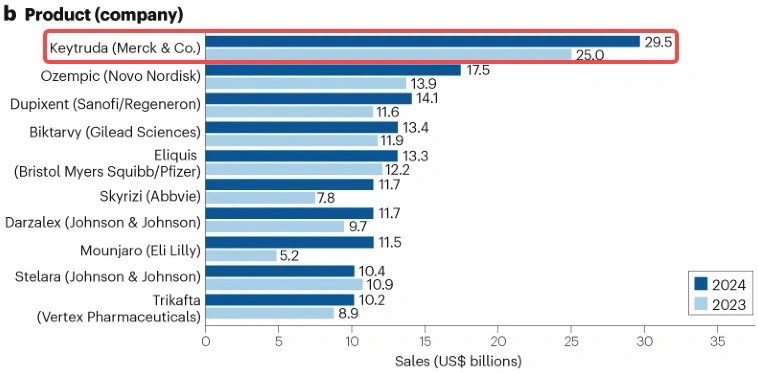
Keytruda, made by Merck $MRK, dominates the PD-1 space and brought in over $25 billion in 2024. But its core patents expire in 2028, and the race is on to find the next-generation replacement.
Goldman Sachs now predicts ivonescimab may be the first to launch in lung cancer—and could beat BioNTech’s candidate to market by two years.
Globally, there are already 14 PD-(L)1/VEGF bispecific drugs in clinical trials—and most of them started in China.
Why So Many of These New Drugs Are Coming From China
This trend didn’t start in 2025—but it exploded that year.
Chinese biotechs signed $57.2 billion worth of out-licensing deals in 2024 alone, up 27% from the year before. Even more telling: $4.9 billion of that came in upfront payments, signaling growing confidence from global partners.
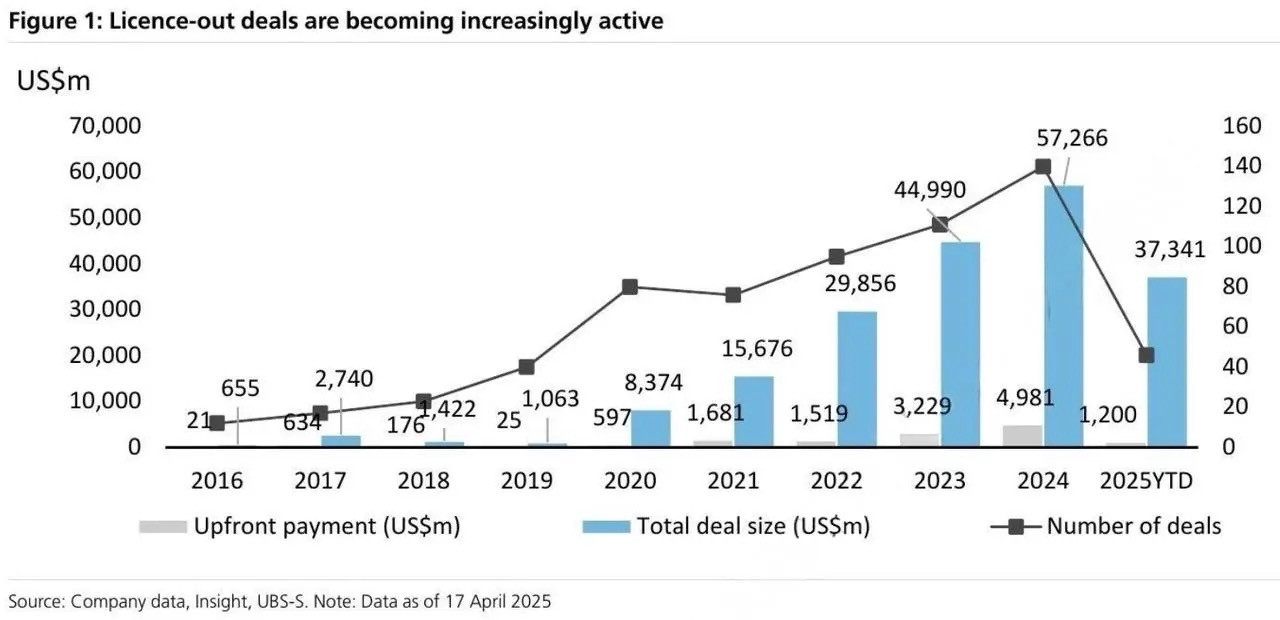
And China’s share of the global pharma pipeline keeps rising—from just 10% in 2020 to 31% by 2024.
Here’s why that shift is happening:
1. Lower cost and faster pace
China now produces world-class innovation in areas like oncology and immunotherapy. But R&D costs are still just 30%–50% of what they are in the US.
Add in a large patient base and quicker trials, and China offers a speed and cost advantage that’s hard to beat.
2. Buying early is smarter than building from scratch
Developing a new drug from zero is a long, risky journey—often called the “10-year, $1 billion” rule.
For US pharma firms facing looming patent cliffs (like Keytruda in 2028), licensing a promising candidate from China is faster, cheaper, and safer.
3. The partnership model is more mature now
Over the past few years, the playbook has become clear: China brings innovation, the US brings capital and commercial muscle.
There’s now a well-worn path for taking a drug invented in China and pushing it to global markets.
What Investors Should Be Watching Now
I see three key takeaways from what’s unfolding:
1. Chinese biotech firms are no longer just low-cost suppliers—they’re becoming global seed banks for next-gen drugs, especially in oncology.
2. The US-China pharma collaboration model is pragmatic: China brings speed and science, the US brings capital and market access. It’s a win-win if managed well.
3. Investors shouldn’t just chase the US stocks that spike after deals. They should also be asking: Who’s next? Which Chinese biotechs are sitting on the next big thing?
The companies that can consistently deliver drug candidates with blockbuster potential—especially in fields like bispecifics—will earn global attention, high valuations, and outsized influence.
Final thought
If you understand why these American pharma stocks are soaring, you’re also one step closer to spotting the real value behind the scenes—China’s quietly rising biotech power.
Follow me for more deep dives into where capital is flowing and how the next wave of innovation is being shaped.