
Stablecoin Frenzy Meets Wall Street: Is Circle’s IPO the Next Financial Game Changer?

Circle’s blockbuster IPO, which raised $1.05 billion at a $6.9 billion valuation, signals a seismic shift in how investors perceive crypto-backed assets. Surging demand for USDC and landmark U.S. legislation nearing passage suggest that stablecoins are poised to cement their role as mainstream conduits for dollar liquidity and Treasury inflows.
What’s Driving the Hype?
Circle’s IPO was oversubscribed 25×, forcing three issuance hikes. The final share count reached 34 million at $31 per share—10 percent above target. At the same time, the U.S. Senate passed the GENIUS Act to define stablecoins as fully reserve backed. Those twin catalysts fueled unprecedented investor excitement and confidence.
Circle’s Simple Model and Explosive Demand
USDC remains pegged 1:1 to the dollar, backed by cash and U.S. Treasuries. Because stablecoins pay no interest, reserve yields flow entirely to Circle. In FY 2024, Circle reported $1.68 billion in revenue and $156 million in net profit, driven solely by reserve income and exchange partnerships.
As of June 5, 2025, USDC held roughly 25 percent of the $253 billion stablecoin market, while USDT led with about 60 percent. Institutional investors, including Ark Invest and BlackRock, bid aggressively, signaling confidence in Circle’s governance and transparency.
How Does Regulatory Clarity Change the Game?
The GENIUS Act, passed in late May, mandates stablecoins be backed 100 percent by cash or short-term Treasuries. Issuers must obtain federal or state licenses, barring unchecked foreign ownership. Rigorous AML and KYC requirements now apply, treating stablecoin firms as regulated financial institutions.
By defining stablecoins as no-interest settlement assets, GENIUS protects bank deposits from being siphoned. Mandatory audits and high-quality reserve standards enhance market confidence. With institutional money migrating on-chain, the bill provides a clear path for compliant issuance and mainstream adoption.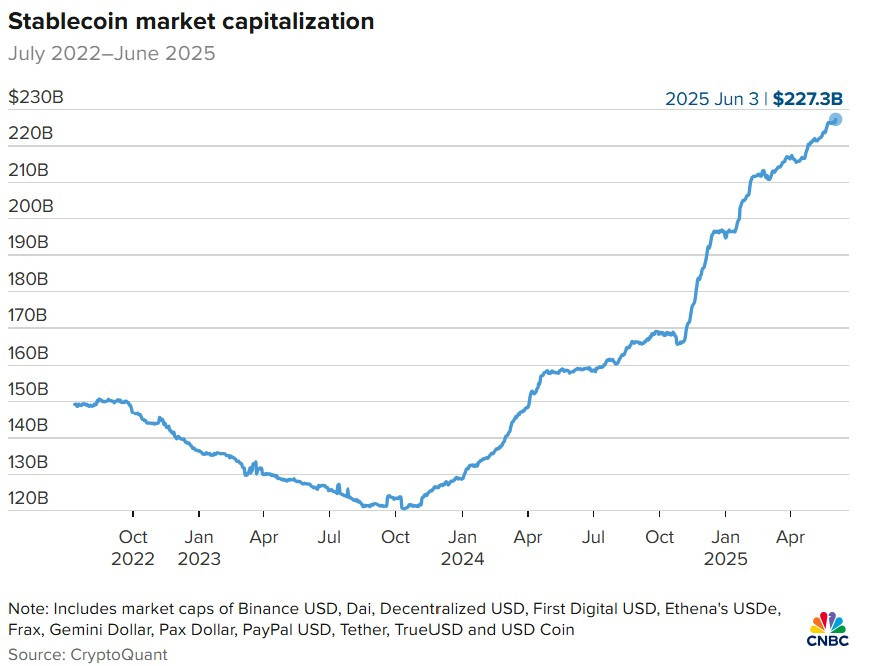
Wall Street Eyes Stablecoin Liquidity
JPMorgan projects that stablecoins could generate $880 billion in short-duration Treasury demand by 2028. As issuers acquire T-bills to back tokens, Federal Reserve influence over yields may intensify. Coinbase’s USDC revenue helped it enter the S&P 500, and Robinhood’s stock soared on stablecoin optimism.
In Hong Kong, lawmakers approved the Stablecoin Ordinance Bill on May 21, 2025, enabling HKD-pegged coins. That move could boost local fintech and bank stocks tied to token issuance. Meanwhile, gold-backed stablecoins continue to appeal as digital inflation hedges with physical asset backing.
Can Stablecoins Really Supercharge the U.S. Dollar?
Stablecoins do not expand the money supply. Each token corresponds to a deposited dollar or equivalent Treasury held in reserve. Unlike Fed quantitative easing, stablecoin minting repurposes preexisting dollars. That means no money-multiplier effect occurs, preserving existing monetary aggregates while enabling blockchain-native settlements.
Stablecoins cannot refinance high-cost debt into low-yield Treasuries. The Treasury still pays full coupon on its bills and notes. Yield spreads accrue to issuers, not the government, unless Congress taxes stablecoin earnings. Yet, by funneling liquidity into Treasury markets, stablecoins may alter yield dynamics and liquidity pools.
Precise Points Extracted
Circle’s IPO raised $1.05 billion at $31 per share after three upsizing rounds, reflecting over 25× oversubscription. This final issuance of 34 million shares valued Circle at $8.06 billion fully diluted.
As of June 5, 2025, USDC held approximately 25 percent of the $253 billion stablecoin market, with USDT leading at about 60 percent. USDC’s backing exceeded $61 billion in cash and Treasuries.
The GENIUS Act, passed late May 2025, requires stablecoins be fully backed by cash or Treasuries under 90 days, imposes strict AML/KYC, and mandates federal or state licensing for issuers.
Circle’s FY 2024 revenue totaled $1.68 billion, with $156 million in net profit, driven exclusively by reserve yields and exchange revenue shares. These figures underscore the profitability of a 1:1 reserve model.
JPMorgan estimates stablecoins could drive $880 billion in short-duration Treasury bill demand by 2028, potentially reshaping yield curves and liquidity pools in government debt markets.
On May 21, 2025, Hong Kong’s legislature approved the Stablecoin Ordinance Bill, legalizing HKD-pegged tokens. That legislation is expected to uplift fintech and bank stocks partnering in stablecoin issuance.
Stablecoins do not create new money; every token corresponds to a preexisting dollar or equivalent Treasury held in reserve. Therefore, minting stablecoins does not expand monetary aggregates.
Issuers cannot use stablecoin backing to replace existing high-interest debt with low-yield Treasuries. The U.S. Treasury continues paying full coupon, so any yield differential accrues to issuers unless Congress intervenes.