
ECB’s Eighth Rate Cut: Is This the Final Bow?

Key Points
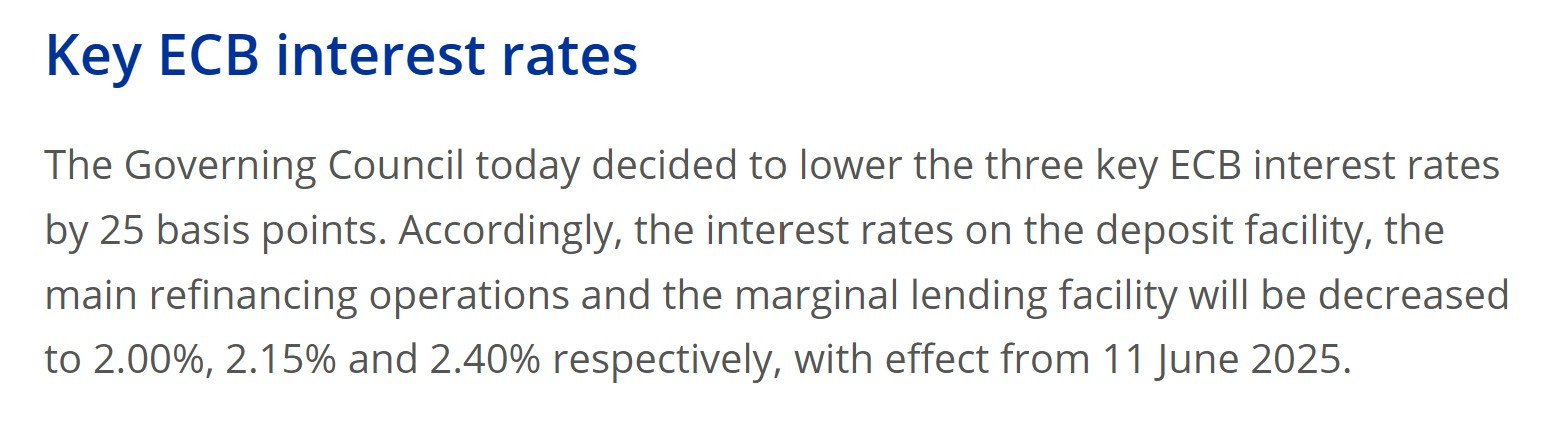
- ECB delivered its eighth rate cut in a year, lowering deposit rate to 2.00%, refinancing to 2.15%, and marginal lending to 2.40%.
- May headline inflation fell to 1.9%; ECB projects 2.0% for 2025 and 1.6% for 2026, prompting debate over further easing.
- Policymakers split: Hawks urge pause at “neutral”00%; doves argue more support is needed given weak growth and policy lags.
- S.–EU tariff uncertainty has eased short‐term inflation via lower energy costs and a stronger euro but risks future price shocks if trade tensions escalate.
- Markets expect the next pause in July, with a one‐in‐three chance of another 25 bps cut later in 2025, though some foresee the next move only by September.
Why Are Policymakers Split?
ECB officials face a stark choice. On one side, so-called “hawks” urge a pause in rate cuts, cautioning that slow-burning inflationary pressures could reemerge if governments ramp up spending.
They argue that once rates reach what the ECB defines as “neutral” (around 2.00% for deposits), further easing risks overstimulating certain sectors and compromising the central bank’s ability to react should inflation rebound.
Conversely, more “dovish” members believe that maintaining a supportive policy stance is crucial until domestic demand shows clearer signs of sustained improvement. They point to soft GDP growth, lackluster business investment, and the 12–18 month lag in monetary policy transmission—suggesting that the cumulative effects of previous rate cuts may not yet fully materialize. Without additional stimulus, the eurozone’s fragile recovery could be jeopardized, they warn.
How Are Tariffs Shaping Inflation?
Tariff-related uncertainties have clouded the eurozone’s inflation outlook. Since the U.S. first announced “reciprocal tariffs” in April, energy costs have fallen and the euro has strengthened—factors that have already eased price pressures in the short term.
However, a full-blown trade escalation could reverse that trend by pushing up import costs. Presently, most EU exports face a 10% U.S. tariff, but if negotiations falter, these levies could jump to 50% come July 1. In response, the EU has extended talks until July 9, attempting to stave off a tariff surge.
Policymakers acknowledge that any abrupt trade standoff would dampen investment and consumer spending, further slowing growth and possibly keeping inflation below target. Over time, however, retaliatory measures, shifting supply chains, and higher defense and green-transition spending could ignite inflationary pressures—especially if labor shortages intensify as the population ages. As a result, some ECB members caution that, while tariffs are currently disinflationary, they also plant seeds for future price shocks.
ECB’s Revised Forecasts Point to Slower Growth
In its quarterly projections released alongside the rate decision, the ECB trimmed its growth and inflation outlooks for 2025–27. GDP for 2025 now stands at 0.9%, unchanged from the previous forecast, while 2026 growth expectations dipped to 1.1% (from 1.2%). For 2027, output is seen expanding by 1.3%, in line with earlier estimates.
On the inflation front, headline consumer prices are forecast to average 2.0% in 2025 (previously 2.3%), before easing to 1.6% in 2026 (down from 1.9%) and then picking up to 2.0% in 2027 (unchanged). Core inflation, which strips out volatile items, is projected at 2.4% in 2025 (versus 2.2% before), before easing to 1.9% in both 2026 and 2027.
Analysts note that the unexpectedly large downgrade for 2026 headline inflation—now at 1.6%—could be the most significant surprise from this round, prompting renewed debate over the need for further accommodation.
What Comes Next for Monetary Policy?
Investors are wagering on a brief pause following June’s cut. Market-implied probabilities suggest that the deposit rate will hold at 2.00% in July, with a one-in-three chance of another 25 basis-point reduction later this year. A more cautious view sees the next cut delayed until September, pending clearer evidence on inflation and growth trajectories.
ECB President Christine Lagarde is expected to maintain a neutral tone at Thursday’s press conference at 20:45 CEST, focusing on the data driving decisions rather than providing explicit forward guidance.
Analysts emphasize that the central bank’s communication will become more nuanced as conflicting short- and medium-term factors intensify. While May’s inflation drop below 2% offers breathing room, rising uncertainties around tariffs, wage pressures, and fiscal spending could swell into a fresh inflation spike.
Ultimately, the summer rate path depends on data stability: if inflation remains benign and economic indicators weaken further, the ECB might opt for two additional 25 basis-point cuts later in 2025. But hawks warn that by late 2026, structural labor shortages—especially in Germany—and higher spending on defense and the green transition could reignite inflation, potentially forcing the ECB back to tightening. Should that scenario materialize, this week’s cut may indeed prove the “final bow” of the current easing cycle.