
Gloomy Outlook! Lululemon Plunges 22% After Earnings!

The tariff curse still haunts apparel brands, and the latest example is lululemon.
On June 5th, Lululemon released its fiscal first-quarter earnings report.
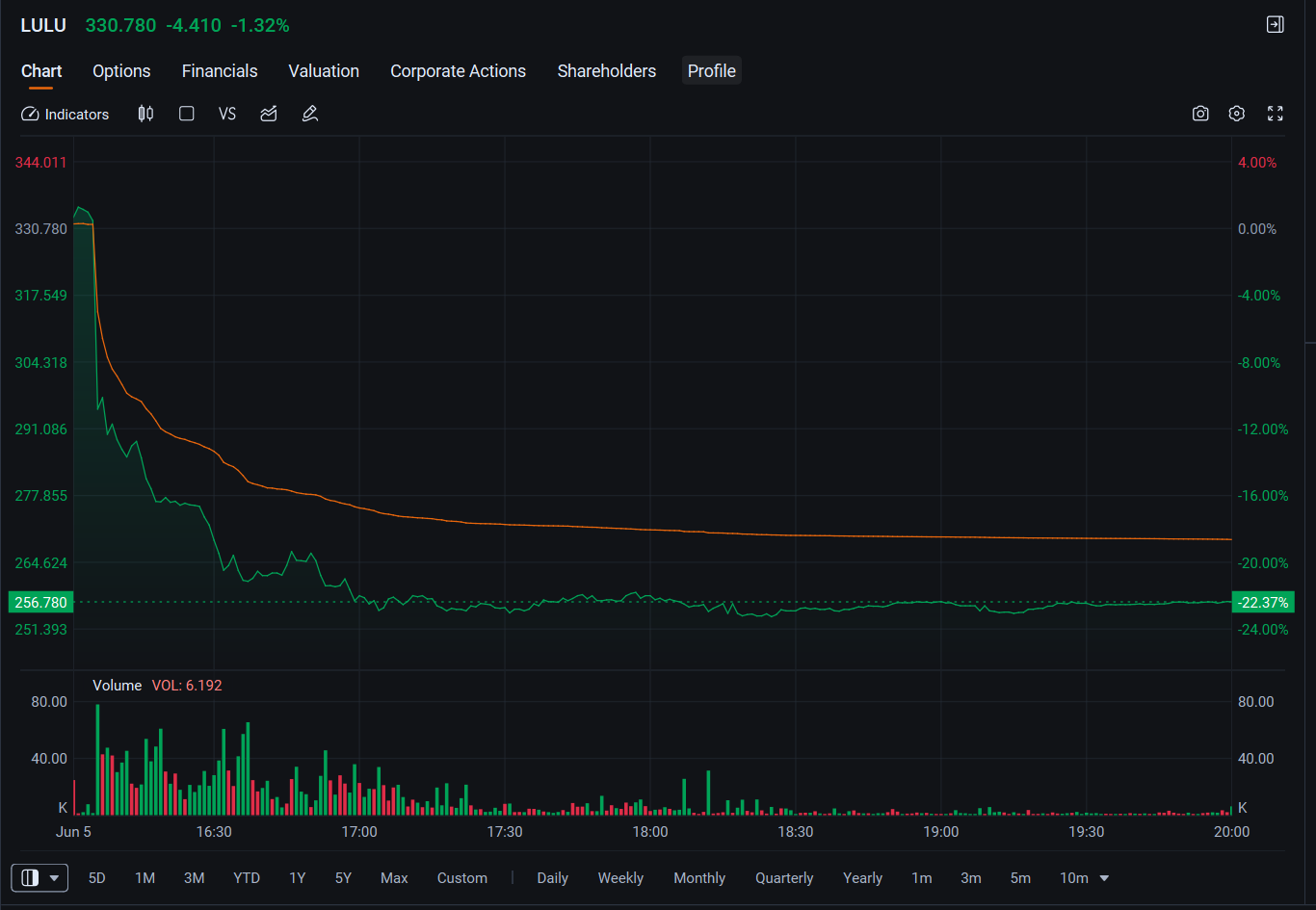
Although its financial performance exceeded Wall Street's expectations, under the macro-environment uncertainty brought by Trump tariffs, Lululemon still chose to lower its full-year performance forecast, which caused the company's stock price to plummet by more than 22% in after-hours trading.
Better-than-expected Performance and Pessimistic Outlook
Lululemon's total net revenue in the first quarter increased by 7% to $2.4 billion. The company has 770 stores worldwide, with a net increase of 3 stores in this quarter. Digital channel revenue was $961 million, accounting for 41% of the revenue. Men's and women's clothing revenues increased by 8% and 7% respectively.
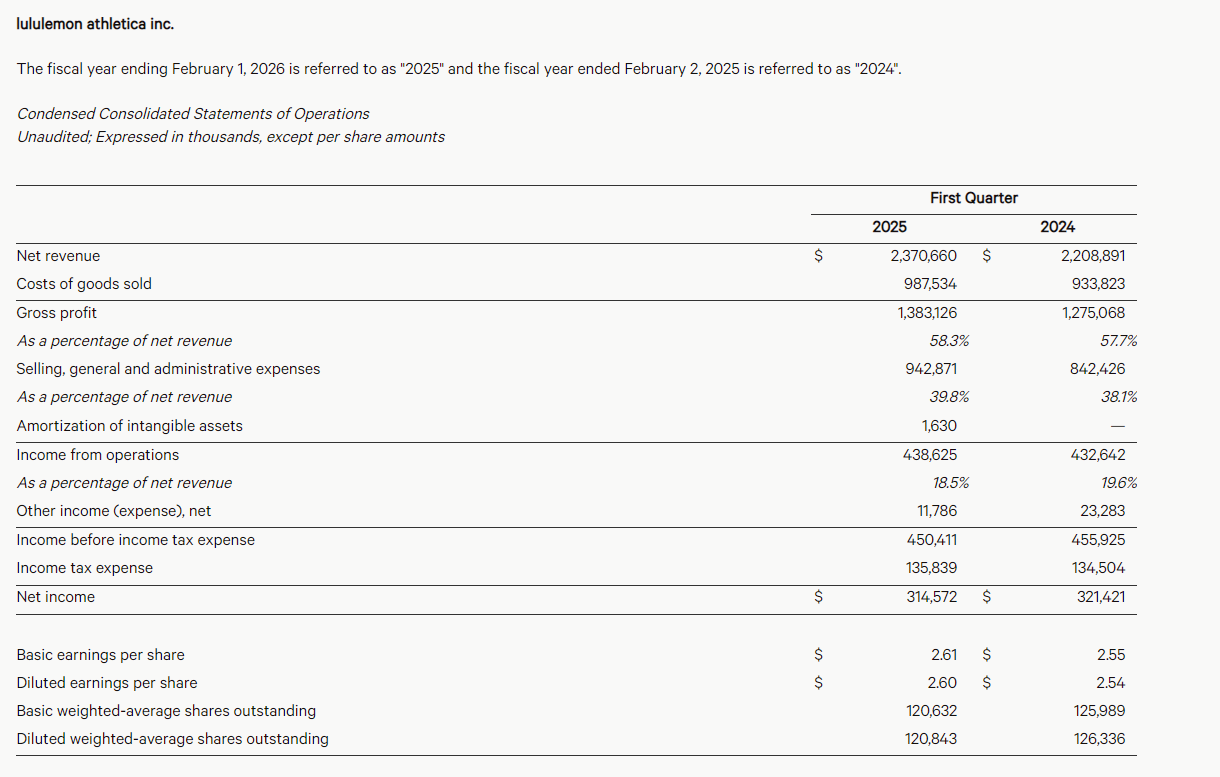
The gross profit margin in the first quarter was 58.3%, compared with 57.7% in the same period last year. The quarterly operating profit was $439 million, accounting for 18.5% of net revenue, compared with 19.6% in the same period last year.
At the end of this quarter, the company held approximately $1.3 billion in cash and cash equivalents. The company expects capital expenditures in 2025 to be approximately $740 million-$760 million, used for distribution centers, capital investment in new stores, and renovations, etc.
The company expects second-quarter revenue to be between $2.535 billion-$2.56 billion, with a growth rate of 7%-8%; it is expected to have a net increase of 14 self-operated stores in the second quarter and complete 9 store optimizations. The second-quarter gross profit margin is expected to decline by approximately 200 basis points year-over-year.
In terms of full-year revenue and profit, the company maintained its revenue expectation, which is $11.15 billion-$11.3 billion, but the full-year operating profit margin outlook was lowered from a year-over-year decline of 100 basis points to a decline of 160 basis points.
Pessimistic about the U.S. Economic Outlook
As the company copes with tariffs and concerns about the slowdown of the U.S. economy, Calvin McDonald, CEO of Lululemon, said in a press release: "We intend to use our strong financial position and competitive advantages to go on the offensive, and at the same time, we will continue to invest in the growth opportunities in front of us."

He said on the analyst conference call that he is "pessimistic" about the U.S. economic growth prospects and that American consumers are very cautious when making purchasing decisions.
Meghan Frank, the company's CFO, added on the conference call that Lululemon plans to "strategically increase prices item by item in our product line" to mitigate the impact of tariffs.
She said: "We will increase the prices of a small number of products, and the increase will not be large." She added that the price increases will start from the second half of the current quarter and continue until the third quarter.
Many Sports Retailers Have Issued Warnings
In fact, under the impact of the uncertainty of Trump tariffs, Lululemon is far from the only retailer that has lowered its performance guidance and announced plans to raise prices, and this also indicates future fluctuations in the U.S. business environment and the increase in the living pressure of American consumers.
For example, for Athleta, a sportswear brand competing in the same track as Lululemon, its parent company, Gap Inc., reported last week that tariffs are expected to have an impact of $100 million-$150 million on its business. And Nike announced last month that it will start to increase the prices of a series of products, although it did not specify whether tariffs are the reason for the price increase.
On Thursday's earnings conference call, McDonald directly admitted that tariffs have brought uncertainty to the business, although he still insisted that he believes the brand is "more capable than most brands" to cope with the current environment.
Frank said on the earnings conference call that the company's performance expectation assumes that the United States currently imposes an additional 30% tariff on China and an additional 10% tariff on goods imported by the retailer from other countries.
According to the company's annual report, as of the end of 2024, 40% of Lululemon's products are produced in Vietnam, 17% in Cambodia, 11% in Sri Lanka, 11% in Indonesia, 7% in Bangladesh, and the rest in other regions.
The company does not directly own or operate any production facilities, but relies on suppliers to provide fabrics and contract manufacturing for its products.
As of Thursday's close, Lululemon's stock price has dropped by approximately 13% so far this year.
Can We Still Buy It Now?
Actually, I don't know much about Lululemon because I have never bought their products.
Although lululemon started from men's yoga pants and entered the men's sports shoes and clothing field. It even launched a number of men's sportswear based on sports such as tennis, men's golf, and hiking.
But I still rarely look at them, which actually reflects that the audience of this brand is still some specific groups.
Under the uncertainty of the macro-economic environment, I think this kind of expensive non-essential living product will be much more impacted than general consumer goods and is easily replaced by some low-price brands.
From the perspective of valuation indicators, the forward 12-month price-to-earnings ratio of Lululemon is 22.59 times, which is higher than the industry average of 12.72 times, indicating that the current valuation is relatively high.
Moreover, after Lululemon lowered its performance forecast this time, its current stock price no longer matches its current valuation. I do not recommend buying it.$LULU