
US May Non-Farm Data Slightly Exceeds Expectations

On Friday, Eastern U.S. Time, data released by the U.S. Bureau of Labor Statistics showed that while consumers and businesses are bracing for tariffs and a potential economic slowdown, the pace of decline in nonfarm job growth was less than expected, providing policy space for the Federal Reserve to delay interest rate cuts.
I think this report is not particularly positive overall: weak job growth, downward revisions to prior figures, a rising unemployment rate, a larger-than-expected decline in labor participation rate, and faster-than-expected wage growth all signal coexisting fears of recession and stagflation. However, the upside surprise in income could boost household earnings and stimulate consumption, potentially delaying the onset of a recession.
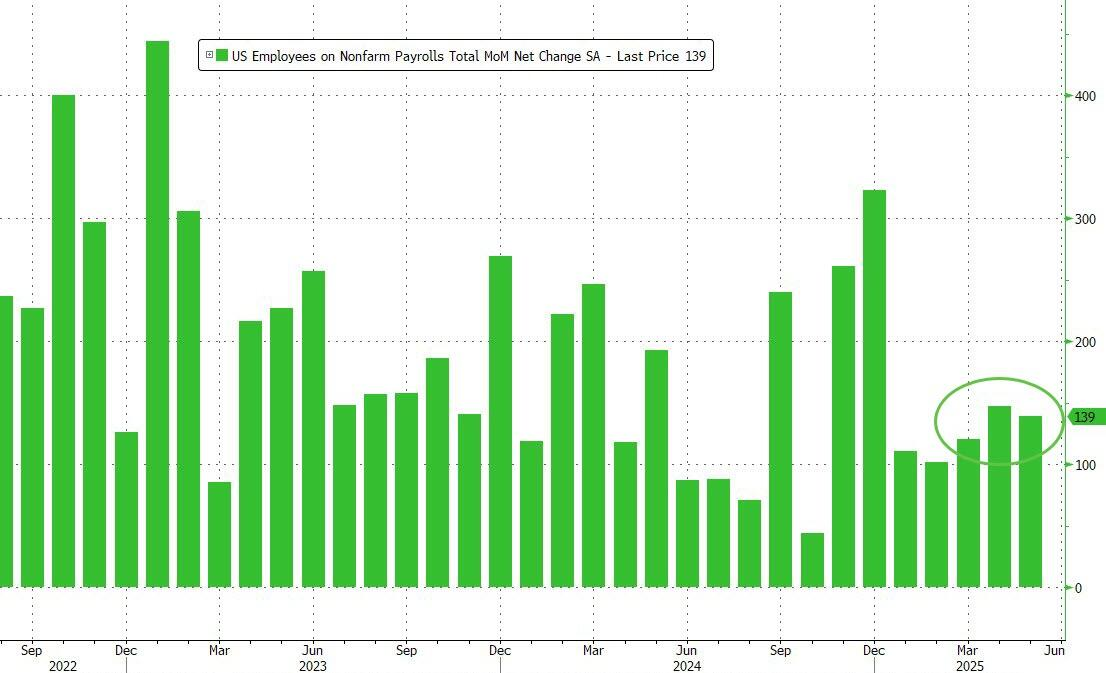
Specifically, the U.S. seasonally adjusted nonfarm payrolls increased by 139,000 in May, the lowest level since February, but higher than the market expectation of 130,000.
The unemployment rate remained at 4.2% for the third consecutive month, alleviating concerns that the labor market is starting to slow significantly.
Additionally, while the May job growth exceeded the median forecast, the cumulative downward revision of 95,000 jobs in the previous two months far offset the impact of May's overperformance.
A closely watched inflation barometer—the average hourly wage—rose 0.4% month-on-month in May, higher than the previous 0.2% and the expected 0.3%; year-on-year, it increased 3.9%, surpassing the previous 3.8% and the expected 3.7%.
By industry, healthcare once again led job growth, creating 62,000 new jobs, even higher than last year's average increase of 44,000. The leisure and hospitality sector added 48,000 jobs.
On the downside, as Musk's-led Department of Government Efficiency began cutting federal employees and spending, the federal government lost 22,000 jobs in May, the highest since 2020.
In recent months, Trump's series of economic policies, particularly the capricious approach to large-scale import tariffs, have shocked businesses.
Uncertainty about the scale and scope of tariffs has made it difficult for major enterprises to operate and plan: they do not know what their costs will be in three months, or even three days; moreover, it has become more uncertain whether consumers will continue to spend.
The outlook has become increasingly blurred, with many of America's largest listed companies already pausing forecasts for future earnings, temporarily disorienting analysts and investors. Small businesses, which have little room for error, are trapped in place.
Ger Doyle, President of ManpowerGroup North America, said Friday's nonfarm report depicts a "stable but cautious" labor market despite growing economic uncertainties. "This is not a freeze, but a temporary cool-down. Employees are choosing to stay put, employers are keeping steady, and everyone is waiting for clearer signals."
Jeffrey Rosenberg, Senior Portfolio Manager at BlackRock, commented that today's U.S. nonfarm data reinforces the Fed's "wait-and-see" stance. There are signs of sustained strong job growth, but from an inflation perspective, wage increases are not yet significant enough to truly worry policymakers.
Peter Cardillo, Chief Market Economist at Spartan Capital, said although the nonfarm data slightly exceeded both consensus expectations and his personal forecast, aside from the hourly wage indicator, the overall report did not signal that the Fed needs to intervene in the labor market.
In my view, the Fed is likely to cut rates 2-3 times this year, with the first cut possibly delayed until July or even September. Notably, the U.S. Dollar Index has decoupled from rate-cut expectations recently, leaving room for further rebounds. A hawkish dot plot and Summary of Economic Projections (SEP) at the June FOMC meeting could strengthen the dollar and weigh on stocks, bonds, and gold—something investors should monitor closely.