
IBM’s Big Bet on Quantum: A 2029 Roadmap and a New All-Time High

Shearing sheep
June 11, 2025
GoGPT Summarizes Articles
IBM just made a move that’s got both the science crowd and Wall Street paying attention.
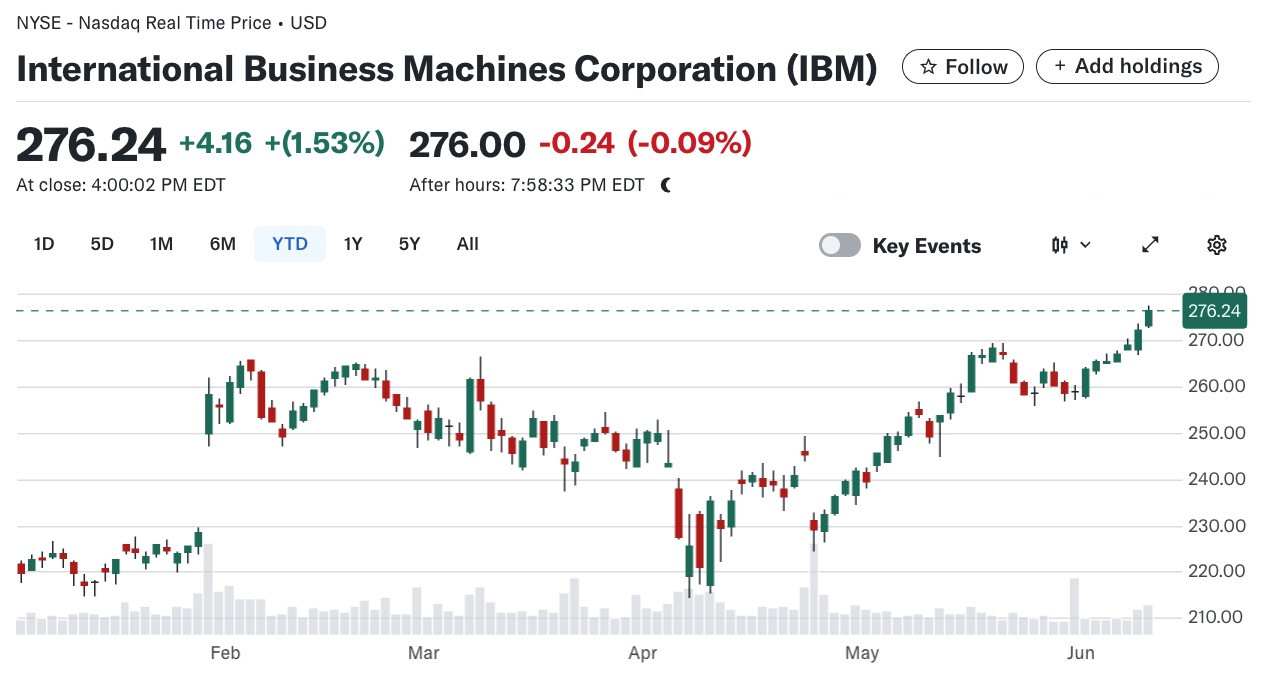
On Tuesday, IBM announced its bold plan to build a large-scale, fault-tolerant quantum computer—called IBM Quantum Starling—by 2029. And markets liked it: the stock jumped 1.5% to close at an all-time high of $276.24, marking its eighth straight day of gains.
So what’s the big deal?
Quantum computing has been "the next big thing" for a while now—but most existing systems are still glorified prototypes. They’re fast in theory, but riddled with errors in practice. That’s because qubits (quantum bits) are extremely sensitive and unstable, and error correction eats up a ton of their processing power.
IBM claims it’s cracked part of this challenge by introducing a new error-correction method called qLDPC codes, which could reduce the number of physical qubits needed by up to 90%. That’s a big step—because only when we have stable logical qubits (essentially error-corrected qubits) in the hundreds or thousands, will quantum computers start doing real, useful work—like drug discovery or complex materials simulation.
Their new system, Starling, will be built at a dedicated quantum data center in Poughkeepsie, New York, and is expected to deliver 200 logical qubits—enough to perform 100 million quantum operations, or what IBM says is 20,000 times more powerful than today’s machines.
They’ve even teased the next system after that: IBM Quantum Blue Jay, targeting 2,000 logical qubits and 1 billion operations.
A Step Ahead or a Long Shot?
IBM isn’t alone in the quantum race—Amazon, Google, Microsoft, and well-funded startups like IonQ and Rigetti are all working on similar tech. But this announcement gives IBM a clear narrative: they’re setting a target, laying out a roadmap, and showing confidence in the tech behind it.
And unlike a lot of companies in the quantum space, IBM already has a working network of quantum computers and published research. They’re not just talking in press releases—they’re showing papers, collaborating with the U.S. Department of Defense, and outlining actual infrastructure development.
Still, some experts—like Gartner’s Chirag Dekate—remain cautious, noting that the real test is whether this will translate into commercial value. That’s a fair point. Most quantum machines today are used for academic or exploratory purposes, and monetizing them at scale is still murky.
Market Reaction: Why the Stock Jumped
For investors, it’s not just about the tech—it’s about the narrative. IBM has long been seen as an aging tech giant, struggling to reinvent itself. But this quantum roadmap gives it a shot at being part of the future, not just the past.
Also worth noting: tech stocks in general are benefiting from a broader shift toward AI and advanced computing infrastructure. IBM’s quantum push fits neatly into that theme.
That said, this isn’t a short-term play. There’s no immediate commercial rollout here, and even IBM admits the path beyond 2029 includes more hurdles. But for long-term investors who believe in the potential of quantum, this could be a signal that IBM is positioning itself as one of the key players in the next phase of computing.
Final Thoughts
Quantum computing is still early-stage, but this feels like a genuine step forward—not hype for the sake of headlines. IBM’s plan may still face plenty of scientific and engineering challenges. Whether they’ll deliver by 2029 is still an open question—but if they do, it could reshape not only IBM’s trajectory, but the future of computing itself.
#U.S. Tech Giants: Tracking U.S. Market Leaders#$International Business Machines Corporation(IBM)