
Chime Soars 37% in Nasdaq Debut! Is Fintech’s IPO Winter Finally Over?

Shearing sheep
June 13, 2025
GoGPT Summarizes Articles
Thursday marked a major turning point for fintech as Chime Financial (CHYM) made its long-awaited debut on the public markets — and Wall Street welcomed it with open arms. Shares opened 59% above the IPO price and closed the day up over 37%, signaling that investor appetite for fintech is roaring back to life.
IPO Overview: A Red-Hot Debut
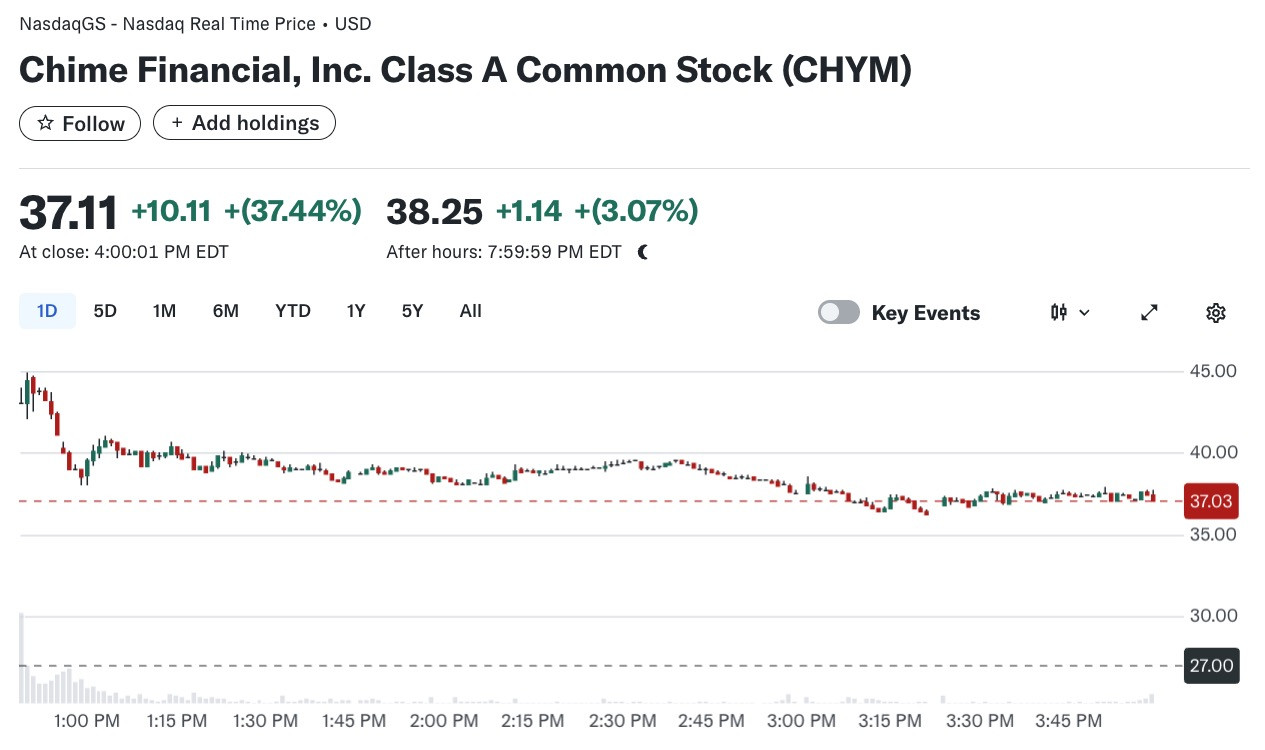
Chime’s IPO priced at $27 per share, already above the expected range of $24–$26, suggesting strong institutional demand ahead of the listing. It opened at a sizzling $43 and soared as high as $44.94 intraday — up more than 66% from the IPO price — before settling at $37.11 at market close. This closing price gives Chime a market cap of around $13.5 billion.
In total, Chime sold 32 million shares, raising $699 million in fresh capital and another $165 million for early investors, bringing the total IPO proceeds to $864 million. On a fully diluted basis, the company’s valuation stands at $15.9 billion — still below its 2021 peak of $25 billion, but highly respectable in today’s more cautious environment.
Chime’s Business Model: Simple, Digital, and Asset-Light
Chime operates as a neobank — a technology-first company that partners with traditional banks (namely The Bancorp Bank and Stride Bank) to offer FDIC-insured checking and savings accounts, debit and credit cards, and essential financial tools. Instead of making money through loans like legacy banks, Chime relies primarily on interchange fees from card transactions — a lean, scalable, and asset-light model.
Chime targets a largely overlooked demographic: Americans earning under $100,000 per year. This income bracket has traditionally been underserved by big banks, often hit with high fees and minimum balance requirements. Chime’s offering is refreshingly different — built around low-cost, consumer-friendly services like:
-
SpotMe, a fee-free overdraft feature that lets users overdraw up to a preset limit without penalties.
-
MyPay, which allows users to access part of their paycheck early.
-
A high-yield savings account offering around 3.75% APY, which is among the most competitive rates in the market today.
User Growth and Engagement
As of Q1 2025, Chime had reached 8.6 million monthly active users, up 23% year-over-year. The engagement metrics are equally impressive: on average, users open the app four to five times daily and swipe their Chime card more than 55 times per month. Importantly, two-thirds of Chime users consider it their primary bank account, which speaks volumes about customer trust and loyalty.
The strong product-market fit, especially among financially vulnerable consumers, has enabled Chime to carve out a loyal customer base in a crowded fintech landscape.
Financial Performance
Chime’s recent financials reflect both rapid growth and improving efficiency. In Q1 2025, Chime posted:
-
Revenue of $518.74 million, up 32% YoY
-
Net income of $12.94 million (vs. $15.9 million YoY)
-
Adjusted profit of $25 million
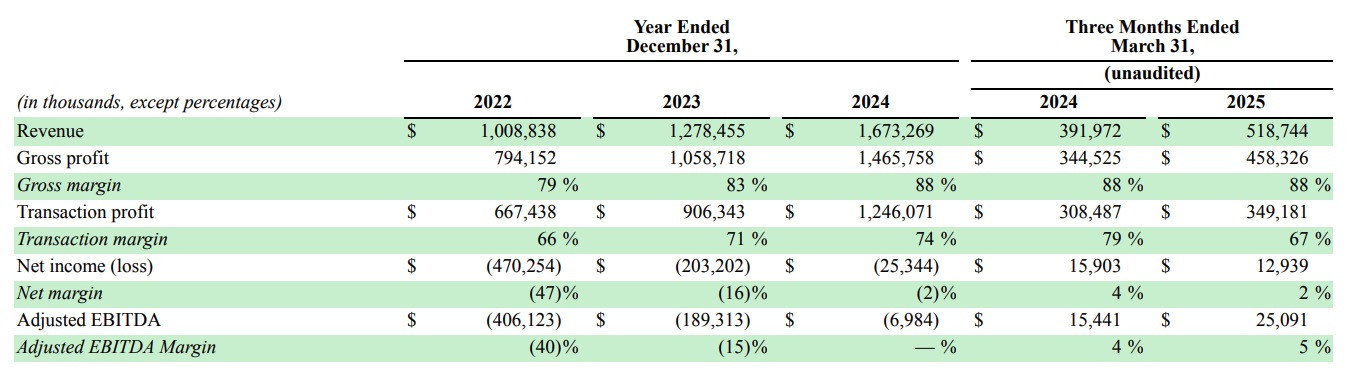
For the full year 2024, the company generated $1.67 billion in revenue, with a net loss of $25.3 million — a significant improvement from its $203 million loss in 2023.
Although still operating at a GAAP loss, Chime has made considerable progress in tightening its margins, improving profitability by 40 percentage points over two years. One major expense remains: customer acquisition, with marketing spend totaling $1.4 billion between 2022 and 2024. That said, Chime reports user retention rates above 90% once direct deposit is activated — a strong indicator that their spending is paying off.
Fintech IPOs: A Comeback Story?
Chime’s blockbuster IPO is the latest in a series of fintech comebacks. Earlier this year, Circle ($CRCL), eToro ($ETOR), and Voyager Technologies ($VOYG) all made strong public market debuts, with Voyager jumping 80% on its first trading day. Circle’s stock has already more than doubled since going public.
Chime’s strong debut suggests the fintech freeze — sparked by 2021’s rate hikes and brutal valuation resets — might finally be thawing. And analysts? They’re cautiously optimistic.
“If Chime performs well over the next two to three months, expect a wave of fintechs to follow,” said David Golden of Revolution Ventures. “Otherwise, companies may still stay cautious.”
Analyst and Industry Reactions
Reactions from analysts and insiders have been largely positive.
-
Dan Dolev from Mizuho described Chime’s model as “so simple it’s surprising” — suggesting its strength lies in clarity and execution.
-
Denis Barrier of Cathay Innovation, an early investor, noted that the IPO “isn’t the finish line,” but rather a milestone in Chime’s journey to redefine U.S. retail banking.
Meanwhile, CEO Matt Newcomb and co-founder Chris Britt emphasized that the company is “just getting started.” Their long-term goal is to replace legacy banks as the go-to financial partner for everyday Americans living paycheck to paycheck.
Final Take
Chime’s IPO is undoubtedly a win — for the company, for fintech investors, and for a market that has long been waiting for signs of a revival. But the road ahead is far from smooth.
The fintech space remains fiercely competitive, with traditional banks investing heavily in digital products and other neobanks racing to grow their share. To maintain momentum, Chime will need to keep innovating, manage its cost structure, and continue building trust among users.
Valuation-wise, Chime trades at a price-to-sales ratio of nearly 8.5. For comparison, peers like SoFi trade around 4.2. That puts pressure on management to deliver strong growth and move closer to sustainable profitability.
Still, Chime’s positioning is compelling. Its fee-based, tech-enabled model, strong brand resonance among lower-income users, and solid user retention offer real staying power in a changing financial landscape.
With fintech IPOs seemingly back in fashion, Chime’s post-IPO performance will be closely watched. Whether it becomes a bellwether for a broader fintech resurgence — or a cautionary tale — depends on what happens next.
#$Circle Internet Group Inc.(CRCL)#$eToro Group Ltd. Class A Common Shares(ETOR)#$Voyager Technologies Inc.(VOYG)