
Escalation of Middle East Tensions: Can Oil Prices Rise to $130?

On Thursday, June 12 (Eastern Time), JPMorgan Chase, a Wall Street giant, warned in a report that under extreme geopolitical scenarios—particularly those involving Iran—oil prices could nearly double to the $120–$130 per barrel range.
Notably, when this report was released, the Middle East situation had not yet escalated to its current tense state. International oil prices were hovering around $69 per barrel, a level that JPMorgan believed already included a premium for geopolitical risks.
In the report, JPMorgan projected that oil prices would remain stable under normal conditions, expecting them to stay at approximately $60 per barrel in 2025 and 2026.
However, the bank cautioned that under extreme geopolitical circumstances—especially those involving Iran—prices could double to $120–$130 per barrel.
This is because JPMorgan believes that if a larger-scale conflict breaks out in the Middle East, blocking the Strait of Hormuz, Iran's daily exports of 2.1 million barrels would be affected, potentially causing severe supply disruptions in the crude oil market.
Natasha Kaneva, JPMorgan's chief commodities analyst, stated that before Thursday, international oil prices were near $70, about $4 higher than the model's estimated fair value of $66 for June, indicating that the market had already factored in the premium from geopolitical risks. Kaneva added that if the conflict continues to expand, oil prices could rise exponentially, surging to the $120–$130 per barrel range.
Escalating Situation Triggers Commodity Volatility
The report proved prescient.
Shortly after its release, Israel launched an attack on Iran in the early morning of Friday (13th), with explosions heard in multiple locations in Tehran. Israel named the operation "Force of the Lion," stating that its targets were Iranian commanders and missile factories.
So far, multiple Iranian commanders have been assassinated or attacked, the Natanz nuclear facility has been struck, and six scientists have been killed in the attacks. However, hydropower infrastructure and oil refining reserve facilities have not yet been damaged.
Iran responded by stating it is prepared to continue the war, and Israeli "criminals" should await a powerful retaliation.
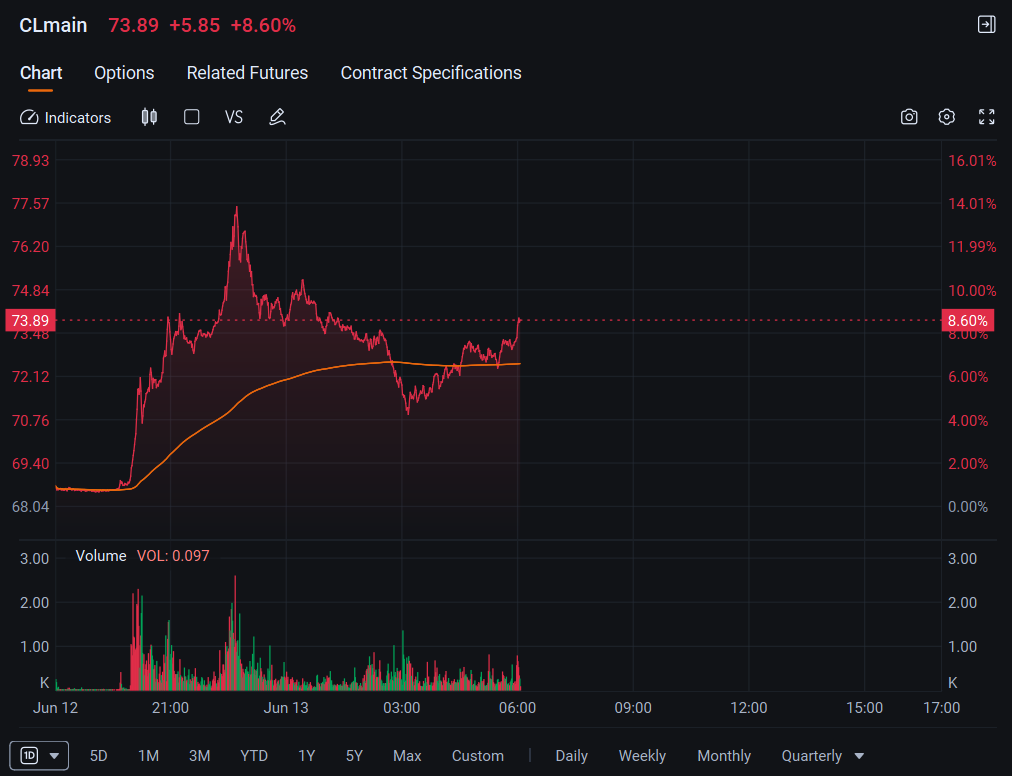
Affected by the developments, commodities such as oil and gold moved significantly on Friday.
As of press time, U.S. WTI crude oil futures rose more than 6% to above $72 per barrel, with intraday gains briefly surging to 13%; Brent crude oil futures rose 5.6% to above $73 per barrel, with intraday gains also hitting 13%; and COMEX gold futures rose 1.1% to $3,440 per ounce.