
Apple Delays Siri’s AI Overhaul to Spring 2026 — What It Means for Investors and the AI Race

Shearing sheep
June 13, 2025
GoGPT Summarizes Articles
Apple just confirmed what many in the industry feared: the long-awaited AI overhaul of Siri is delayed—again.
On June 12, reports revealed that Apple now targets spring 2026 for the release of its revamped Siri, expected to debut with iOS 26.4. Senior Apple executives later confirmed the timeline in post-WWDC interviews.
This isn’t just a routine delay—it’s a major strategic setback. The new Siri was positioned as the centerpiece of Apple’s AI transformation, showcasing how generative AI could reshape user interactions across iPhones, iPads, and beyond.
What Was Promised: A Smarter, Context-Aware Siri
At WWDC 2024, Apple teased a more intelligent Siri, introducing:
-
Cross-app tasking: Imagine Siri booking lunch after your flight lands by pulling data from Calendar, Messages, and Maps.
-
Deeper context awareness: Auto-filling forms using your ID photo, or understanding what’s on-screen to suggest relevant actions.
This wasn’t a minor update—it was Apple’s boldest attempt yet to compete with Google Gemini and Microsoft Copilot.
Now, that vision is officially on pause.
Why the Delay?
Sources point to both technical challenges and internal friction.
Siri currently runs on a hybrid of legacy and next-gen architecture. Integrating the two has proven so complex that some engineers now believe a complete rebuild may be necessary.
Meanwhile, tensions are reportedly brewing between teams. Engineers blame marketing for announcing features too soon, while marketing points fingers at engineering for slipping deadlines. The fallout has already begun: AI chief John Giannandrea has been relieved of consumer product responsibilities, with leadership now shifting to Craig Federighi (SVP of Software Engineering) and Mike Rockwell (head of Vision Pro). It’s a clear sign Apple is tightening control from the top down.
The Investor Angle: A Missed Moment
For investors, the delay underscores a growing concern: Apple is falling behind in the AI race.
While Microsoft and Google have already embedded generative AI into productivity tools, search, and cloud platforms, Apple is still playing catch-up. And each delay widens that gap.
Marketing for the iPhone 16 reportedly leaned heavily on the new Siri experience. But with that upgrade now pushed to 2026, the phone launched without its most anticipated feature—prompting swift backlash. Several class-action lawsuits have already been filed, accusing Apple of misleading customers with advertising that overpromised and underdelivered. Beyond damaging brand trust, this could invite regulatory scrutiny at a time when consumer expectations around AI are skyrocketing.
And Siri isn’t the only product affected. Earlier this year, Apple quietly disabled Apple Intelligence’s news summarization for apps like The New York Times and BBC, after users flagged misleading or inaccurate summaries. Meanwhile, a planned smart home hub—originally slated for release in March—has been shelved indefinitely due to its heavy reliance on Siri’s delayed capabilities.
Taken together, these issues raise broader concerns about Apple’s ability to execute under the mounting pressure of the AI era.
Meanwhile: Apple Quietly Dodges Trump’s Tariff Threat
While Apple struggles on the AI front, it’s showing strategic agility elsewhere—particularly in geopolitics.
Between March and May 2025, 97% of iPhones exported by Foxconn India went to the U.S., up from just 50.3% in 2024. The shift is widely viewed as Apple’s response to Donald Trump’s renewed tariff threats, warning that iPhones not made in the U.S. could face a 25% levy.
Rather than enter the political fray, Apple acted decisively behind the scenes:
-
Over $4.4 billion worth of iPhones were shipped from India to the U.S. in just five months—already surpassing all of 2024’s total of $3.7 billion.
-
In March alone, Apple chartered planes to fly $2 billion worth of iPhones directly to the U.S., bypassing slower sea routes.
-
The company also lobbied Indian authorities to slash customs clearance times from 30 hours to just 6.
Key supplier Tata Electronics mirrored the pivot, with 86% of its March–April exports heading to the U.S., up from 52% a year earlier.
While Trump tweets, Tim Cook plays chess—quietly building a resilient global supply chain that protects Apple’s margins and market share.
Looking Ahead: AI Copilot and “Knowledge”
Despite the Siri delay, Apple’s broader AI roadmap is still in motion.
Long-term, Apple aims to turn Siri into a true AI copilot—an intelligent assistant embedded across devices and apps, working silently and seamlessly. Think Microsoft Copilot or Google Gemini, but deeply integrated into the Apple ecosystem.
Another initiative, codenamed “Knowledge,” is also underway. It’s reportedly a ChatGPT-style chatbot that will pull real-time data from the web and blend it into Apple’s services. However, no launch timeline has been set.
Final Thoughts
Apple’s Siri delay is more than a product hiccup—it’s a glimpse into the company’s internal tug-of-war between innovation and perfectionism.
While rivals are willing to release “good enough” AI features and improve them in the wild, Apple remains committed to behind-closed-doors development. That philosophy may preserve polish and privacy—but in a fast-moving AI market, waiting too long could cost more than launching too early.
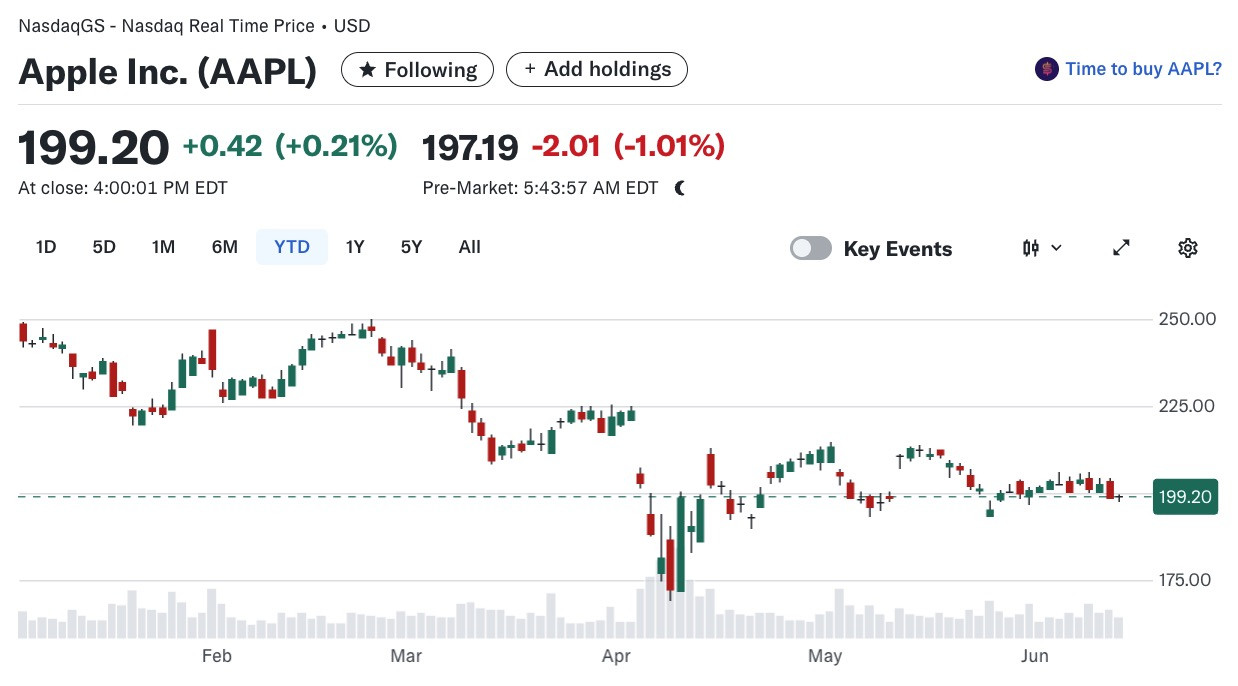
For now, Apple stock remains solid at $199.20, backed by a near-$3 trillion market cap. But patience isn’t infinite. Apple must now prove its AI vision isn’t just delayed—it’s worth the wait.
At the very least, Tim Cook might want Siri ready before Trump’s next tweet—or tariff. $AAPL
#U.S. Tech Giants: Tracking U.S. Market Leaders#$Apple Inc.(AAPL)