
Global Highlights This Week: Middle East Conflict Ignites Oil Market Storm, Central Bank Decision - Making Week is Full of Tension.

Last week, due to the escalation of the Middle East situation, the three major U.S. stock indexes all recorded declines. The Dow fell 1.32% last week, the S&P fell 0.39%, and the Nasdaq fell 0.63%, all ending their two-week winning streak.
Earlier in the day, according to military officials, the Israeli Air Force has not yet attacked all of Iran's nuclear facilities, "but these efforts will continue", and the military will also strike Iran's ballistic missile arrays.
Iranian President Pezeshkian said in a message posted on social media that after the Israeli attack on Iran, the Iranian government immediately convened a special meeting. Pezeshkian said that Israel would regret the day's actions.
Market participants are concerned that the situation may further escalate, affecting the energy infrastructure of Iran and its neighboring countries, and even leading to the blockade of the Strait of Hormuz. Brent crude oil once rose above $78 per barrel, reaching its highest level since January this year.
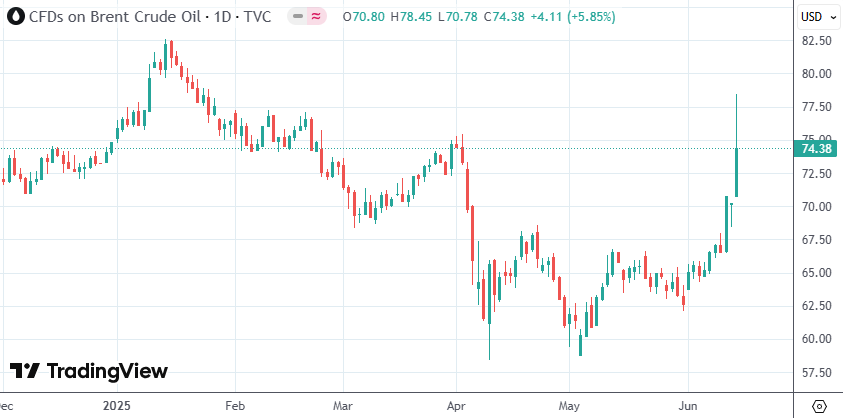
The International Energy Agency (IEA) said it was prepared to release emergency oil reserves if there was a shortage in the crude oil market. In response, OPEC Secretary-General Haitham Al-Ghais criticized that the IEA's statement would only cause panic.
This week, OPEC and the IEA will successively release their monthly oil market reports. In addition to the Middle East situation, a number of central banks are scheduled to announce interest rate decisions this week, including (in the order of decision time) the Bank of Japan, the Federal Reserve, the Swiss National Bank, the Bank of England, etc.
As for the Federal Reserve, although U.S. President Trump has repeatedly exerted political pressure on the bank to lower interest rates, and the CPI increase is lower than expected, the market generally expects that Fed officials will maintain the federal funds rate unchanged in the short term.
Carl Weinberg, chief analyst at High Frequency Economics, said that the Federal Reserve has no reason to discuss adjusting interest rates. "In fact, if Trump had not implemented tariff policies, the Federal Reserve might have considered cutting interest rates to stimulate the economy."
At the same time, the Bank of Japan's determination to raise interest rates is also facing great challenges. Last month, the bank lowered its economic outlook and hinted that despite the steady rise in inflation, under the pressure of uncertainties in U.S. trade policies, Japan may still postpone raising interest rates.