
U.S. Stock Strategy: U.S. Stocks Under Pressure, Focus on Traditional Energy, Telecommunications Services and Other Sectors

Recent U.S. Stock Market Trends
Major U.S. stock indexes have steadily rebounded recently, continuing the recovery trend since the market bottomed out in early April. In the past 10 trading days, the S&P 500 Index has accumulated a 2.3% increase, and the Nasdaq 100 Index has risen by 2.6%.
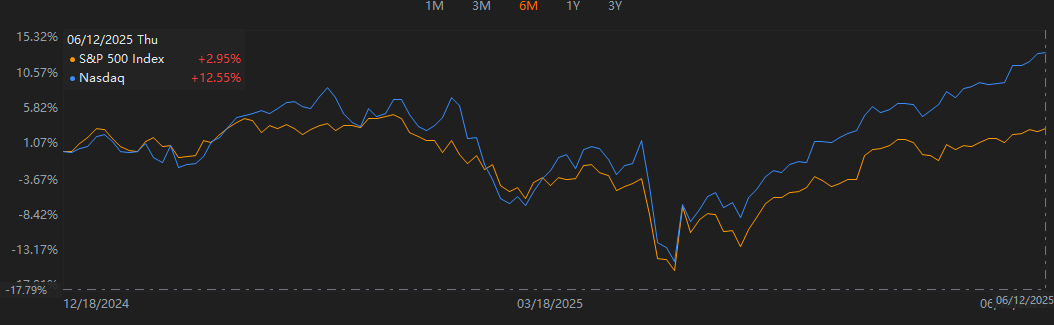
The better-than-expected U.S. employment data, the decline of U.S. inflation toward the long-term target level, and the progress in Sino-U.S. trade talks have jointly driven the steady rise of the U.S. stock market.
Geopolitical Risks and Market Pressures
Although the U.S. government has stated that geopolitical risks in the Middle East are expected to be controlled, investors remain concerned about the escalation of the situation between Israel and Iran. The risk appetite in the U.S. stock market has suppressed the space for further gains in U.S. stocks to a certain extent.
Strong Performing Sectors
In the past 10 days, energy and information technology have performed the best, with cumulative increases of 5.5% and 4.0%, respectively.
Information Technology Sector: The sector's strong performance is mainly driven by the resilience of the U.S. economy and the first meeting of the Sino-U.S. trade consultation mechanism. After the heads of state of the two countries reached partial consensus in a phone call on June 5, the first meeting of the Sino-U.S. trade consultation mechanism was held in London, UK, from June 9 to 10 (local time), and reached a consensus on a framework agreement.
The U.S. side stated that the meeting achieved positive results, further stabilizing bilateral trade relations. Earlier, U.S. President Trump's announcement of substantial tariff hikes on foreign goods triggered a sharp correction in the tech stocks.
The market believes that Trump's tariff policy will inevitably increase the costs of U.S. multinational enterprises. Therefore, the progress in Sino-U.S. trade relations has alleviated some market concerns, improving the profit expectations of multinational enterprises represented by tech companies.
Energy Sector: The strength of the energy sector is related to the recent tension in the Middle East and the rise in international oil prices. The energy market continues to focus on the tension between Israel and Iran in the Middle East, and international oil prices have continued to rise from the low levels in April-May.
Investors believe that if the scale of the Middle East conflict expands, leading to the blockade of the Strait of Hormuz, international oil prices may rise further. In the early morning of June 12 (local time), Israel launched an attack on Iran, escalating the situation again and causing international oil prices to soar further.
In addition, according to the Short-Term Energy Outlook released by the U.S. Energy Information Administration (EIA), as oil producers reduce well conversion activities, the EIA has for the first time since 2021 forecast that U.S. crude oil production will decline in the future.
Weak Performing Sectors
The industries that have dragged down the U.S. stock market are mainly consumer staples and consumer discretionary. The market believes that U.S. consumer enterprises have borne most of the cost pressure under Trump's phased policy of imposing high tariffs.
The May CPI data showed that U.S. inflation pressure further eased. Although energy prices remained low in April-May, which was an important force to ease U.S. inflation, the decline in prices of some goods also helped reduce U.S. inflation pressure.
The fall in U.S. commodity prices contradicts the earlier consensus that tariffs would raise U.S. commodity prices. According to the recent U.S. tariff revenue data, customs tariff revenue in May reached $23 billion, an increase of $17 billion (a surge of 270%) compared with the same period last year, which reflects the effect of Trump's new tariffs.
Therefore, U.S. stock investors tend to believe that the reason why U.S. commodity prices have not risen is likely that consumer enterprises are reluctant to risk losing customers by rashly raising commodity prices.
Instead, they are more willing to consume previously hoarded inventories to maintain prices and bear more tariff costs to wait and see the development of the situation. The damaged profit expectations have dragged down the performance of the U.S. consumer sector.
Outlook and Key Sectors to Watch
Market Drivers: The continuous progress of Sino-U.S. trade consultations and the recent decline in U.S. inflation data, which show that tariffs do not seem to have affected inflation, have provided the Federal Reserve with a certain degree of policy flexibility.
After the inflation data were released, market expectations for two rate cuts this year heated up, which helped boost the discount rate end of U.S. stocks. However, this inflation data may not fully reflect the effect of tariffs being passed on to prices, and investors still need to pay attention to more inflation data.
In addition, another major factor that has depressed inflation, the decline in energy prices, may rebound as geopolitical tensions in the Middle East heat up, which could cause reflation and dampen expectations of Fed rate cuts.
Structural Opportunities:
Traditional Energy and Telecommunications Services: These sectors are expected to benefit from Middle East geopolitical tensions and policy support.
Technology Stocks: They still have configuration value under the support of valuation repair, solid AI demand, and R&D expenditure tax deduction policies.