
Nippon Steel Secures U.S. Approval to Acquire U.S. Steel, Completing Its “Steel Triangle” Strategy

Shearing sheep
June 16, 2025
GoGPT Summarizes Articles

On June 14, Japan’s Nippon Steel announced that its $14.9 billion acquisition of United States Steel Corporation had received final approval from the U.S. government—marking a major milestone in its long-term global expansion push.
First announced in December 2023, the deal has faced a turbulent path. The Biden administration initially blocked it on national security grounds. But with a new administration in place, sentiment shifted. The transaction is now set to close within days.
The Acquisition Details
Nippon Steel will acquire 100% of U.S. Steel’s common shares, effectively transforming the historic American steelmaker into a wholly owned subsidiary. But the green light didn’t come without conditions.
To address national security concerns, Nippon Steel must issue a so-called “golden share” to the U.S. government and sign a formal national security agreement.
While the precise terms of the golden share remain under wraps, former President Donald Trump claimed it would give the U.S. “51% ownership” and “complete control”—comments that appear more political than factual.
On Saturday, U.S. Commerce Secretary Howard Lutnick posted on X that the golden share grants the U.S. government veto power over key decisions—such as relocating headquarters, shutting or moving factories, changing the company’s name, or altering board composition. In essence, Washington will retain influence over strategic moves tied to national interest.
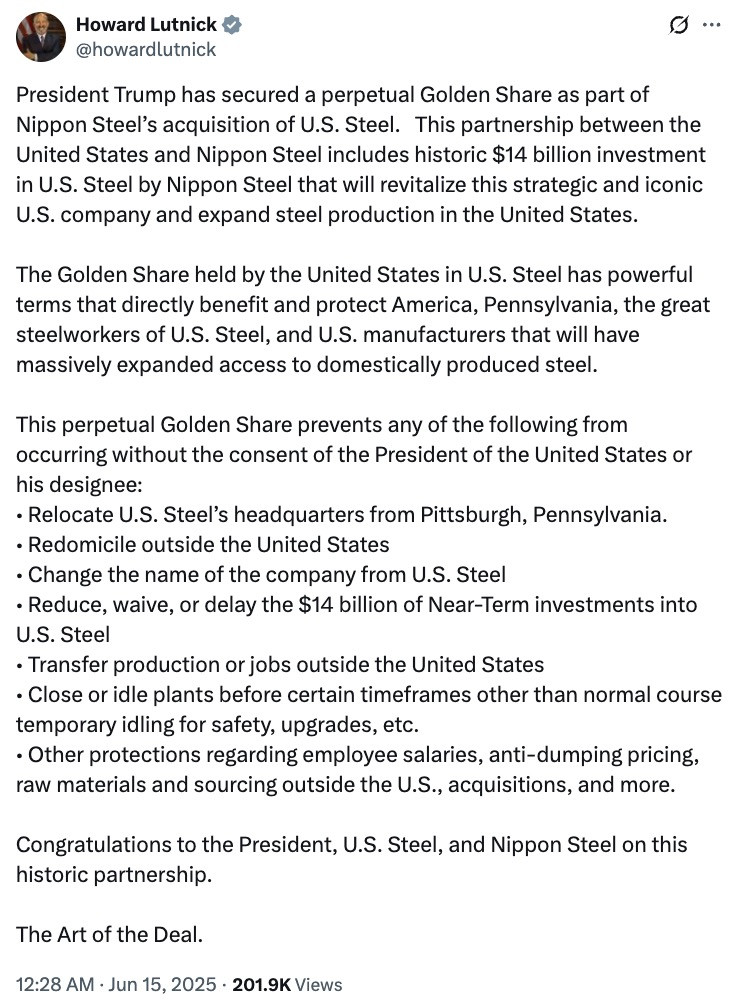
Still, the operational reins will largely remain in Japanese hands. According to Japan’s Yomiuri Shimbun, a senior Nippon Steel executive said, “We will have 100% of the voting rights in U.S. Steel, so management freedom will be maintained.”
The company has also pledged to invest $11 billion in U.S. operations by 2028, with total combined capital expenditures—including projects beyond 2028—estimated to exceed $14 billion.
Market Reaction
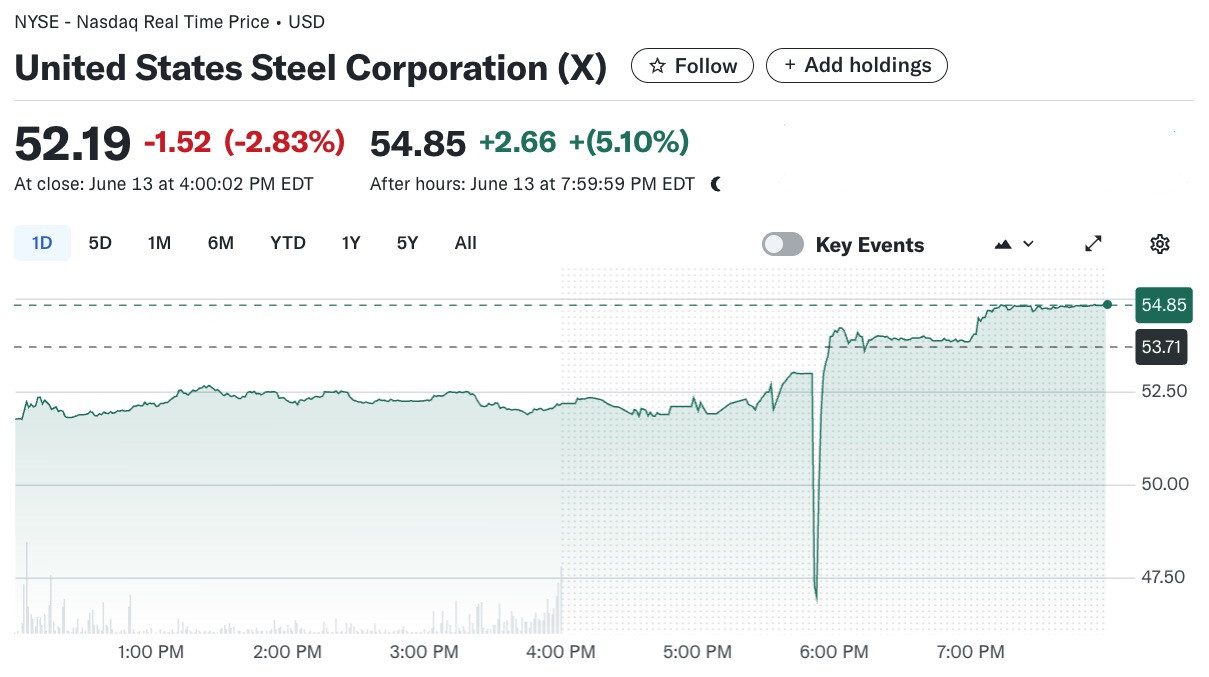
Investors welcomed the news. Following the announcement, U.S. Steel ($X) shares jumped 5.10% in after-hours trading last Friday, reflecting optimism that the deal will now proceed swiftly.
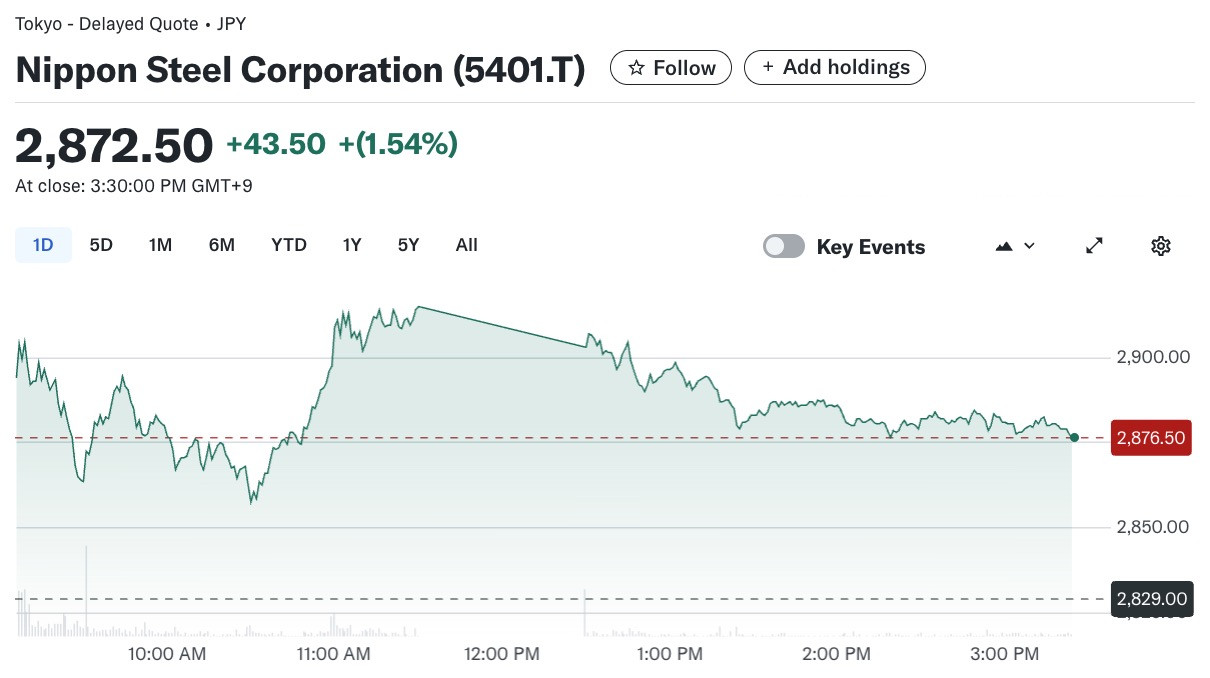
Meanwhile, shares of Nippon Steel Corporation (5401.T) closed up 1.54% in Monday’s Tokyo trading, reflecting investor confidence in the company’s overseas growth strategy and the potential synergies from the U.S. Steel acquisition.
The Strategic Implications
Japanese media have hailed this deal as the final piece in Nippon Steel’s “Steel Triangle” strategy—anchoring its operations across Japan, India, and the United States.
The company secured its Indian footprint in 2019 through a joint acquisition of Essar Steel with ArcelorMittal. With the U.S. now added to the mix, Nippon Steel is placing big bets on two of the world’s largest—and most strategic—steel markets.
Why the U.S.? Because it remains the world’s largest market for high-end steel, particularly in sectors like automotive, aerospace, and defense. These industries demand advanced, high-performance steel—and the U.S. government is doubling down on domestic supply. Just recently, tariffs on imported steel and aluminum were raised from 25% to 50%, signaling stronger protectionism.
This isn’t just a buyout. It’s a long-term strategic investment. Nippon Steel’s $14 billion commitment underscores its intent to become a leading player in U.S. steel manufacturing, not just a foreign parent company.
Global Industry Impact
According to the World Steel Association, Nippon Steel produced 43.6 million tons of crude steel in 2024, ranking fourth globally. U.S. Steel, with 14.2 million tons, came in at 29th. Combined, they begin to rival China’s Ansteel Group, the world’s third-largest producer.
This merger may not make daily headlines, but it represents a quiet reshaping of the global steel industry. It also reflects deepening economic alignment between Japan and the U.S., especially around critical supply chains and industrial resilience.
As Japan’s domestic economy matures and domestic demand stagnates, the global expansion—particularly into the U.S. and India—looks both timely and necessary.
My Take
This deal isn’t just about steel. It’s about geopolitics, national security, and a new era of cross-border M&A.
The golden share mechanism signals how national security has become a key filter for foreign acquisitions in strategic sectors. But it also shows that the U.S. remains open to international investment—if the right guardrails are in place.
From an investor standpoint, this could bring greater efficiency and profitability to U.S. Steel, especially with Nippon Steel’s R&D capabilities and operational expertise. The wildcard? Whether the golden share will constrain real autonomy.
This won’t grab as much attention as Nvidia or Apple—but in terms of global industrial strategy, it’s huge. Japan is quietly reasserting itself as a heavyweight in strategic industries. And it’s doing so with a long-term mindset and relatively little noise.
#Breaking Macro Events: Market Impact & Analysis#$United States Steel Corporation(X)