
Palantir Hits an All-Time High — Is There Still Upside Left?

Shearing sheep
June 17, 2025
GoGPT Summarizes Articles
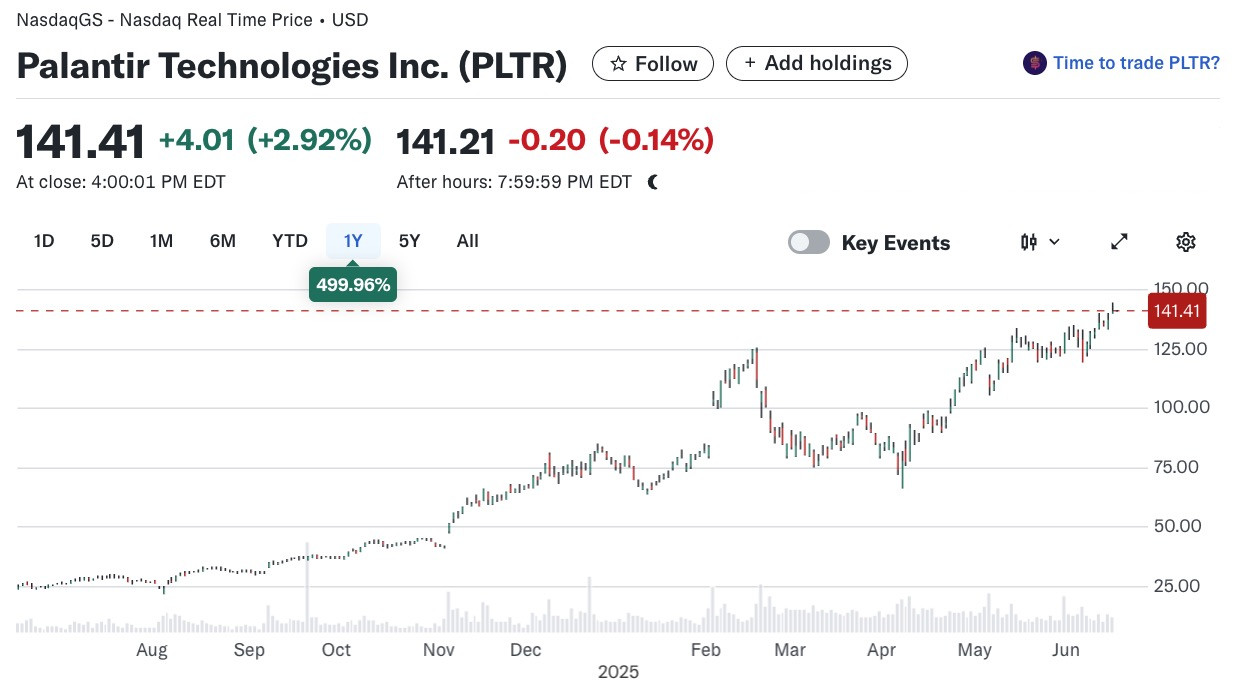
Palantir Technologies ($PLTR) hit a new all-time high on Monday, closing at $141.41 after gaining another 2.92%. The stock has now surged nearly 500% over the past year—making it the top performer in the S&P 500 so far in 2025.
What’s Behind the Surge?
The rally isn’t just driven by momentum—it’s backed by a steady stream of bullish developments:
1. New Partnerships Across Industries
Just last week, Palantir announced a strategic partnership with Italian specialty paper maker Fedrigoni, which will use Palantir’s AI platform to accelerate its digital transformation. While it may seem like an unlikely pairing, this collaboration highlights how Palantir’s AI tools are expanding beyond tech and defense—reaching even traditional sectors like manufacturing. It reflects Palantir’s broader ambition to become indispensable across old-economy industries.
2. Strong Financial Performance
In its most recent earnings report, Palantir posted a 39% year-over-year increase in customer count and raised its full-year revenue guidance. The company reported Q1 revenue of $634 million—beating Wall Street expectations—and net income of $106 million, marking its sixth consecutive quarter of GAAP profitability.
These numbers confirm that Palantir’s transition beyond its government roots is well underway. Its commercial business, once a minor segment, is now delivering double-digit revenue growth, while government contracts—still accounting for over half of total revenue—continue to provide a stable foundation.
3. AI Adoption and the National Security Narrative
Palantir’s AI platform is now used not just in defense, but in fraud detection, logistics, and compliance. For example, the company has rolled out an AI-powered anti-fraud initiative in partnership with Fannie Mae. Its data integration platform, Foundry, is now deployed across multiple U.S. government agencies, including DHS, HHS, and reportedly the IRS and SSA.
With rising geopolitical tensions and surging global defense budgets, many investors now view Palantir as a national security tech play—a company positioned at the intersection of defense, data, and AI.
Why Traditional Valuation Might Miss the Point
At first glance, Palantir’s valuation looks extreme. Its forward price-to-earnings ratio exceeds 200, while projected 2024 revenue is about $2.9 billion, with a net margin around 16%.
Those numbers would make any value investor wince. Still, Palantir isn’t your typical SaaS business.
It’s more like mission-critical AI infrastructure. Think of it as an operating system for high-stakes decision-making in governments and Fortune 500 companies. For that reason, many investors argue that conventional metrics fail to capture its long-term strategic value.
One key metric that often flies under the radar is RPO—Remaining Performance Obligations. These are revenues already committed through long-term contracts, and they’ve been growing especially fast in Palantir’s U.S. commercial segment. While not always discussed in headlines, RPO offers a clearer picture of future revenue visibility—and that’s something institutional investors are increasingly watching.
Still, optimism doesn’t mean it’s risk-free. A premium valuation leaves little room for missteps.
Risks Still Linger
For one, the stock’s sky-high valuation means expectations are priced for near-perfection. Most Wall Street analysts remain cautious, with Bloomberg data showing a consensus closer to neutral than bullish. Jefferies, for instance, pegs Palantir’s fair value at just $60—less than half of its current trading price.
Even strong earnings don’t guarantee a rally. In the most recent quarter, despite beating estimates, PLTR shares dropped 9% in after-hours trading.
The reason? The beat wasn’t big enough. With the stock already up several hundred percent, the margin for disappointment is razor-thin.
Palantir also continues to rely heavily on government contracts, which account for roughly 55% of total revenue. While this provides stability, any shifts in U.S. fiscal policy or changes in administration priorities could negatively affect future growth.
And international commercial expansion remains a soft spot. Revenue from overseas commercial clients fell 5% year-over-year and 11% quarter-over-quarter, with Europe proving particularly slow to adopt AI.
Still Eyeing Global Opportunities
That said, Palantir isn’t ignoring global growth. The company recently deepened its partnership with South Korea’s KT Corp to support AI-driven transformation in Korea’s financial and telecom sectors. It’s also developing training and certification programs to help clients better internalize AI—part of its strategy to embed Palantir’s platform more deeply within organizations.
Beyond its core business, Palantir’s founding team is making waves elsewhere. Co-founder Joe Lonsdale is reportedly teaming up with Oculus creator Palmer Luckey to launch a crypto-friendly neobank for Silicon Valley elites, dubbed “Erebor.” While this venture is unrelated to Palantir itself, it underscores the broader ambition of its founders in shaping the tech infrastructure of tomorrow.
Final Thoughts
Palantir isn’t a stock for everyone. Its current valuation is steep—no question. But for many investors, the real bet is on the future: a world where Palantir becomes the default AI operating system for both public and private sectors. Whether that vision comes true will hinge on continued execution, global expansion, and broader AI adoption.
One thing’s for sure: in a world increasingly shaped by data and algorithms, Palantir isn’t going away anytime soon.
#Market Spotlight: The Stories Driving Today’s Trading#$Palantir Technologies Inc. Class A Common Stock(PLTR)