
The US Just Passed Its First Stablecoin Bill and That Changes Everything

On June 17, 2025, the US Senate officially passed the GENIUS Stablecoin Act—marking the first major federal move to regulate stablecoins.
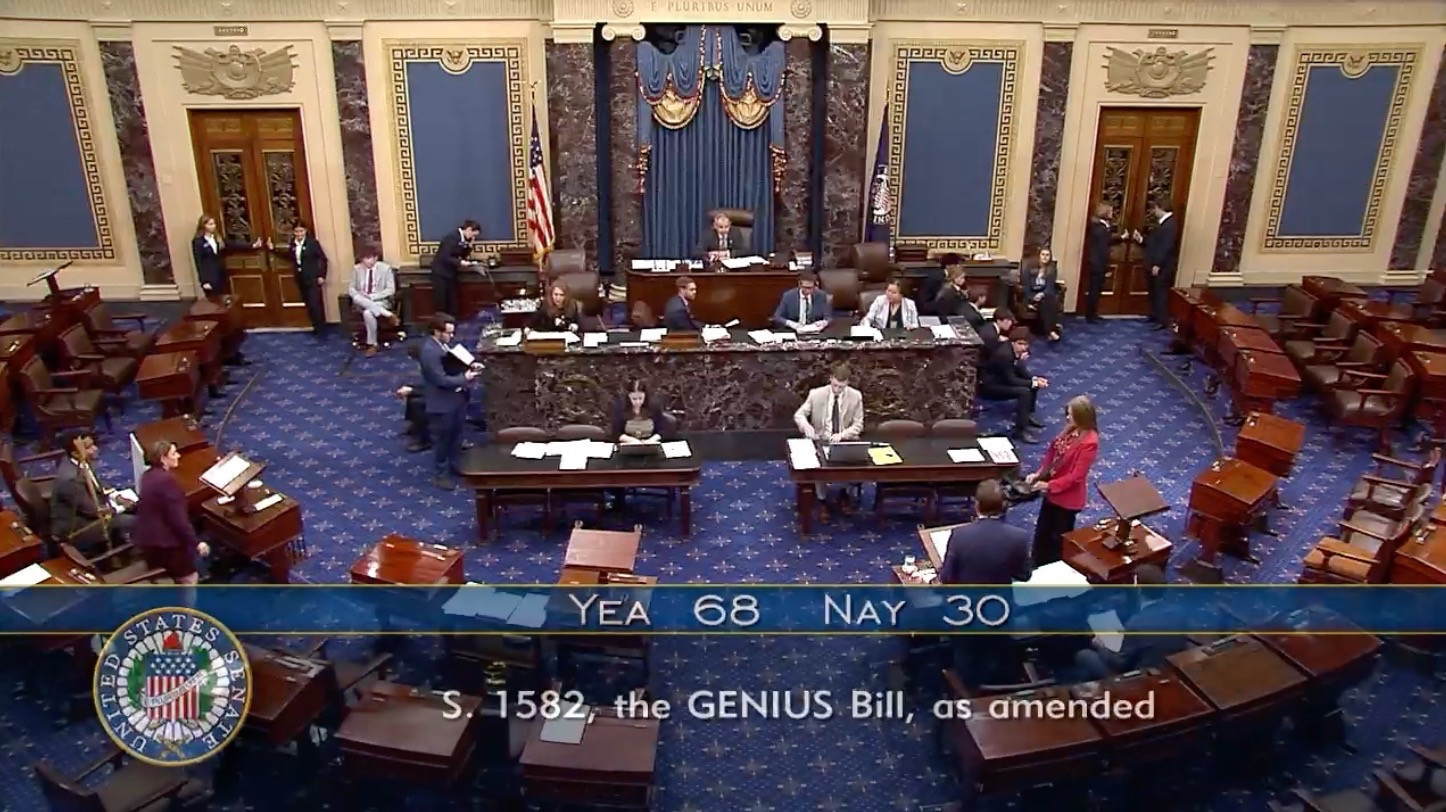
But the journey is far from over. A competing bill is waiting in the House of Representatives, and the real battle is just getting started.
What exactly is the GENIUS bill trying to do
The full name of the bill is the Guiding and Establishing National Innovation for U.S. Stablecoins Act. Sounds like a mouthful, but at its core, it’s about laying down the rules for how stablecoins are issued and regulated in the US.
In case you’re new to this: stablecoins are digital assets pegged to fiat currencies (mostly the US dollar). Think USDT or USDC—tokens that promise 1-to-1 convertibility with the dollar. They’re fast, easy to transfer like crypto, but less volatile, which makes them one of the most essential tools in the world of digital payments and blockchain finance.
What the GENIUS bill aims to do is bring these stablecoins under official regulatory oversight.
Here are the bill’s three main pillars:
• Full reserve backing: Issuers must hold 100% reserves so users can redeem their coins anytime.
• Consumer protection: Measures to safeguard users in case of hacks, bankruptcies, or other disasters.
• Federal oversight: Large issuers will be required to comply with federal regulations—not just state-level rules.
Why this is more about politics than tech
The bill was co-sponsored by a bipartisan group of senators—Republicans Bill Hagerty and Tim Scott, along with Democrats Kirsten Gillibrand and Cynthia Lummis. That’s important. It signals that stablecoins are no longer just a niche crypto issue, but a real financial and policy priority across both parties.
Still, the bill now heads to the House, where it faces competition from the STABLE Act—another stablecoin proposal with similar goals but very different approaches:
• Who gets to issue stablecoins?
• Should regulation be federal or left to the states?
• Are tech giants restricted enough?
It’s like two rival scripts trying to make it into the same blockbuster movie. Eventually, someone will have to write a final version everyone agrees on.
Getting this far wasn’t easy
Here’s how the GENIUS bill made it through the Senate:
• March 13: Cleared the Senate Banking Committee (18–6 vote)
• May 21: Passed a cloture vote, breaking a potential filibuster (66–32)
• June 17: Officially passed the full Senate
Now it’s up to the House, which has three options:
1. Pass the Senate version as-is (unlikely)
2. Pass a revised version (more likely)
3. Do nothing (especially possible during election season or heated budget talks)
If the House changes anything, the bill will return to the Senate for reconciliation—which could drag things out even longer.
Why this matters for the bigger picture
First, it’s a clear sign that governments are finally stepping in to regulate stablecoins seriously.
Even though stablecoins look like a tech innovation, they raise deep questions about monetary sovereignty and financial control. Just imagine using US dollar-backed stablecoins in a country with high inflation—you’re bypassing the local currency altogether. Naturally, Washington wants a say in how these “dollar shadow coins” operate.
The GENIUS bill is about bringing stablecoins into the official US monetary system and setting global standards while doing it.
Second, this could be a major turning point for the industry.
The stablecoin space has long been a gray zone. Tether (USDT), for example, is based in the British Virgin Islands and has faced constant scrutiny over its transparency. USDC, by contrast, is issued by Circle, a US-based firm that’s actively seeking regulation.
If this bill passes, the biggest winners won’t necessarily be the biggest players—but the ones most willing to comply. Think full reserve audits, transparency, and federal licenses.
In other words, being the “teacher’s pet” might finally pay off.
But there are concerns too
Some industry watchers have already flagged a few red flags:
• Barriers to entry: If compliance costs are too high, only big tech or big banks will survive—killing smaller innovators.
• Overregulation risks: Too many rules might crush the very DeFi and crypto-native innovation that stablecoins enabled in the first place.
• Weaponizing the dollar: If the US starts labeling certain stablecoins as “official” and others not, what happens to global trust? Could other countries accelerate their own central bank digital currency (CBDC) programs to push back?
My take on what’s coming
I think the GENIUS bill is likely to pass—maybe with some tweaks and delays—but the direction is clear. Stablecoins are being rebranded from gray-market tools into white-labeled US dollar assets. And the US wants to decide who gets the license to print these digital dollars.

✅ It’s part of a bigger US crypto strategy
From Bitcoin ETFs to this bill, the US is clearly moving toward integrating crypto into its financial system—not banning it, but setting rules. That sets a global example. Europe, Japan, and Singapore may soon follow with their own regulatory frameworks.
This isn’t just about crypto. It’s about digital financial sovereignty and geopolitical influence in the era of programmable money.
✅ We’re entering a new phase
In the short term, we’ll see political back-and-forth. But once the direction becomes clear, I expect:
• USDC and other compliant stablecoins to appear in more financial products (ETFs, money market funds, centralized exchanges)
• Growth in total stablecoin market cap, which could boost Bitcoin and Ethereum trading volumes
• A shift toward compliance-driven valuations, where DeFi projects that are audit-friendly and regulation-ready get more investor attention
In particular, Ethereum-based DeFi platforms may benefit from this push toward legal clarity.
If you’re into digital finance or curious about how crypto policy could reshape our wallets, follow along. I’ll be diving deeper into the stories shaping the future of money.