
Will Netflix's Stock Rise Again as Squid Game Final Season Premieres?

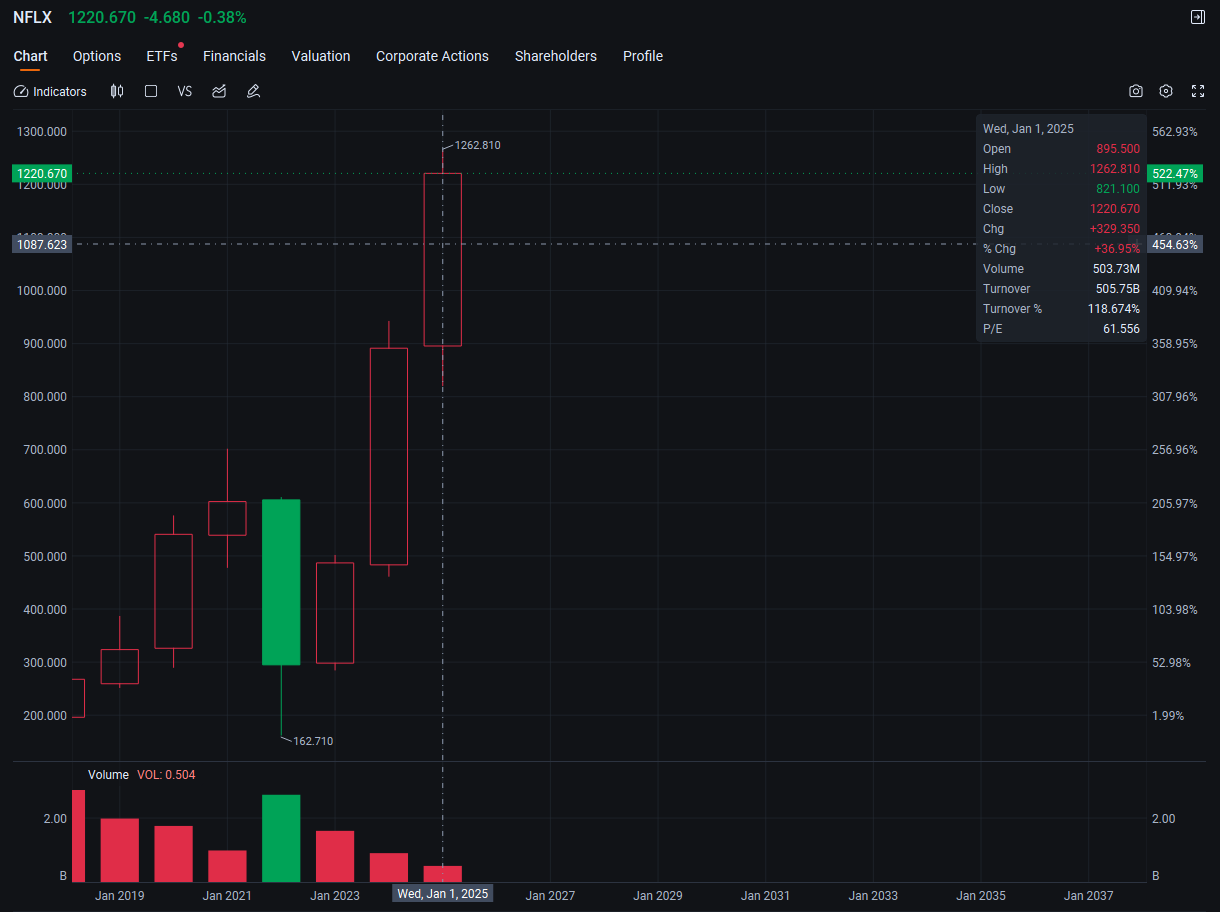
The final season of Squid Game is set to premiere in a few days, and Netflix's stock price has surged nearly 120% over the past two years.
Some time ago, I was pondering: What kind of investment do investors dream of?
Some say it’s those stocks that double overnight, but for such companies, either you realize their potential too late, or their success is short-lived.
Others say it’s companies that offer stable dividends, where you can "make money while lying down."
However, such companies often lack upward potential, and it takes a decade or even two to see significant growth.
I believe that for ordinary investors, the truly dream investment should be a company that not only has remarkable growth potential but also rises steadily, allowing for worry-free investment. In my view, Netflix currently fits this description.
Netflix's Moat
The streaming industry itself is highly competitive, similar to Texas Hold'em—where the strong dominate and keep winning.
Netflix now boasts the largest user base, the biggest content library, and the best content. Its content attracts users, users generate revenue, and revenue fuels content creation—a self-sustaining flywheel.
Combined with economies of scale, this flywheel means Netflix's snowball will only grow larger in the future.
The company has spent 15 years building an incredibly strong moat.
In 2010, Netflix welcomed its first historical content blockbuster: Breaking Bad. This series completely opened up the market for Netflix, driving rapid expansion and a surge in subscribers. In just one year, the stock price quintupled.

However, the good times didn’t last. As user numbers grew, copyright holders partnering with Netflix grew envious and began jacking up prices. For example, the copyright fee for Friends soared to $100 million.

Other streaming platforms, eyeing Netflix’s success, also entered the game—Disney, HBO, etc.—and pulled their content from Netflix.
Facing this threat, Netflix CEO Reed Hastings decided to invest in original content to break free from reliance on content producers.
Through data analysis and modeling, Netflix decided to spend $100 million on its first original series: the later world-renowned House of Cards. Upon release in 2013, the show became a phenomenon, bringing 3 million new subscribers to Netflix in a single quarter.

After House of Cards, Hastings’ investment in original content snowballed: $100 million for the first season, nearly $5 billion by 2013, $7.5 billion in 2014, $8.5 billion in 2015, and $17 billion by 2020.
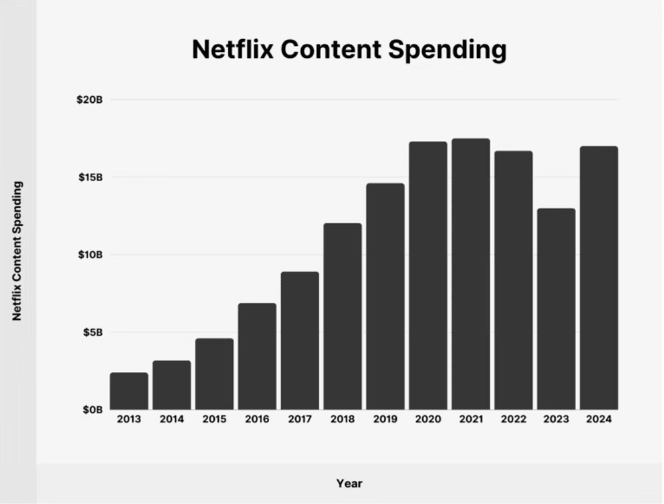
Since then, Netflix has transformed from a content-distribution streamer to an original-content powerhouse, with original works now accounting for over 50% of its library—a strategy that continues today.
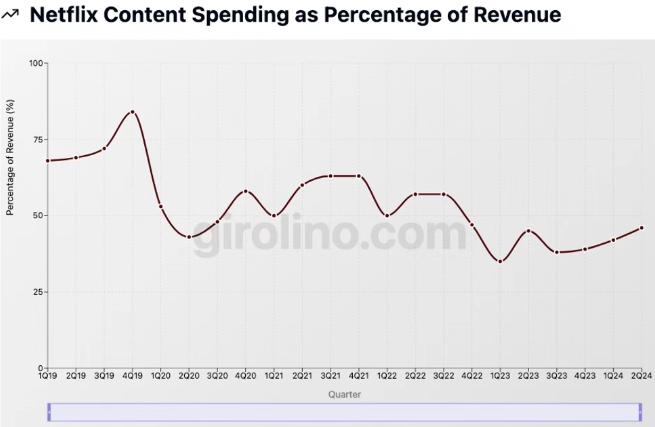
Since House of Cards premiered in 2013, Netflix’s subscriber base has exploded from 1.8 million to 300 million today—a 16-fold increase. Revenue has grown from $2 billion to $40 billion (20x), while the stock price has soared 150-fold.
Can Netflix Keep Rising? A Blockbuster-Filled Second Half of the Year
This second half marks Netflix’s strongest ever content lineup:
Squid Game Final Season premieres at the end of June.

Wednesday Season 2 drops in September.

Stranger Things Season 5 arrives in November.

Add in Adam Sandler’s new film Happy Gilmore 2, the Knives Out sequel Wake Up Dead Man, the Taylor & Serrano boxing special, and Christmas NFL games...
Netflix has mastered the art of creating "event-level content" to drive traffic surges. Blockbusters are no longer a matter of luck for Netflix—they’ve become the norm.
Thus, Netflix’s growth now relies not on money-burning hits, but on its long-accumulated high-quality content and a systematic ability to consistently produce blockbusters. Financially, this translates to sustainable positive cash flow.
Technologically, Netflix isn’t on par with Silicon Valley’s top tech firms; creatively, it doesn’t rival legacy studios; and financially, it can’t match the biggest tech giants.
But it remains the only streaming company in the market that has weathered negative cash flow and losses to achieve sustainable growth. Others are still losing money and burning cash to chase hits.
I love companies with deep moats, and Netflix today reminds me of Costco in its prime—absolute market dominance grants it unmatched bargaining power, allowing it to drive growth through price hikes easily.
In the future, Netflix can steadily expand: entering new regions, creating fresh content, and testing new technologies.
For now, I see Netflix as a long-term hold—no need to time the market, a company you can hold for over a decade.$NFLX
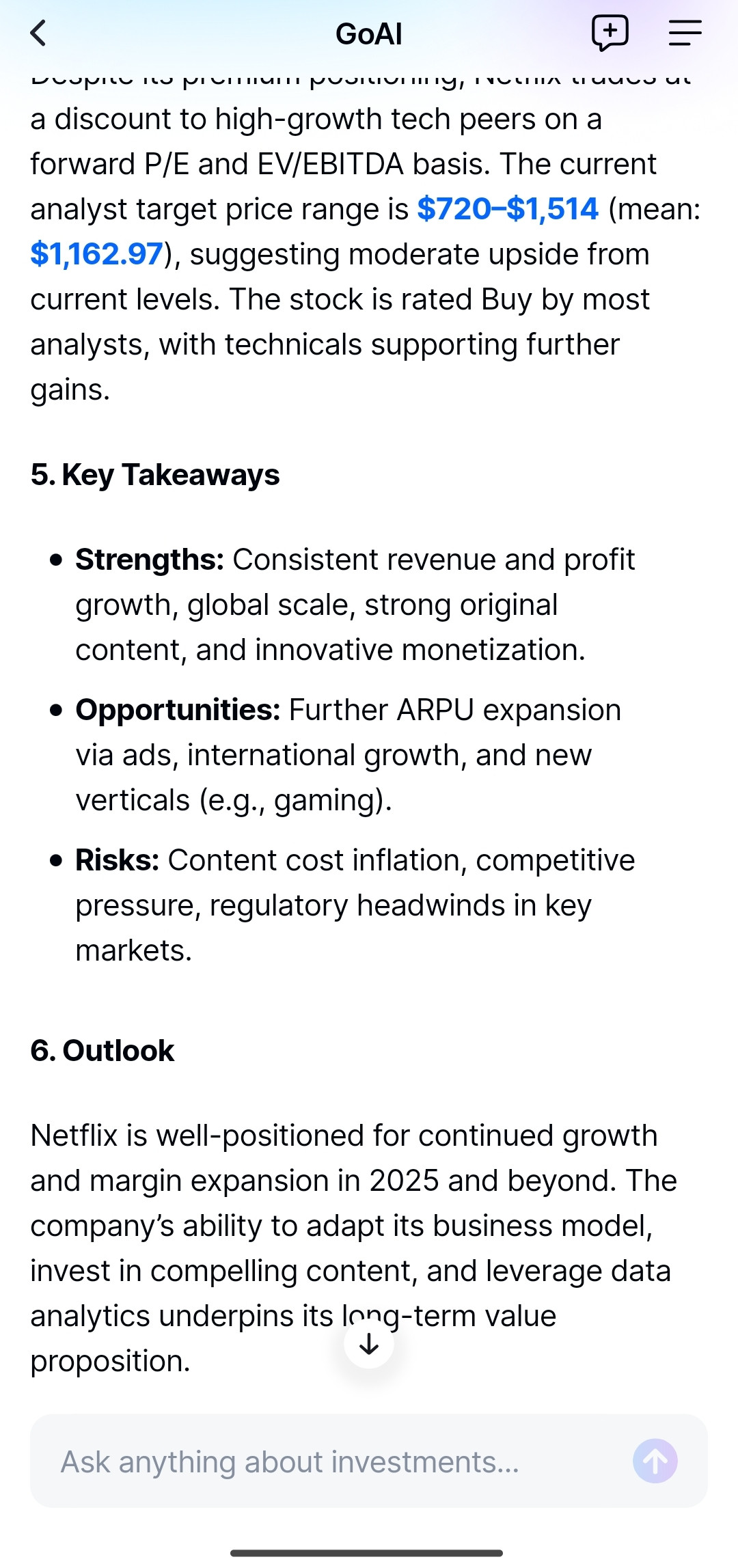
Finally, Go AI has reached the same conclusion as I did.