
Trump Announces Ceasefire Between Iran and Israel: How the Markets Are Reacting

On Monday night, President Trump took to social media to announce that Iran and Israel have agreed to a ceasefire, effectively ending a conflict that had lasted for 12 days. This announcement came just hours after Iran launched missiles at the largest U.S. military base in the Middle East, adding fuel to the already volatile situation. But what does this ceasefire mean for global markets? Let’s break down the events and see how the markets are responding.

The Background: Missiles and Ceasefire
1) Missiles and Escalating Tensions
Iran fired missiles at the Al Udeid Air Base in Qatar, a key U.S. military installation, though fortunately, there were no casualties. This missile strike was seen as a direct retaliation for U.S. airstrikes on Iranian nuclear facilities. The attack pushed the geopolitical tension in the region to a boiling point.
However, surprisingly, President Trump soon announced that Iran and Israel had agreed to a ceasefire, with the cessation of hostilities set to begin in phases on Tuesday. Iranian Foreign Minister Abbas Araghchi confirmed that Iran would stop its attacks if Israel ceased bombing by the agreed deadline.
2) Qatar’s Role in Mediation
Qatar played a key role in mediating the ceasefire agreement. With its neutral stance and diplomatic ties to both Iran and the U.S., Qatar helped facilitate communications, preventing the conflict from spiraling further. Iran had reportedly warned the U.S. about the missile attack in advance, giving everyone a chance to prevent casualties and make way for a ceasefire.
Trump expressed his appreciation for Iran’s heads-up, saying that it was this early warning that prevented any loss of life and paved the way for peace talks.
Market Reaction: Geopolitical Risks Shake Up the Markets
1) Oil Prices Take a Hit: A Sudden Drop in Crude
Geopolitical tensions in the Middle East often cause fluctuations in oil prices, and this situation is no exception. The uncertainty surrounding the Strait of Hormuz, a critical oil shipping route, had initially caused concerns that oil supplies might be disrupted, pushing oil prices higher. However, with the announcement of the ceasefire, market sentiment eased, and Brent Crude prices dropped sharply by 9%, falling to $69.86 a barrel.
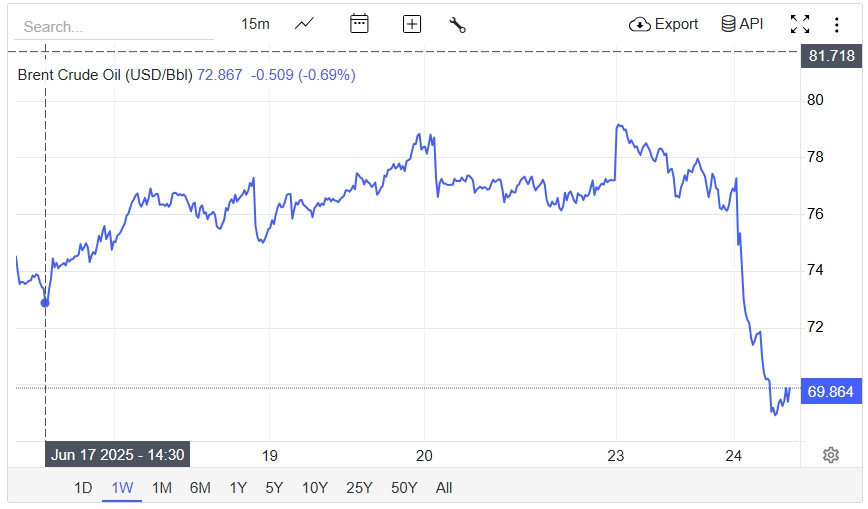
Short-term oil prices will likely continue to be influenced by the region’s political stability. While the drop in prices might indicate some relief, if tensions resurface, oil could quickly climb back above the $80 per barrel mark.
Analyst Insight: The volatility in oil prices underscores how sensitive the market is to geopolitical developments. Investors should stay alert for any changes in the political landscape that could push oil prices either higher or lower in the short term.
2) Gold Rises Slightly: Safe-Haven Demand Remains Strong
Gold, as a traditional safe-haven asset, saw a slight increase of 0.4%, reaching $3,381.70 per ounce as investors sought stability amid the geopolitical uncertainty. Even though the ceasefire provided a temporary calm, the long-term risks associated with the Middle East conflict keep gold in demand as a hedge against economic and geopolitical turmoil.
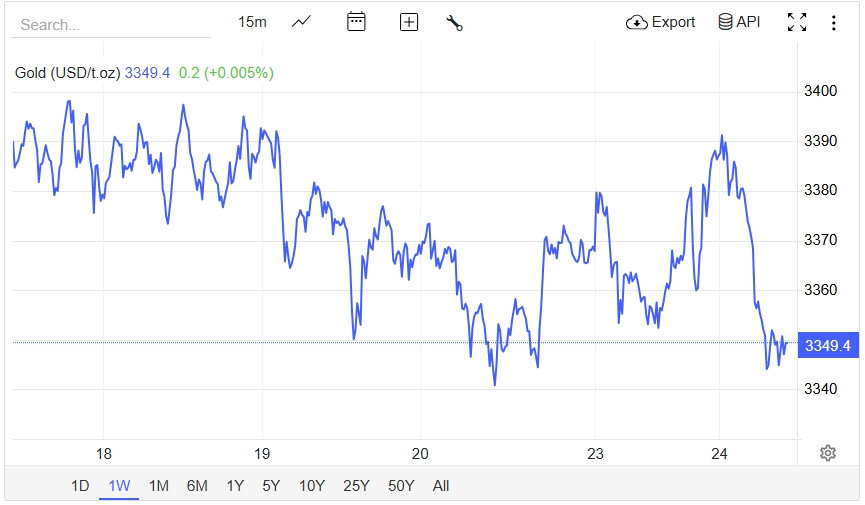
Analyst Insight: Gold may continue to hold above the $3,300 per ounce mark for the foreseeable future, especially if geopolitical risks remain in place. Investors are likely to turn to gold whenever there’s uncertainty in the global market.
3) U.S. Stocks Rebound: Investor Sentiment Picks Up
With the potential for a de-escalation in tensions, U.S. stocks saw a positive reaction. The $DJI rose by 0.9%, the $SPX gained 1%, and the $IXIC climbed by 0.9% overnight. The announcement of a ceasefire boosted investor confidence, particularly in the energy and tech sectors, which had been under pressure in recent days.
Analyst Insight: While the stock market is showing signs of recovery, it’s important to keep in mind that the geopolitical risk isn’t fully gone. Even if there’s a short-term rally, the market will likely remain jittery if tensions flare up again in the Middle East.
Looking Ahead: Will the Ceasefire Hold?
Although the ceasefire has provided a temporary pause in hostilities, there’s still significant uncertainty about whether Iran and Israel can resolve their issues for good. Israel continues to carry out airstrikes, and nuclear talks have stalled, meaning the underlying causes of the conflict are far from settled.
Long-Term Market Implications:
-
Oil Prices: Oil prices will likely continue to be impacted by political events in the region. If U.S.-Iran tensions rise again, oil prices could surge, especially if the Strait of Hormuz becomes a flashpoint.
-
Gold: Gold will remain a popular safe-haven asset as long as geopolitical and economic risks persist. The precious metal is expected to stay elevated in the face of uncertainty.
-
U.S. Stocks: The U.S. stock market may continue to show resilience in the short term, but long-term volatility remains a possibility due to the unresolved issues in the Middle East.
Conclusion
While the ceasefire has temporarily cooled the situation, the geopolitical risks in the Middle East are far from over. As tensions in the region continue to shape the global economic landscape, investors will need to stay on top of market changes. Monitoring oil prices, gold movements, and stock market trends will be key to navigating the coming weeks.