
The Market Faces July Risks, S&P 500's Bounce Could Be Tested

The U.S. stock market may face a period of turbulence in July, even though historically, July is one of the strongest months for the S&P 500. As the market enters the second-quarter earnings season, which could be pivotal for its future, a number of risks tied to President Trump's agenda are expected to surface.
Trump has consistently delayed making final decisions, and the massive fiscal package he pushed for earlier this year still needs to go through a complex process before it can be passed. This means that July will bring a series of critical deadlines. These deadlines are not just crucial for the U.S. stock market, but could have global implications as well.
Will Seasonal Growth in July Help the Stock Market?
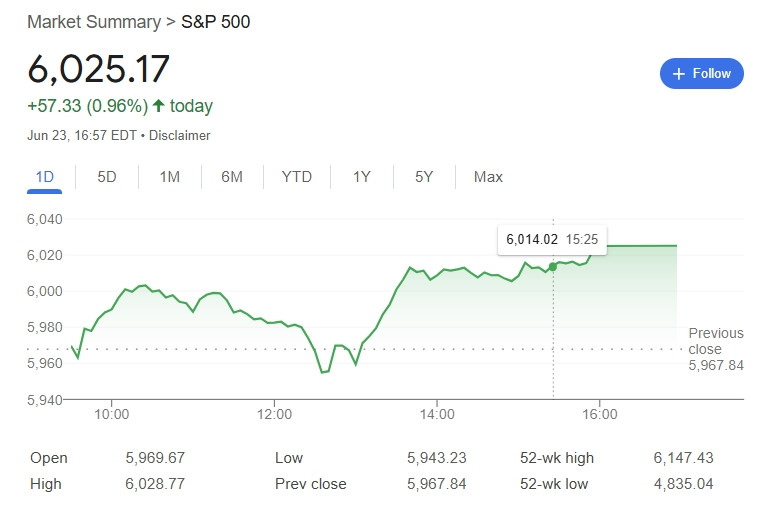
According to Dow Jones market data, July has historically been a strong month for the S&P 500. Since 1950, the index has risen 45 times in July, with an average gain of 1.3%. With the spring rebound coming to a close, the S&P 500 has risen more than 20% from its low in early April. However, the index has only risen 0.5% in the past month. At this point, the seasonal trend in July could provide some support for the market.
Key Fiscal Decisions Coming in July
The first risk point for July will come on July 4, when the Senate hopes to reach an agreement on the Republican tax and spending bill, aiming for a vote before the summer recess. This bill is expected to increase the U.S. federal deficit by about $3.4 trillion over the next decade and raise the national debt ceiling by $500 billion. The bill must pass both chambers of Congress, or it could lead to the Treasury facing the risk of default later in the summer.
The bond market is highly sensitive to the deficit and debt ceiling. If the Senate's version of the bill differs too much from the House's, it could lead to significant volatility in the bond market, pushing up bond yields and putting pressure on the stock market.
Changes in Tariff Policies
Another key risk will come on July 9, when the 90-day suspension of "reciprocal tariffs" put in place by the president in April will expire. If agreements are not reached in the coming weeks, this could trigger widespread tariffs on major U.S. trading partners, or investors will have to wait to see if the White House will extend or exempt these tariffs once again.
Although no major agreements have been reached yet, many tariffs have been temporarily waived or delayed, and all parties seem to be searching for a common solution—at least at some point, an agreement may be within reach, according to Mark Malek, Chief Investment Officer at Siebert Financial.
Ceasefire Agreement Leads to Drop in Oil Prices
Oil futures dropped further after President Trump announced a ceasefire agreement between Israel and Iran, wiping out all the gains from earlier this month after the outbreak of hostilities. Earlier, benchmark domestic oil futures saw a sharp decline due to Iran's retaliation for U.S. bombings over the weekend, which targeted a U.S. military base in Qatar rather than energy infrastructure or oil tankers. Oil futures closed down 7.2%, at $68.51 per barrel.
This drop of $5.33 per barrel is the largest single-day decline since August 2022 in dollar terms. Percentage-wise, it's also the biggest drop since Trump announced the massive tariff policy in early April. The prospect of a ceasefire fueled further after-hours selling, with West Texas Intermediate oil futures falling another 5%, dipping below $65 per barrel.
The Crucial Role of Second-Quarter Earnings
On July 15, JPMorgan will be the first to release its second-quarter earnings report, kicking off earnings season. According to LSEG data, S&P 500 collective earnings are expected to grow 5.7% year-on-year, reaching $528.4 billion, compared to 13.7% growth in the first three months of the year.
Earnings data has been critical to rescuing the stock market. In early April, after hitting a low, the S&P 500 rebounded briefly, thanks to strong corporate earnings, especially from the so-called "seven tech giants," which contributed major gains to the index.
LSEG data shows that earnings growth for these tech giants was 16%, while other companies saw only a 4.3% increase. This highlights the dominant position of tech stocks in the market.
Investor Sentiment: Soft Landing and Earnings Growth
Brian Buetel from UBS Wealth Management notes, "The recent strong performance of the stock market reflects growing investor optimism about a soft landing, improvements in corporate earnings, and expectations of potential rate cuts." He believes earnings season could become the next market catalyst for investors.
Personal Viewpoint and Market Insight
From my perspective, while the seasonal factors in July might offer some support to the market, the political and economic uncertainties that follow are impossible to ignore. In particular, the series of decisions from the Trump administration could lead to significant volatility in global financial markets. The upcoming second-quarter earnings season could become a new breakthrough for the market. If corporate earnings continue their solid growth momentum, especially with tech stocks holding up, it could inject more confidence into the market. However, the current geopolitical tensions and shifting economic policies remain the biggest risks for the market.
In the end, investors need to remain cautious and not just focus on U.S. stocks but also closely monitor changes in the global economy. With July fast approaching, we may witness a storm involving U.S. fiscal policies, global trade, and energy prices—how the market reacts will be a crucial consideration for every investor.