
Circle Shares Fall Over 15% After BIS Issues Warning on Stablecoins

Shearing sheep
June 25, 2025
GoGPT Summarizes Articles
On Tuesday, the Bank for International Settlements (BIS), often referred to as the “central bank of central banks,” issued a strong warning on stablecoins, calling them a potential threat to financial stability and monetary sovereignty.
In a preview of its upcoming annual report, the BIS stated: “Stablecoins are inadequate as a reliable currency form and pose risks to financial stability and monetary sovereignty in the absence of regulation.”
BIS Highlights Three Major Concerns
1. Monetary Sovereignty
Dollar-pegged stablecoins could erode confidence in local currencies, especially in emerging markets, potentially triggering capital flight.
2. Transparency Issues
Concerns persist around the nature, quality, and location of reserves backing stablecoins. The BIS warned of a potential "fire sale" scenario if confidence collapses—similar to the TerraUSD (UST) meltdown in 2022.
3. Fragmentation of Payments
Unlike central bank money, stablecoins lack uniform settlement guarantees. BIS economic advisor Hyun Song Shin compared them to 19th-century private banknotes, which traded at varying discounts depending on the issuer’s credibility—a reflection of an unstable financial era.
The BIS’s message is clear: if stablecoins are to play a role in the global financial system, the current loosely regulated model will not suffice. “Stablecoins offer some promise on tokenization but fall short of requirements to be the mainstay of the monetary system when set against the three key tests of singleness, elasticity, and integrity.”
Market Reaction
The timing of the BIS warning was no coincidence. Just days earlier, the U.S. Senate advanced a bill to regulate dollar-linked stablecoins.
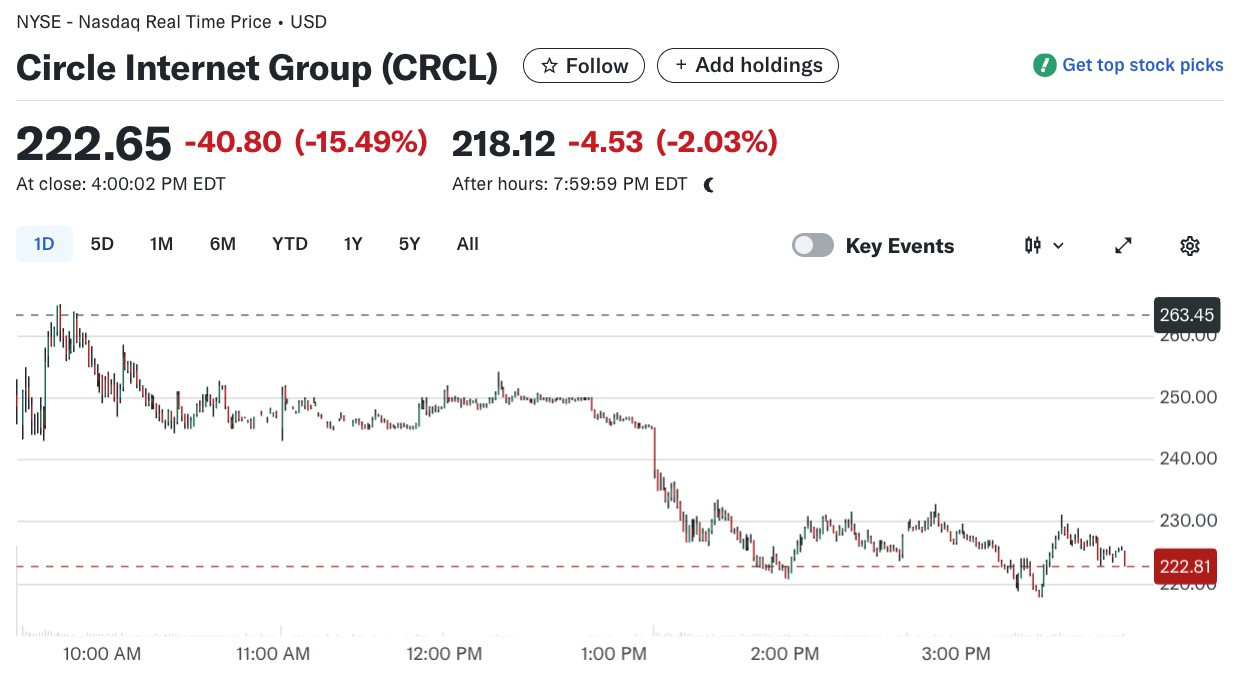
Markets reacted swiftly. Circle ($CRCL), the issuer of USDC, which is the second-largest stablecoin, plunged more than 15%, reflecting heightened investor concern. With dollar-pegged stablecoins making up over 99% of the $260 billion market, regulatory scrutiny is clearly intensifying.
Circle isn’t alone. Tether ($USDT), which dominates over 50% of the stablecoin market, has also faced ongoing scrutiny over its reserve transparency — and recently exited the EU market in response to new licensing requirements. Regulators are clearly turning up the pressure.
ARK Invest Sells Into Strength
Circle’s IPO was one of the most talked-about crypto listings in recent years. The stock skyrocketed from $31 to a high of $263.45 — a nearly 750% surge — pushing its market cap to $50 billion. With such a steep rise, some degree of profit-taking was to be expected.
Bloomberg analysts described ARK’s move as a “natural part of its strategy,” suggesting that the firm likely recovered most of its initial investment. Even after selling, ARK remains Circle’s 8th-largest shareholder.
Rising Valuation Concerns
Circle’s valuation is drawing increasing scrutiny. Its forward P/E ratio is approaching 180x, far above the S&P 500 average of roughly 22x.
Jefferies analyst Trevor Williams questioned whether stablecoins can meaningfully disrupt U.S. payments. He argued that stablecoins lack compelling advantages over existing card-based systems, which already offer speed, security, and rewards.
Similarly, RIA Advisors’ Michael Lebowitz described stablecoins more as “crypto-native money market tools” than true alternatives to major payment networks like Visa or Mastercard.
Further complicating matters, Circle’s public float stands at just 25%, compared to the S&P 500 average of around 95%. This limited float means Circle’s stock is more vulnerable to price swings as investor sentiment shifts.
BIS Pushes for CBDC Acceleration
The BIS didn’t just issue warnings — it called for action. It urged central banks to accelerate development of central bank digital currencies (CBDCs) and build programmable platforms that integrate reserves, commercial bank deposits, and government securities.
Such platforms would enable near-instant settlement, reduce transaction costs, and ensure central bank money remains the core of global payments infrastructure.
What’s Next?
Looking ahead, stablecoin regulation is likely to intensify. The recent U.S. bill may be the first step in a broader international effort to enhance oversight — especially regarding reserve audits, licensing requirements, and issuer transparency.
At the same time, central banks are clearly responding to the stablecoin threat by fast-tracking their own CBDC initiatives. Emerging markets, in particular, are likely to adopt digital currencies as a tool to strengthen monetary sovereignty and modernize payment systems.
Meanwhile, valuation volatility will remain a key risk for Circle and other crypto-linked stocks. With low public float, elevated expectations, and policy uncertainty, Circle’s share price could remain highly sensitive to news flow. Until regulatory frameworks mature and business models stabilize, investor sentiment is likely to stay fragile.
Bottom Line
Circle’s explosive rally made it one of the most high-profile crypto IPOs since Coinbase. But with the BIS sounding the alarm, Cathie Wood taking profits, and analysts raising red flags over utility and valuation, the path ahead looks increasingly uncertain.
Stablecoins promised stability — but now, they may become the next big battleground in the evolving global financial landscape.
#$Circle Internet Group Inc.(CRCL)#$USDT/USDT COINBASE(USDT)