
FedEx Earnings Reveal What’s Really Going On in the US Economy

Every time $FDX releases its earnings, I read the report right away. Not because the stock swings are dramatic, but because this company is something else entirely.

FedEx is one of the most sensitive indicators of the US economy.
This latest report paints a two-sided picture. Strong headline numbers that beat expectations—but management refused to give full-year guidance. The stock dropped over 5% after hours. Some call it a contradiction. I think it’s a perfect reflection of what the US economy feels like right now:
Stable on the surface but weakening underneath.
Why FedEx Is a Better Macro Gauge Than It Looks
To understand why FedEx says so much about the broader economy, you need to look at how its business works.
FedEx doesn’t just serve consumers. It’s a backbone of B2B logistics—moving goods for manufacturers, exporters, and cross-border e-commerce. Its Asia-Pacific routes, especially China to the US, are a proxy for global trade velocity.
This quarter, FedEx flagged a sharp drop in trans-Pacific shipping, particularly from China to the US—right after President Trump’s so-called “Liberation Day” tariffs were announced in April.
The company also took a $170 million hit to operating income due to those tariffs. That’s how directly macro policy shows up on FedEx’s balance sheet.
This is why Wall Street sees FedEx not just as a logistics stock, but as a macro barometer.
What the Numbers Say on the Surface Solid Results Driven by Cost Cuts
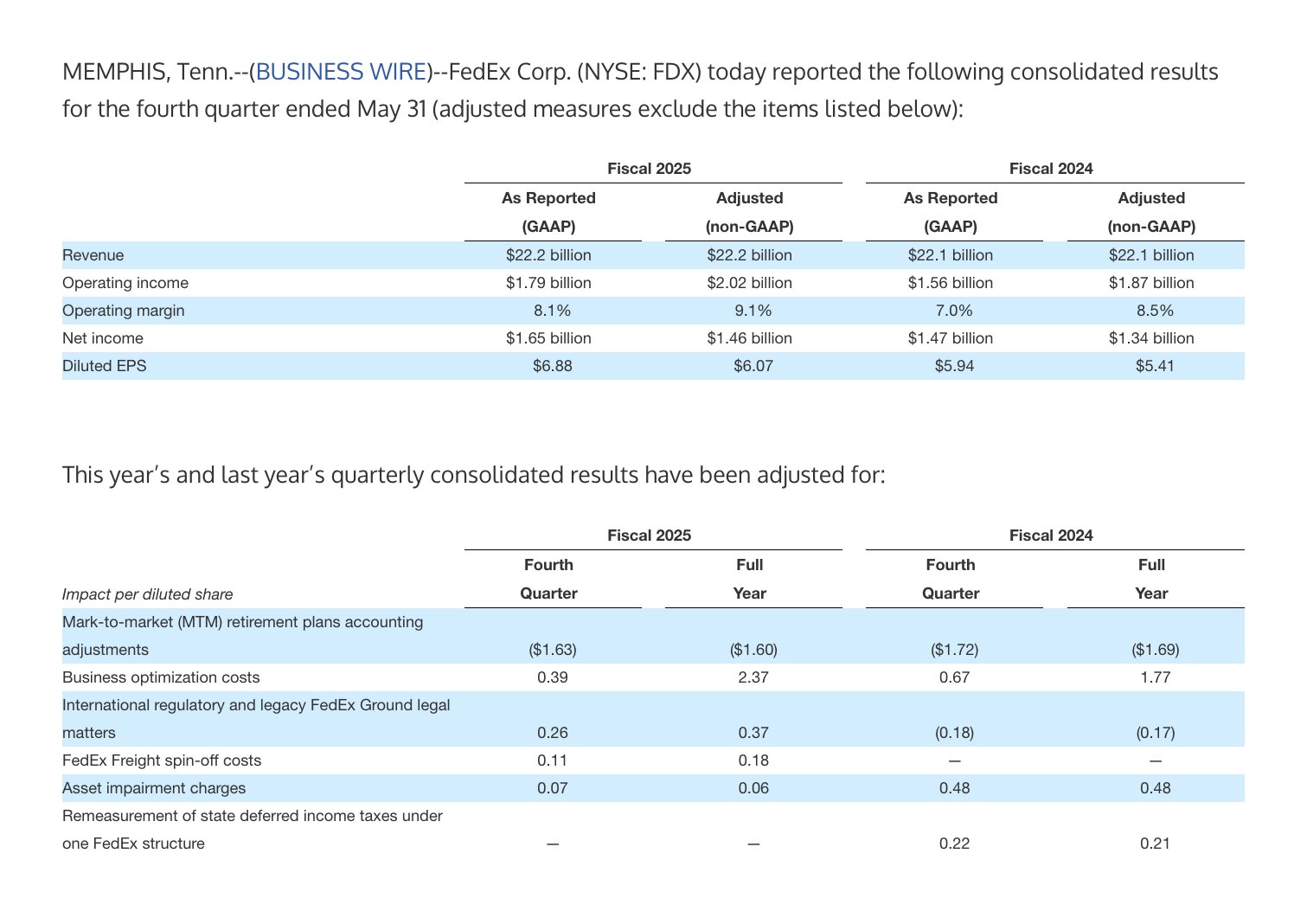
Let’s start with the top-line results:
-
Q4 revenue came in at $22.2 billion, beating expectations of $21.8 billion
-
Adjusted EPS was $6.07, above the $5.87 consensus
-
Daily package volume grew 5% year-over-year
-
US domestic volume rose 6%
These numbers look healthy. But the driver behind the earnings beat wasn’t revenue growth—it was aggressive cost control.
FedEx has been running a cost-saving initiative called DRIVE. So far:
-
$2.2 billion in structural cost reductions were delivered this year
-
12 aircraft were retired and routes trimmed in Q4
-
Capital expenditures were cut by 22% to $4.1 billion—the lowest capex-to-revenue ratio in company history (just 4.6%)
-
A European headcount reduction plan is underway, targeting $150 million in annual savings
In parallel, FedEx is also rolling out “Network 2.0,” aiming to cut another $1 billion in costs by fiscal 2026.
Translation: margins are holding up not because the business is booming, but because FedEx is squeezing every dollar out of its operations.
What’s Behind the Curtain Three Things This Earnings Report Tells Us About the Economy
1. Corporate confidence is slipping even if headline numbers aren’t
Here’s the big surprise: FedEx did not offer full-year earnings guidance. That almost never happens—especially from a company that prides itself on operational visibility.
Even its Q1 EPS guidance of $3.40 to $4.00 fell short of the $4.05 consensus.
In today’s world of “narrative management,” when a company refuses to tell a growth story, that silence speaks volumes.
A company that stops painting blue skies might be seeing storm clouds before the market does.
2. Global trade is softening especially between the US and China
The most important line in the entire earnings call? A “notable decline” in trans-Pacific shipping.
That means fewer goods are being shipped from China to the US.
The trigger? Trump’s latest round of tariffs. FedEx saw volumes fall sharply after the announcement, and they remained soft through May.
This tells us two things:
-
Global trade flows are highly sensitive to political risk
-
The US-China supply chain is cooling faster than expected
3. US domestic demand is holding up but losing momentum
Domestic package volume grew 6% in Q4, which is decent. But FedEx only expects 0–2% revenue growth next quarter.
Even they aren’t convinced that this bounce has staying power.
Zooming out, this fits the broader pattern we’re seeing in US macro data: retail sales are flat, e-commerce inventory levels are cautious, and manufacturing remains in a soft patch.
So yes, demand is there—but it’s being held up by habit more than strength.
From a Macro Lens This Is What a Pre-Stagflation Economy Looks Like
FedEx is telling us that the US economy right now is:
-
Growing slowly
-
Still absorbing inflation-related cost pressures
-
Navigating policy uncertainty
-
Facing weak business visibility
Put together, this looks like the early innings of a stagflation-lite environment—moderate growth, sticky costs, and fragile confidence.
That’s why FedEx’s report matters far beyond the logistics space.
Is FedEx a Buy at This Valuation Maybe but It’s Not That Simple
At first glance, FedEx looks cheap—trading at just 11x forward earnings, well below its historical average of 14–15x.
But here’s the catch: low multiples often reflect low growth visibility.
FedEx isn’t broken, but it’s fighting headwinds that are beyond its control—slowing globalization, e-commerce saturation, and unpredictable policy shifts.
Until those big-picture issues clear up, even strong quarterly beats might not be enough to win back investor conviction.
If you want to understand what’s happening in the real economy—not just the markets—read FedEx’s earnings report.
It may be about packages, but it’s delivering the pulse of the global economy.