
Nvidia Hits New High as Market Cap Tops the World Again

Nvidia has done it again.
The chip giant closed at an all-time high on June 26, with its stock up 4.33% to $154.31, bringing its market value to a staggering $3.77 trillion. That’s enough to reclaim the title of the world’s most valuable company, overtaking Microsoft — at least for now.
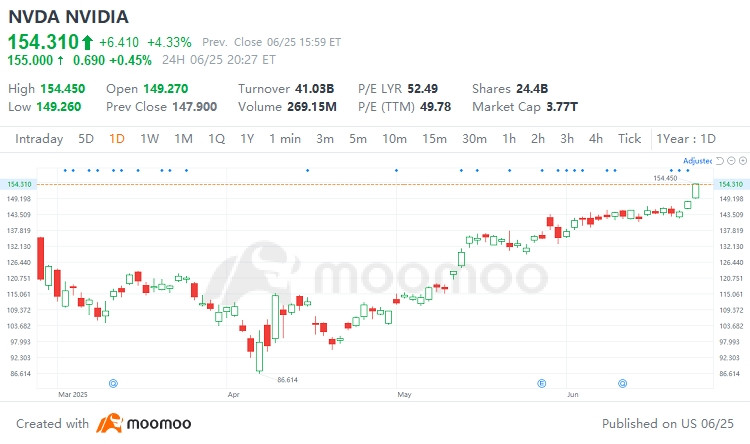
This time, though, it’s not just hype or lofty expectations driving the move. There’s a deeper, more solid reason behind Nvidia’s surge. From robust AI infrastructure demand to new business lines taking shape, investors are beginning to see something bigger in play.
So what’s really fueling Nvidia’s climb — and can it keep going?
A Strong Signal from the Supply Chain
Let’s start with something critical in the AI hardware world: memory chips.
$NVDA’s most important products — like the H100 and H200 AI accelerators — don’t work alone. They need high-bandwidth memory (HBM) to fully unleash their power. HBM chips are expensive, complex to make, and have been in short supply — creating a real bottleneck for the AI boom.
That’s why Micron’s latest earnings report was such a big deal. As one of the few global suppliers of HBM (alongside SK Hynix and Samsung), Micron plays a key role in Nvidia’s supply chain. Its stronger-than-expected results suggest that demand for HBM — and by extension, for Nvidia’s products — is holding up well.
In short: the “fuel” for Nvidia’s AI engines isn’t running out anytime soon. That’s a strong reason why the stock continues to rise.
A New Growth Engine in the Works
While Nvidia’s chips are still its main revenue driver, there’s a new business quietly gaining speed — and it could eventually become just as important.
The company’s DGX Cloud platform lets customers rent AI supercomputing power directly from the cloud, instead of buying expensive hardware. This kind of AI-as-a-Service model hasn’t made a big splash on Nvidia’s income statement yet, but it’s growing fast.
If it takes off, DGX Cloud could turn Nvidia into a major player in cloud computing — a space currently dominated by Amazon Web Services, Microsoft Azure, and Google Cloud.
This shift — from selling chips to selling services — could unlock an entirely new layer of long-term value. Think of it as Nvidia’s transition from a “hardware seller” to a full-stack AI infrastructure provider.
What Could Slow It Down
Still, it’s not all green lights from here. There are a few things investors should keep an eye on:
Valuation is high. Nvidia’s price-to-sales and price-to-earnings ratios are both well above historical averages. That means expectations are already sky-high — and any slowdown in revenue or profit growth could trigger a correction.
Competition is heating up. AMD, Intel, Google, Amazon — all are racing to develop their own AI chips. Nvidia’s lead is safe for now, but in tech, nothing stays static forever. Pricing power and market share could shift in the years ahead.
Macro risks remain. The broader market is still sensitive to interest rate policy. If the Fed shifts its tone again or economic data sours, high-valuation tech stocks like Nvidia could feel it first.
My Take
So, can Nvidia go even higher from here?
In my view, yes — though maybe not in a straight line. Nvidia is still the most critical player in the global AI infrastructure stack. It dominates not just in chip performance, but in software (CUDA), developer tools, client relationships, and ecosystem depth.
More importantly, we’re still in the early innings of the AI buildout. Many companies are just starting to invest in large-scale AI compute infrastructure, and that trend could run for years.
Short-term, the stock may wobble. But over the long haul, as long as Nvidia continues to execute — and its newer business lines like DGX Cloud keep gaining traction — it has a good shot at staying on top.