
APAC Market Wrap - 27 Jun

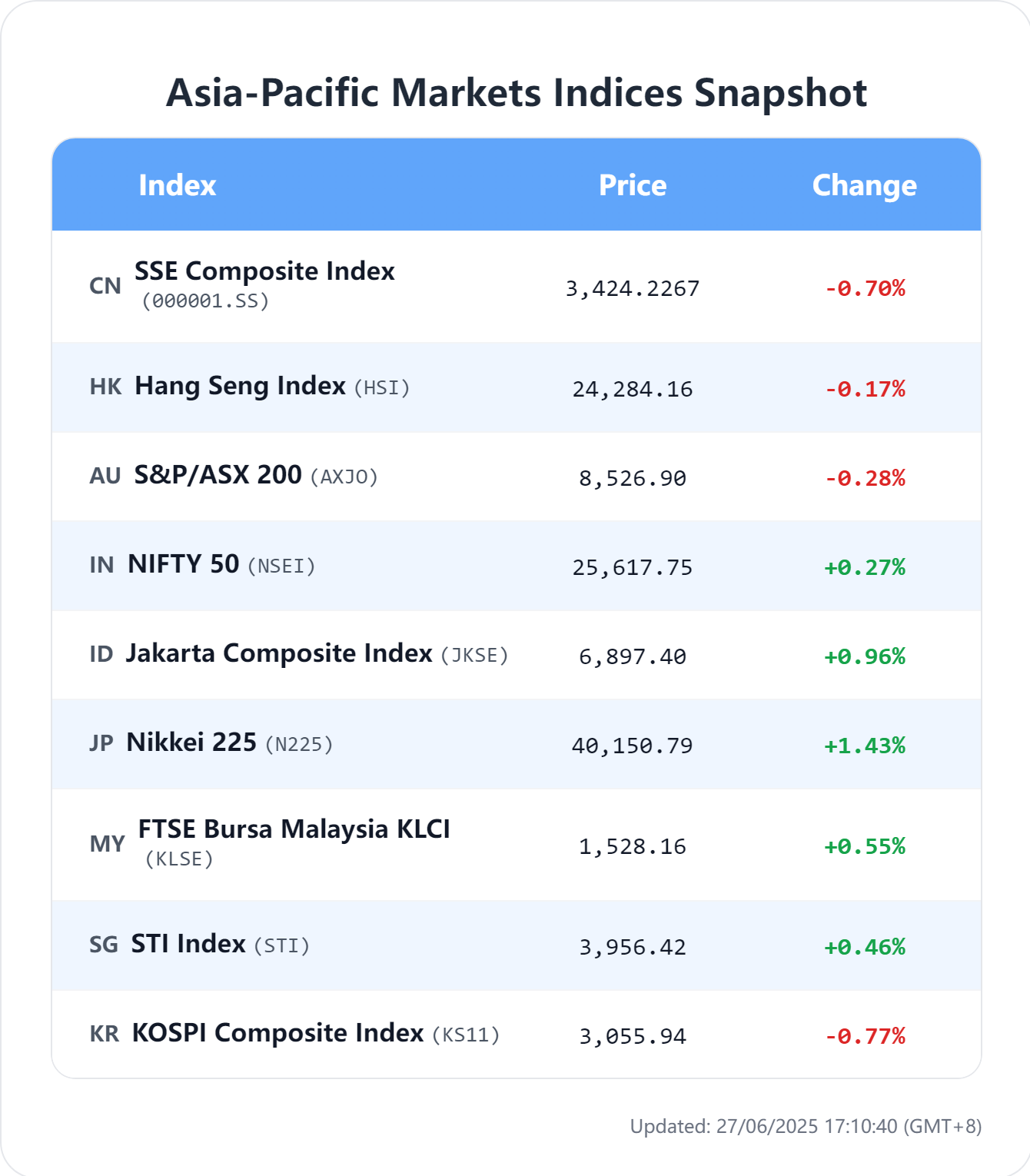
China: At close, the Shanghai Composite fell 0.7%, the Shenzhen Component rose 0.34%, and the ChiNext Index gained 0.47%. Markets surged then retreated, with mixed performance across major indexes.
Total trading volume in Shanghai and Shenzhen was 1.54 trillion yuan, down 42.1 billion yuan from the previous session.
Sectors like non-ferrous metals, high-speed copper cables, CPO, and diversified finance led gains, while banking, oil & gas, cross-border payments, and liquor saw the largest declines.
Hong Kong: All three major Hong Kong indexes declined, with the Hang Seng Index down 0.17%, the Hang Seng Tech Index down 0.07%, and the H-share Index down 0.47%.
Internet healthcare stocks performed strongly, new energy vehicle stocks were mixed, non-ferrous metal stocks rose, biotech weakened, and power stocks fell.
Japan: On June 26, 2024, the Nikkei Index rose 1.43% for the fourth consecutive day, gaining 566.21 yen to close at 40,150.79 yen—the highest closing price since December 27, 2024, surpassing the 40,000-yen mark.
On the Tokyo Stock Exchange’s main board, over 1,200 stocks (70%+) advanced. By sector, 29 industries, including non-ferrous metals, transportation equipment, securities & futures, and electronics, gained, while mining, food, warehousing & transport, and oil & coal declined.
South Korea: The KOSPI Index fell 0.77% to 3,055.94. Non-ferrous metals, diversified communication equipment, and machinery led gains, while utilities, electrical products, communication equipment, and chemicals saw significant declines.
Singapore: The Straits Times Index rose 0.48%, up 18.82 points to 3,957.28. Semiconductors, non-alcoholic beverages, and education led gains, while industrial products, oil & gas, and medical equipment saw declines.
Key Events
Shanghai and Shenzhen Exchanges: Plan to adjust price fluctuation limits for main board risk-warning stocks to 10%.
Both exchanges announced on the same day that the price fluctuation limit for main board risk-warning stocks will be expanded from 5% to 10%.
SoftBank CEO Masayoshi Son: Plans $33.2 billion investment in OpenAI, fully backing the company!
At SoftBank’s annual shareholder meeting in Tokyo on Friday, CEO Masayoshi Son reiterated the company’s AI ambitions and shared views on succession.
Son aims for SoftBank to become the largest AI platform provider in the next decade, comparing its goals to Microsoft, Amazon, and Alphabet’s Google.
As part of this ambition, SoftBank committed $6.5 billion to acquire U.S. semiconductor design firm Ampere and led a new funding round for OpenAI, with a conditional investment of up to $40 billion. Son revealed SoftBank’s total planned investment in the unlisted, non-profitable OpenAI could reach 4.8 trillion yen ($33.2 billion).
South Korea’s April Births Surge: Highest year-on-year increase in 34 years.
Official data released Wednesday showed South Korea’s April births rose 8.7% year-on-year to 20,717, the largest monthly increase since April 1991, driven by rising marriage rates and demographic shifts.
The total fertility rate (TFR) rose 0.06 to 0.79, still far below the 2.1 needed for generational replacement.
Institutional Views:
Goldman Sachs: Low 4% chance of Hormuz Strait oil transport disruption, limiting oil price upside.
Goldman Sachs’ Thursday report noted that, post-Iran-Israel ceasefire, options markets indicate a 4% chance of Hormuz Strait oil transport disruption. With easing geopolitical risks, international oil prices have limited upside potential.
Mitsubishi UFJ: Dollar faces further decline after hitting 3-year low.
Mitsubishi UFJ’s Lee Hardman stated that if Trump pre-selects a successor to Fed Chair Powell, the dollar, already at a 3-year low, could fall further. A candidate seen as more willing to cut rates per Trump’s demands would reinforce the dollar’s weakness.
Allianz Global Investors: De-dollarization and U.S. fiscal concerns drive capital flows to Asia.
AllianzGI’s Christiaan Tuntono said concerns over U.S. policy credibility and fiscal sustainability are pushing capital to Asia. Fears of a U.S. economic slowdown have triggered U.S. bond and dollar sell-offs, prompting diversification into non-dollar assets.
De-dollarization benefits Asian economies, with strong regional currencies allowing central banks to ease rates. Asian entities hold ~$8.6 trillion in U.S. equities and bonds, and partial repatriation could significantly boost Asian markets. AllianzGI favors domestically driven economies open to rate cuts, notably China, India, and Australia.
Capital Economics: Japan’s inflation overshoot signals Bank of Japan rate hike.
Capital Economics’ Marcel Thieliant noted Tokyo’s June CPI shows inflation exceeding the Bank of Japan’s 2% target, signaling a rate hike. Despite easing, inflation remains above the BOJ’s May forecast.
Thieliant expects a BOJ rate hike in October, with core inflation (excluding fresh food and energy) projected to stay around 3% by year-end, justifying a tightening cycle resumption.