
Markets Just Hit Record Highs but July Could Be Full of Surprises

After a stunning two-month rally, US stocks are now flirting with all-time highs. The S&P 500 and Nasdaq both closed at record levels at the end of June, and the Dow is catching up fast. That defies the old Wall Street adage “Sell in May and go away.” But this rally may be about to face some serious tests.
As we move into July, investors should keep an eye on three major developments: a new tax bill, the expiration of a tariff pause, and a fresh earnings season. All three have the potential to shake things up.
Stocks bounced back fast and hard
Back in early April, the mood was much gloomier. Stocks had plunged after President Trump rolled out a new round of tariffs, sending the Dow, S&P 500, and Nasdaq into correction or bear market territory. But then came a sharp rebound.
After bottoming out in April, the S&P 500 staged the fastest recovery in history from a drop of 15% or more. It took just 89 days to return to a record high, beating the previous record set in 1998. That’s not just a number — it reflects how quickly investors have shrugged off bad news.
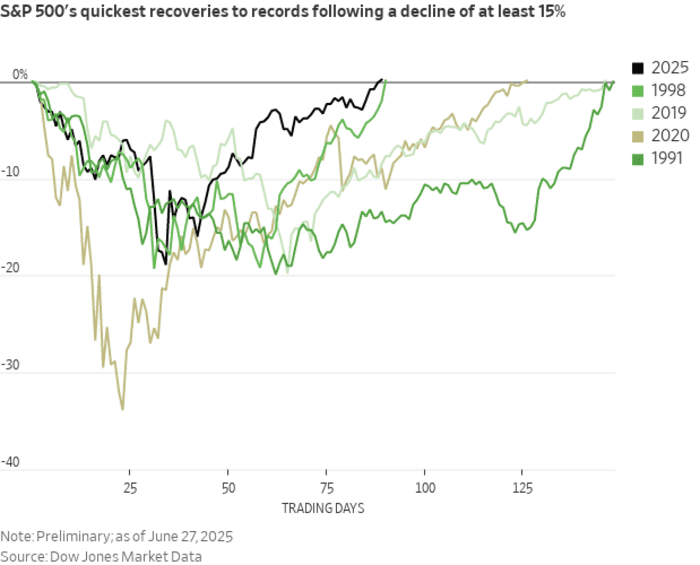
Historically, when markets recover this fast, they tend to keep rising for a while. According to CFRA Research strategist Sam Stovall, these sharp recoveries are often followed by an additional 6% to 10% gain before the next dip.
Add to that some seasonal optimism: July is traditionally one of the strongest months for stocks. On average, the Dow rises 1.5%, the S&P 500 gains 1.7%, and the Nasdaq adds 0.9%, according to Dow Jones data.
So everything looks great, right? Not so fast.
Tax reform could go either way
President Trump’s administration is pushing hard to pass what he calls the “One Big Beautiful Bill” — a tax reform package that aims to extend the corporate tax cuts passed in 2017. Back then, the tax rate dropped from 35% to 21%, and that helped fuel a stock market boom.

This time, though, the impact may be more muted. The new bill would mostly extend current cuts, not introduce dramatic new ones. That means the boost to corporate earnings — and stock prices — could be limited.
There’s also a risk the bill won’t pass before the old cuts expire in 2025. If that happens, it could be seen as a tax hike by markets.
And even if the bill passes, there’s another twist. To fund the cuts, the government would likely have to raise the debt ceiling and issue more bonds — pulling liquidity out of the financial system in the short term. That could weigh on markets in the near future, even if the long-term picture stays positive.
The 90-day tariff pause is ending
In April, the White House announced a 90-day pause on most of its new tariffs, helping calm the markets. But that pause is set to expire on July 9.

Trump has said he might extend it, but he’s also made it clear he prefers to go ahead and impose new tariffs if deals aren't reached. This kind of uncertainty could bring trade tensions back into the spotlight — and that’s not good for investor confidence.
We’ve already seen signs of this. Just last Friday, stocks pulled back in the afternoon after Trump announced he was ending trade talks with Canada. As trade headlines return, markets may get bumpy again.
Earnings season is the next big test
The July earnings season could reveal whether companies are actually feeling the pressure from tariffs, higher costs, and other economic headwinds. And that’s especially important right now because the recent rally has been driven mostly by a small group of mega-cap tech stocks — the so-called “Magnificent Seven.”
If those names don’t deliver strong earnings, the whole market could wobble. Investors will be watching closely when Apple, Nvidia, Microsoft, Amazon, Meta, Alphabet, and Tesla report between late July and early August.
As Morgan Stanley’s Dan Skelly points out, the market is now highly concentrated in just a few stocks. If even one or two of them disappoint, it could drag down the broader indexes.
What I think
This rally has been impressive, but I’m not convinced it’s on solid ground. The rebound feels more like a technical bounce than a broad-based rally supported by fundamentals.
If you’re a long-term investor, there’s no need to panic. But I wouldn’t rush to buy more right now. July is shaping up to be a month full of key events — the kind that could either confirm the bull run or bring it to a screeching halt.
In this kind of environment, patience is underrated. Sometimes the smartest move is to wait, watch, and be ready to act when the dust settles.