
APAC Market Wrap - 30 Jun

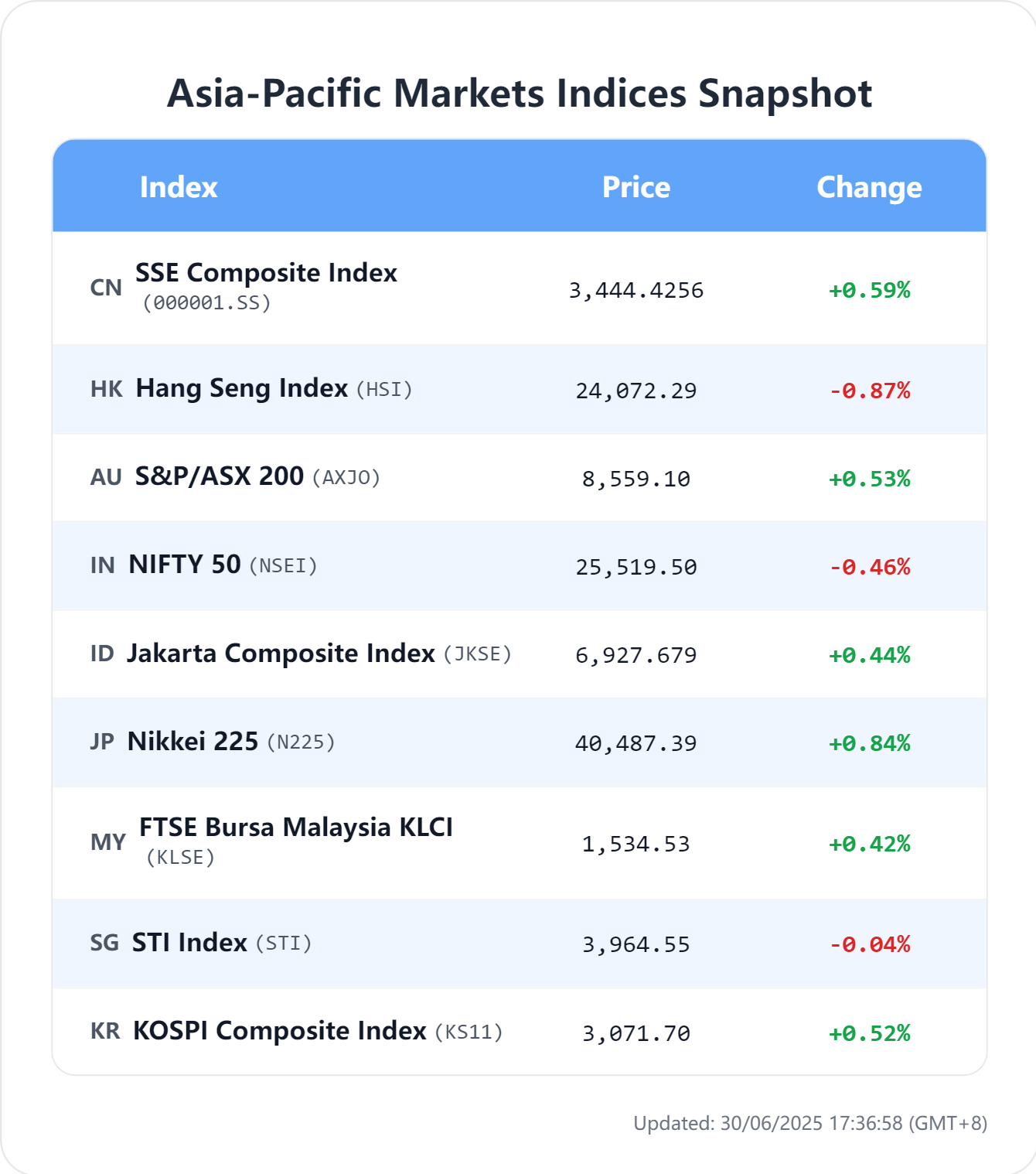 China: A-shares concluded the first half of 2025 today, with major indices recording gains. The Shanghai Composite Index climbed 2.76%, the Beijing Stock Exchange 50 soared 39.45% to a record high, and the National Index 2000 gained over 10%.
Thematic sectors like AI large models, humanoid robots, new consumption, innovative drugs, and solid-state batteries attracted significant capital inflows. Nearly 20 bank stocks reached all-time highs, with small and mid-cap stocks outperforming.
Over 3,700 stocks rose, with more than 100 surging over 100%. Chemical stock United Chemical led with a 440% gain, earning the title of “stock king” for the first half.
Hong Kong: The Hang Seng Index fell 0.87%, and the Hang Seng Tech Index dropped 0.72%. Sectors such as cryptocurrency, medical aesthetics, entertainment, and new consumption performed strongly, while elderly care, cloud office, and baby products saw modest declines.
Japan: The Nikkei 225 rose 0.8% to 40,487.39, its highest level since July 17, 2024, following Wall Street’s gains last Friday. Power & gas, information & communication, and mining sectors led gains, while transportation equipment, non-ferrous metals, and shipping saw slight declines.
BofA Global Research highlighted three key drivers behind Japan’s stock rebound: structural catalysts, particularly the widespread adoption of artificial intelligence, alongside other market dynamics.
South Korea: The KOSPI index gained 0.52%, closing at 3,071.70. Petroleum & gas, internet & retail, leisure equipment, and tobacco sectors saw strong gains, while IT services, defense, and non-ferrous metals experienced notable declines.
Singapore: The Straits Times Index edged down 0.05% (1.91 points) to 3,964.29. Packaging & containers, furniture, and medical services sectors rose, while industrial products, education, and medical equipment saw larger declines.
Key events
Gold’s East-West Great Game! As Asian Buyers Keep Snapping Up Gold, Are U.S. Investors Cashing Out?
While Asian buyers continue aggressively purchasing physical gold, U.S. investors are selling to capitalize on high prices. In the U.S., gold bars and coins are oversupplied, with dealers slashing premiums to a six-year low to stimulate sales.
This divergence suggests contrasting views among global investors on economic prospects and the gold market’s trajectory.
The New Wave Behind South Korea’s Stock Market Surge: “Crypto Powerhouse” Ignites Stablecoin Frenzy
Following President Lee Jae-myung’s push to fulfill campaign promises by proposing legislation allowing local companies to issue stablecoins, South Korea’s stock market is riding a wave of enthusiasm for digital currencies.
Stocks tied to the central bank’s digital currency project, such as Kakao Pay (up over 100% this month) and LG CNS (up nearly 70% despite some profit-taking), have seen significant gains.
U.S., U.K., Europe, Japan, South Korea! Five Major Central Bank Governors to Gather in Sintra, Portugal This Week
Five major central bank governors will convene at the European Central Bank’s 2025 Forum in Sintra, Portugal, from June 30 to July 2.
This prestigious event, comparable to the Fed’s Jackson Hole symposium, will address global economic challenges, particularly in the context of U.S. President Trump’s second term, with discussions shaping monetary policy directions.
Japan Reports China’s Intention to Invite Trump to Beijing’s 80th Anniversary Military Parade
According to Japan’s Kyodo News, China is considering inviting U.S. President Donald Trump to Beijing’s military parade on September 3, 2025, marking the 80th anniversary of WWII’s end.
This coincides with potential U.S.-China leader meetings during the UN General Assembly in New York, potentially marking their first face-to-face since Trump’s second term began.
Institutional Views:
UBS: Still Bullish on Gold’s Long-Term Prospects
UBS remains optimistic about gold’s long-term prospects, noting its status as a top-performing asset in 2025. Central bank purchases and inflows into exchange-traded funds (ETFs) have propelled gold past the euro to become the world’s second-largest reserve asset, according to European Central Bank data.
Despite a slight retreat from record highs amid optimism that the worst of trade war tensions may ease, UBS believes gold’s value will endure due to sustained demand and its role as a safe-haven asset.
UBS: U.S. Trade and Fiscal Decisions in July Expected to Have No Lasting Impact
UBS anticipates that U.S. trade and fiscal policy decisions in July 2025 will create short-term market volatility but are unlikely to have lasting impacts on the U.S.’s robust economic growth or broader markets.
A declining interest rate and yield environment supports equities and high-quality bonds, though global stock returns may be constrained for the remainder of 2025. UBS also expects the U.S. dollar to show signs of weakness as market dynamics shift.
Mitsubishi UFJ: USD Could Fall if July Rate Cut Expectations Rise
Derek Halpenny of Mitsubishi UFJ warns that rising market expectations for a Federal Reserve rate cut in July 2025—currently priced at a 21% probability by LSEG data—could pressure the U.S. dollar downward.
A weaker-than-expected U.S. non-farm payrolls report next Thursday or lower-than-anticipated inflation data on July 15 could accelerate this shift, prompting markets to more confidently price in a July rate cut.
TD Securities: USD Faces Next Risk from Canadian Pension Funds Increasing Hedging
TD Securities predicts further U.S. dollar weakness, driven by Canadian pension funds, which hold approximately $1.8 trillion in U.S. equities, increasing their currency hedging ratios. As the dollar’s safe-haven appeal diminishes, these funds face growing pressure to hedge their U.S. asset exposures.
TD estimates that a 5% increase in hedging ratios could lead to $90 billion in selling pressure on the USD/CAD pair, particularly as some Canadian funds maintain policies of under-hedging U.S. assets, currently at 10-15% hedging ratios.