
Is Circle’s Meteoric Rise on Shaky Ground? A Deep Dive into the Stability Token Shake‑Out

J.P. Morgan’s debut coverage slashed Circle’s target to $80, citing a “scissors effect” of falling yields and rising distribution costs. Even with a 10% sentiment premium, the fair value sits well below today’s $180+ share price.
Goldman Sachs chimed in with a neutral stance and an $83 target. Short interest has surged as options traders bet on a pullback.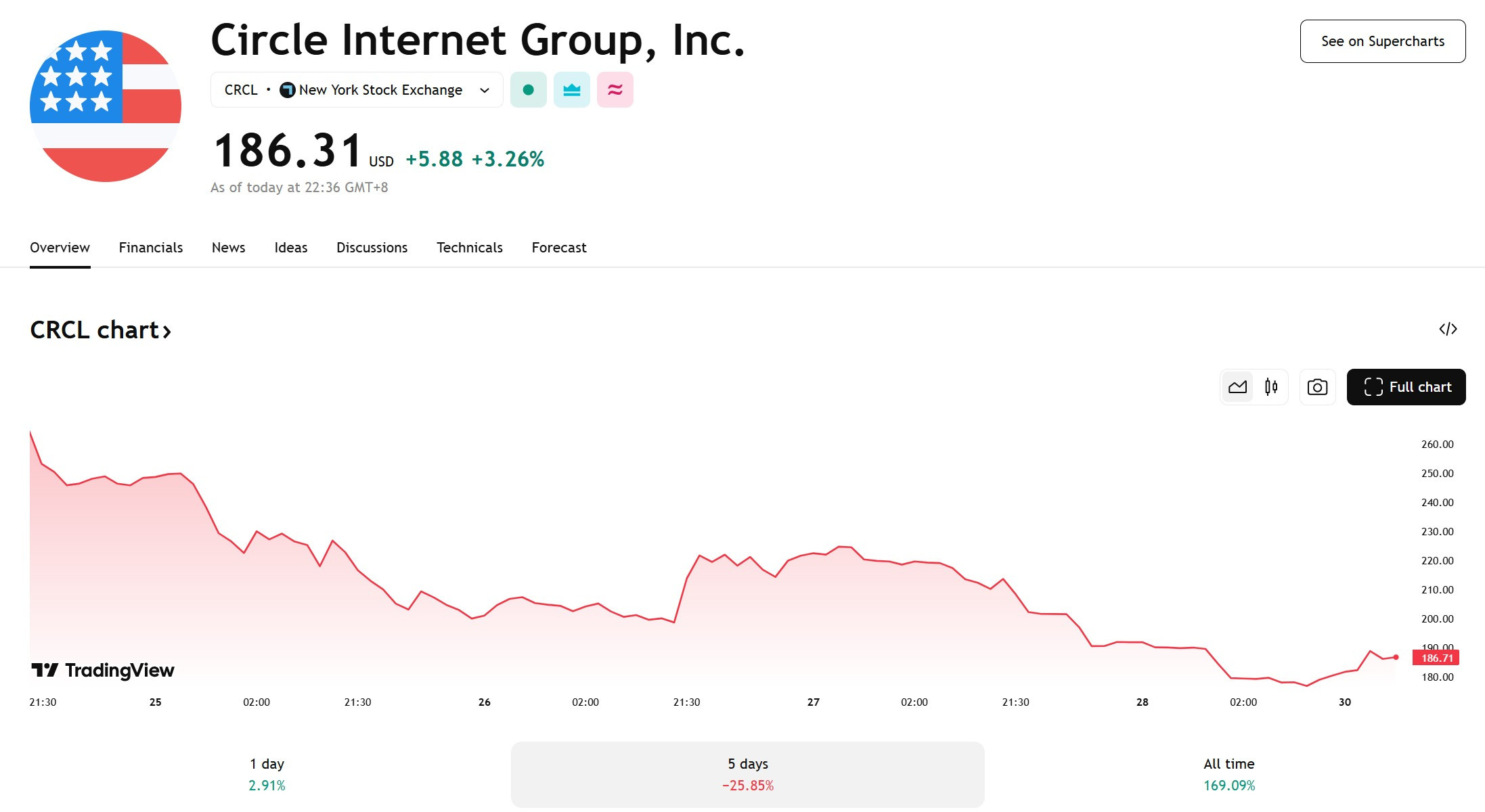
Why Are Profit Margins Under Threat?
Circle relies on reserve yields for 97% of its revenue, but two-thirds of those proceeds are paid out to distribution partners.
As the number of partner platforms grows, JPMorgan estimates that payout ratios could climb from 66% to 70%, dragging gross margins from 39% down to 34%.
Coinbase alone accounted for $908 million in partner fees in 2024, representing 55% of Circle’s reserve income split.
Under the deal, Coinbase earns 100% of yield on USDC balances it hosts, and 50% on all other platforms’ yields, a structure that may erode margins further if competition intensifies.
If rivals demand higher cuts to secure distribution deals, Circle’s model risks becoming akin to low‑margin money‑market funds. JPMorgan warns of “race to the bottom” dynamics in yield sharing, which could leave Circle squeezed between partner demands and compressed spreads.
How Vulnerable Is Circle to Rate Swings?
With roughly $60 billion in USDC outstanding, each 100 basis‑point drop in interest rates could sap about $600 million in annual reserve income and $200 million in adjusted EBITDA.
JPMorgan sees reserve yields peaking in 2024 and settling around a 3.00% steady‑state, putting pressure on profitability absent major USDC growth.
Lower rates might, paradoxically, boost stablecoin adoption by encouraging developers to fund innovations on blockchain networks.
Yet the net effect on Circle’s bottom line hinges on balancing increased transaction volumes with dwindling yield spreads—a trade‑off that remains finely poised.
Can New Entrants Shake the Throne?
Circle commands roughly 25% of the dollar‑pegged stablecoin market—second only to Tether. But newcomers are dangling higher yield incentives to lure users away, and tokenized money‑market funds are nibbling at stablecoin use cases.
Once “winner‑takes‑all” network effects falter, Circle’s compliance brand may not offset fresh competition.
USDC’s compliance pedigree—MiCA‑ready in Europe and positioned to meet forthcoming U.S. regulations—reinforces its moat.
Yet rivals could match regulatory standards while offering better yields. When switching costs remain low, even a modest yield bump might trigger market share shifts.
Market Sentiment: Are Investors Turning Bearish?
Since its June 4 IPO at $31, Circle’s stock has rocketed 482% to over $180, valuing the company near $40 billion. Yet put option volume ballooned this week, with 560,000 open puts as traders buy downside bets ahead of Friday expiries—some spiking over 3× in value.
Short interest now exceeds 25% of float, according to S&P Global, as institutions brace for a correction. In South Korea, stablecoin‑linked stocks like KakaoPay saw triple gains before a sharp sell‑off, underscoring the fragility of sentiment‑driven rallies when fundamentals fall under scrutiny.
Market Outlook and CPN Integration
Circle’s long‑term pivot hinges on the Circle Payments Network (CPN), launched May 2025 to embed stablecoin rails into traditional banking.
By tapping the $37 trillion B2B cross‑border payments market, CPN could unlock new fee‑based revenue streams if transaction volumes scale and pricing power takes hold.
CPN’s modular APIs and smart‑contract underpinnings aim to let third‑party developers craft bespoke finance workflows.
But integration hurdles with legacy rails, and the need for buy‑in from Visa, Mastercard and banking partners, will test Circle’s execution chops. Success could recast Circle as the “Stablecoin Swift,” yet failure risks relegating it to a commoditized issuer role.
Circle stands at a crossroads. After an unprecedented IPO surge, bearish signals from Wall Street and rising short bets raise questions about the sustainability of its run.
As yield curves shift, partner economics pinch, and rivals circle, the next chapters will determine whether Circle cements its paradigm‑shifting vision or succumbs to market realities.