
Decoding Report Insights | UBS: Tesla Robotaxi Deep Dive

The news of Tesla launching its first Robotaxi service in Austin has once again ignited market imagination for “autonomous driving + mobility networks.”
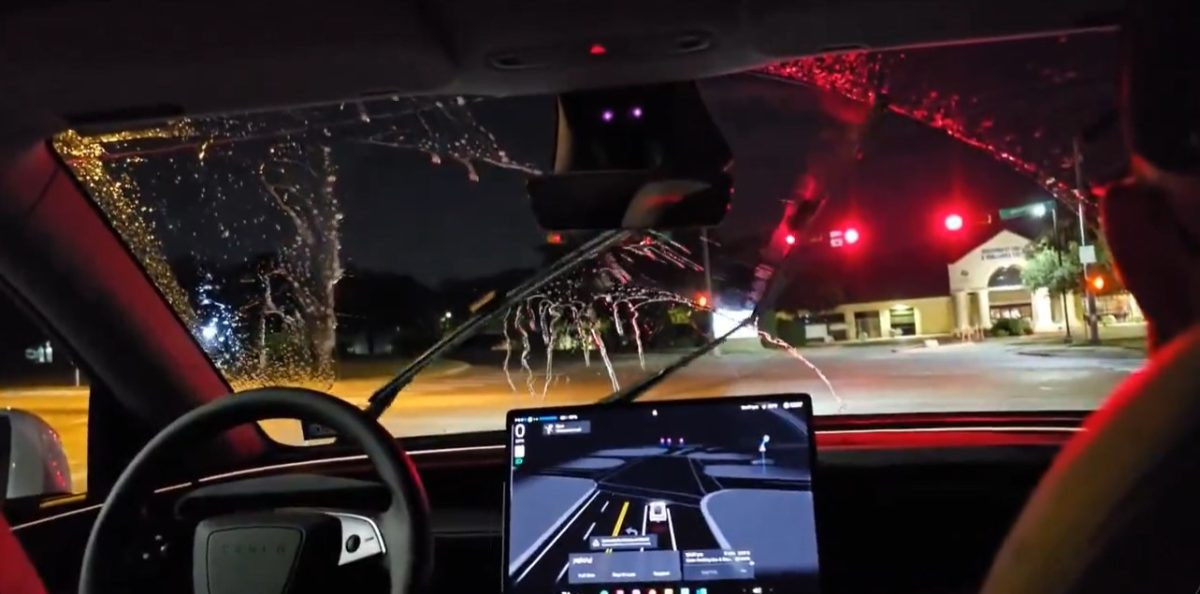
Elon Musk has said that Tesla’s long-term value primarily comes from two directions: one is the Optimus humanoid robot, and the other is Robotaxi.
UBS recently released a detailed report, modeling Robotaxi separately, estimating a future value of up to $350 billion, equivalent to about $99 per share.
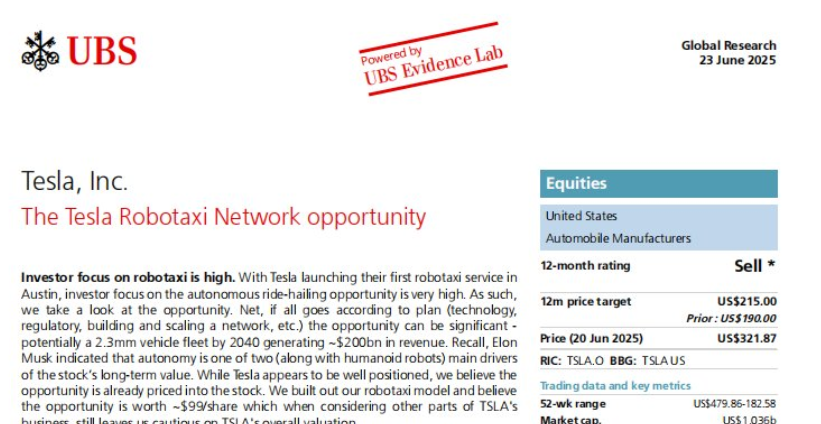
Today, we’ll dive into this report.
Let’s first look at the report’s core views:
- If everything goes as planned, Tesla’s Robotaxi service holds immense potential, possibly operating a 2.3-million-vehicle fleet by 2040, generating ~$200 billion in revenue, though this opportunity may already be reflected in the stock price.
- Tesla has unique advantages in Robotaxi, with its vertically integrated autonomous driving system and vehicles, as well as operating its own transportation network company, enabling it to control the narrative and attract investor interest.
- Tesla Network’s business model includes Tesla-owned vehicles and individual/fleet-contributed vehicles, the former with high revenue but high costs, the latter with lower revenue but higher margins.
- Based on the valuation of Tesla Network, UBS assigns it $350 billion, or $99 per share, and raises Tesla’s target price from $190 to $215.
What does this mean?
To put it in perspective, UBS’s overall target price for Tesla is $215, meaning Robotaxi accounts for more than half of its valuation support.
Why is Tesla the most likely to succeed in Robotaxi?
Robotaxi isn’t an app or a single feature—it’s an entire system. UBS breaks down Robotaxi into three core components:
- Autonomous Driving Stack (AV Stack): Algorithms + computing power + perception systems.
- Vehicles: Cars designed for autonomous driving.
- Transportation Network Company (TNC): A platform that efficiently matches users with vehicles.
Most players only cover 1-2 of these, like Mobileye with algorithms or Waymo using Jaguar vehicles but relying on Uber’s platform.
Tesla’s uniqueness lies in its full-stack integration: it builds its own cars, develops FSD (Full Self-Driving software), and plans to operate its own “Tesla Network” platform.
The benefits of integration include: rapid closed-loop iteration; no middleman costs for technology or platforms; and control over pricing and user experience.
How will Robotaxi’s business model work?
UBS points out that Robotaxi will form two main models:
- Heavy Asset Model (TNC-owned fleet): The platform owns the vehicles, earning full revenue but bearing all operating costs.
- Light Asset Model (user/fleet-contributed vehicles): The platform acts as an intermediary, taking a commission, with high margins but smaller revenue scale.
Tesla will likely adopt a “hybrid model.” Initially, to control quality and experience, it will operate its own Robotaxi fleet.
As the network matures, Tesla will allow individuals or fleets to contribute their Tesla vehicles to the platform, with Tesla earning FSD subscription fees + commissions.
The biggest advantage of this model is flexibility in adjusting supply during demand fluctuations, avoiding the full burden of idle costs.
What should investors watch?
Although UBS raised the target price, it maintains a “Sell” rating, reasoning that: Robotaxi’s long-term value is significant, but Tesla’s current stock price (over $1 trillion market cap) implies overly high expectations;
- Autonomous driving still faces technical, regulatory, and user acceptance challenges;
- Short-term pressures remain on Tesla’s traditional auto and energy businesses.
For investors, Robotaxi is like a long-term valuation check, but its realization may be slower than the market expects.
UBS’s Perspective
Musk’s visions are always grand, but capital markets ultimately reward execution. Robotaxi isn’t just a PowerPoint—it’s a commercial challenge far more complex than autonomous driving alone.
Whoever can master the technical closed loop + business logic + user scale will earn a slice of the Robotaxi pie.
Tesla is clearly the closest to the finish line, but whether that finish line is a dream or a mirage remains to be validated by the market.$TSLA