
Big U.S. Banks Lift Dividends and Buybacks After Passing Fed Stress Test

Shearing sheep
July 2, 2025
GoGPT Summarizes Articles
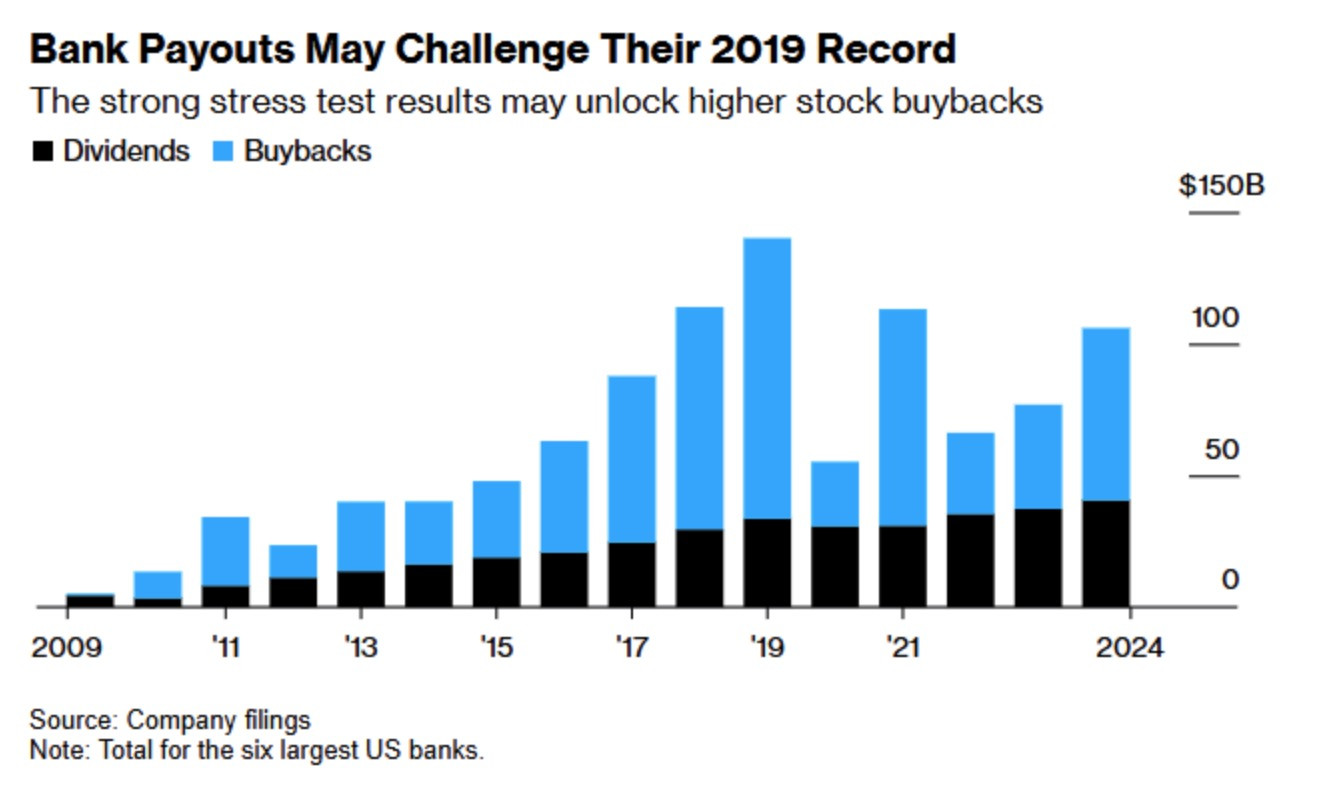
After passing this year’s Federal Reserve stress test with relative ease, Wall Street’s biggest banks wasted no time rewarding shareholders. On Tuesday, several major U.S. financial institutions—JPMorgan, Bank of America, Wells Fargo, Morgan Stanley, and Goldman Sachs—announced sizable dividend hikes and fresh buyback programs.
These capital distribution plans follow the Fed’s annual stress test, which all 22 participating banks cleared. While the test still modeled a severe global recession scenario—including unemployment spiking to 10% and a 33% plunge in home prices—analysts and investors noted that this year’s assumptions were less severe than in 2024. Regulators have also softened some of the stricter requirements introduced in previous years, contributing to more favorable outcomes this time.
In fact, the Fed said the banks demonstrated their ability to absorb over $550 billion in hypothetical losses, reinforcing their resilience even under extreme scenarios. That’s no small feat, and it sent a clear signal that these firms are in a strong enough position to return more capital to shareholders.
Dividend and Buyback Programs
-
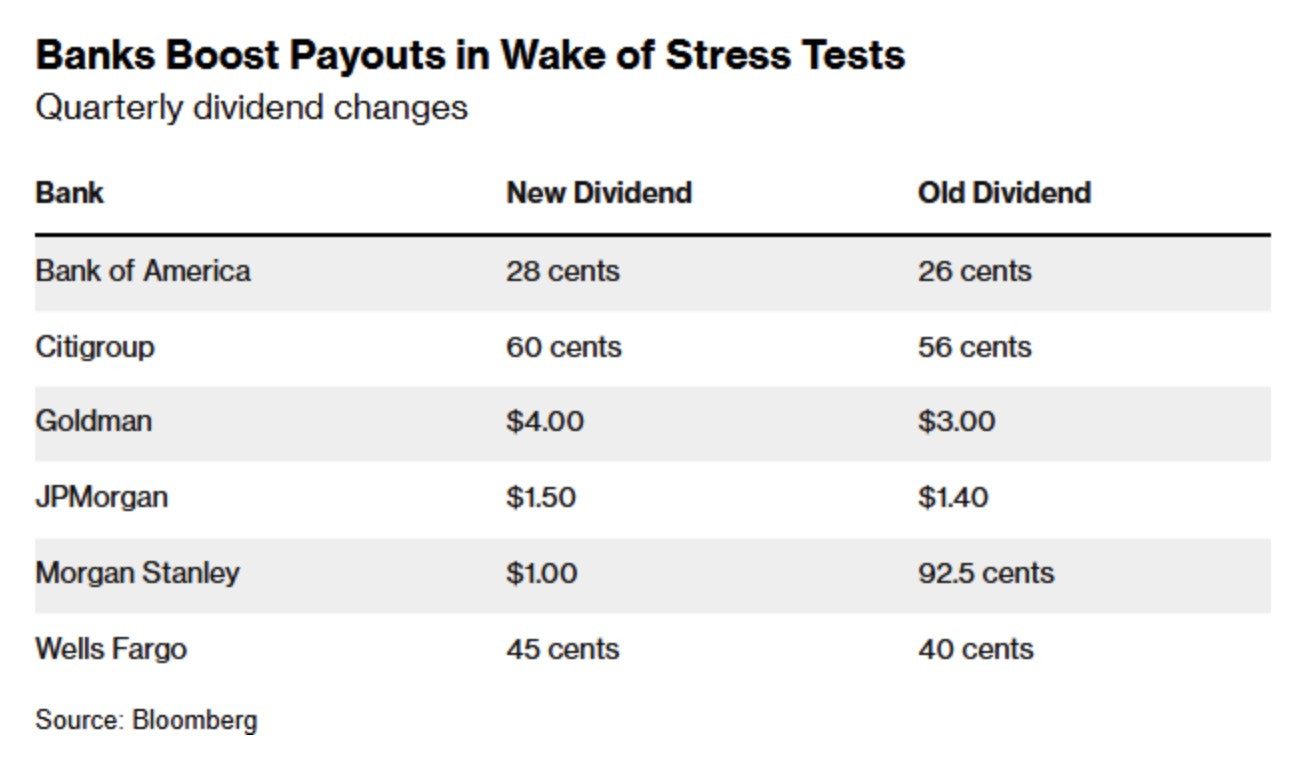
Bank of America ($BAC) will raise its dividend to $0.28 per share.
-
Citigroup ($C) will raise its dividend to $0.60 per share.
-
Goldman Sachs ($GS) is increasing its dividend to $4.00 per share.
-
JPMorgan ($JPM) is raising its quarterly dividend to $1.50 per share and launching a new $50 billion share repurchase plan.
-
Morgan Stanley ($MS) is lifting its dividend to $1.00 per share and reauthorizing a multiyear $20 billion buyback program with no expiration date.
-
Wells Fargo ($WFC) is hiking its payout to $0.45 per share.
A Softer Test, But the Debate Continues
Stress testing, introduced in the aftermath of the 2008 financial crisis, serves as a key tool for determining how much capital banks can safely return to shareholders. It requires firms to assess how they would fare under crisis conditions and estimate potential losses based on their current balance sheets.
While markets welcomed this year’s results, the broader debate over the usefulness and transparency of the Fed’s stress tests continues to simmer. Critics from the banking industry argue that the tests lack transparency and don’t reflect improvements banks have made over the past decade. Executives like JPMorgan’s Jamie Dimon have voiced their frustration, calling the current format “dead wrong,” even while acknowledging that stress testing itself is valuable.
On the regulatory side, officials say the unpredictability of the test design is intentional—it ensures that banks are preparing for unexpected crises, not just predictable ones. Fed Chair Jerome Powell emphasized this in 2019, stating, “Banks will need to be ready not just for expected risks, but for unexpected ones.”
To address growing concerns about the volatility of capital requirements, the Fed is currently reviewing reforms to its framework. A proposal released in April suggests averaging stress test results over two years to smooth out year-to-year fluctuations. Additionally, there are plans to adjust the enhanced supplementary leverage ratio, a rule that requires banks to hold capital in proportion to their total assets.
What This Means for Investors
The strong capital return plans are a clear positive signal for shareholders. They reflect confidence in banks' balance sheets and a return to more shareholder-friendly policies amid a relatively stable macro backdrop. Lower SCBs mean more flexibility—and Wall Street is clearly ready to use it.
That said, even as this year’s test proved less demanding, future changes to the framework could reshape how banks prepare and respond. With new regulatory leadership in place and Powell’s term as chair ending next spring, the tone of bank oversight may shift once again.
For long-term investors, this is a reminder that U.S. megabanks remain well-capitalized and, for now, more than capable of weathering hypothetical storms. But as always, the real test is the one that no one sees coming.
#$Bank of America Corporation(BAC)#$Citigroup Inc.(C)#$Goldman Sachs Group Inc.(GS)#$JPMorgan Chase & Co.(JPM)#$Morgan Stanley(MS)#$Wells Fargo & Co.(WFC)