
Chinese Carmakers Are Making a Quiet Comeback in Europe

Chinese automakers are pushing deeper into Europe, and May marked a major milestone. For the first time, their share of hybrid car sales topped 9%, matching their slice of the electric vehicle (EV) market, which hit a 10-month high. Overall, Chinese-branded cars now account for more than 5% of total registrations in Europe—a record.

That may not sound dramatic at first glance, but there’s more going on beneath the surface. This rebound is happening despite rising trade tensions and new tariffs from the European Union targeting Chinese EVs. Clearly, Chinese brands aren’t backing down. In fact, they’re adapting—and fast.
Hybrid sales are booming and Chinese brands are riding the wave
Unlike EVs, hybrids are not subject to EU tariffs. That’s allowed Chinese brands to shift gears and double down on hybrid offerings, giving them a backdoor into Europe’s competitive auto market. Just a year ago, they barely had 1% of the hybrid segment. By May 2025, they had jumped to 12% of plug-in hybrid sales and 7% of mild hybrid sales.
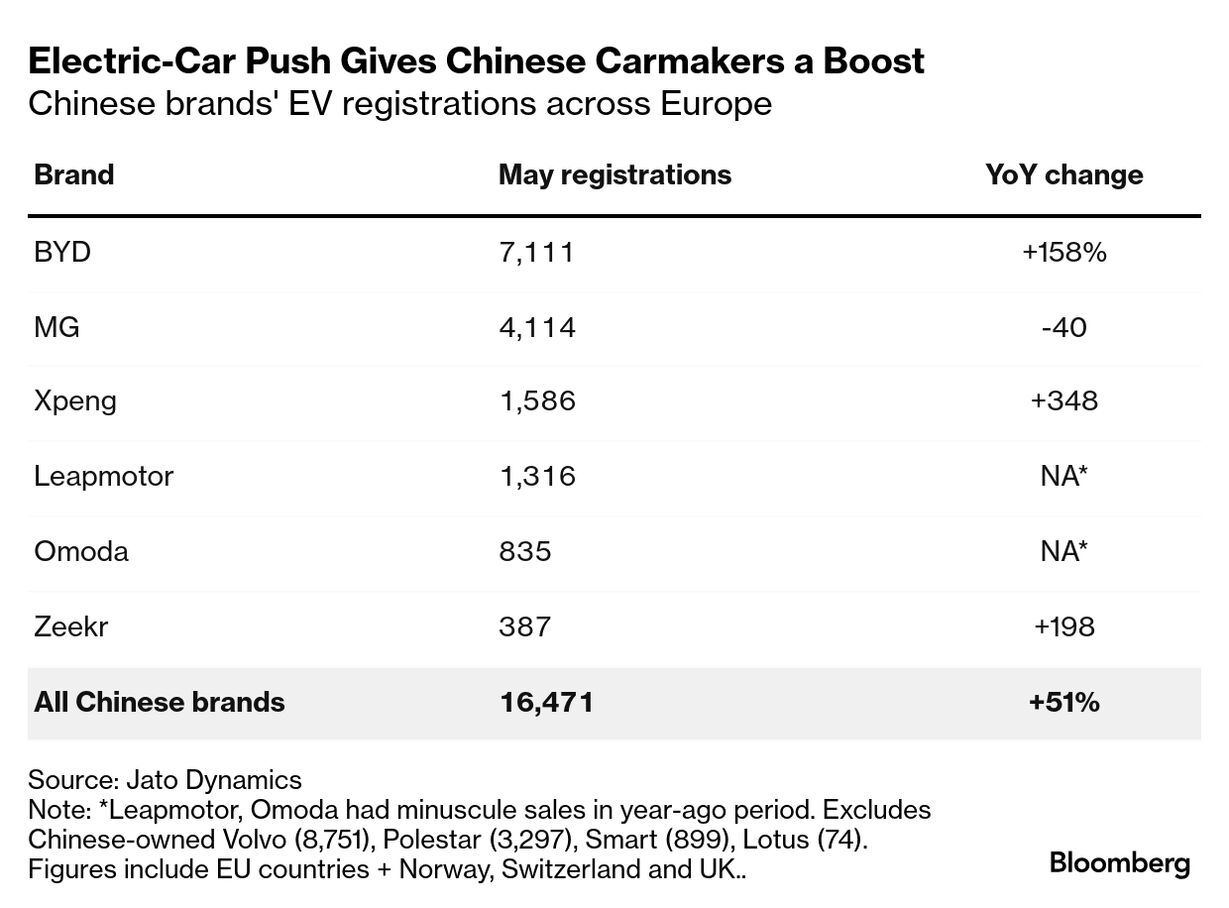
MG, a once-British brand now owned by China’s state-backed SAIC Motor, was hit with a steep 45% tariff on EVs. Instead of retreating, it pivoted toward hybrids, cutting back on EV sales and emphasizing other electrified options. That flexibility has kept it in the game.
EV sales bounce back to pre-tariff levels
Meanwhile, Chinese EV sales are back to where they were before the EU’s anti-subsidy probe kicked off in mid-2024. That investigation concluded that Chinese automakers were benefiting unfairly from government support—and tariffs followed. BYD, one of China’s EV leaders, faces a tariff of 17.4%.
But instead of slowing down, BYD is introducing more affordable models tailored to Europe, like the Dolphin Surf and the Atto 2, both of which target popular urban and compact SUV segments. These are the price points and styles that European consumers are actually buying.
In short, the tariffs didn’t stop them—they forced a smarter playbook. That’s arguably more dangerous for local competitors in the long run.
Chinese brands are learning how to win in Europe
The bigger story here is about adaptability. Chinese automakers aren't just competing on price anymore. They're refining their product lines, adjusting to regulations, and expanding their appeal. Their advantage in battery tech and fast product development cycles is helping them stay one step ahead.
This mirrors what we saw with China’s solar industry a decade ago. After facing trade barriers in Europe, they kept improving, and many of them eventually came out stronger. Now the auto sector might be on a similar path.
Why this matters going forward
What’s unfolding isn’t just a rebound in EV numbers—it’s a shift in strategy. China’s carmakers are no longer just “low-cost disruptors.” They’re becoming global players with a more sophisticated understanding of how to navigate regulation, branding, and local consumer demand.
As I see it, Europe is turning into a policy sandbox—a place where protectionism meets innovation. Tariffs may slow things down, but they won’t reverse the trend. If anything, they’re pushing Chinese automakers to sharpen their edge, particularly in segments like hybrids that remain outside tariff reach.
It’s still early, but the trend is clear: Chinese car brands aren’t just surviving in Europe—they’re learning how to win.