
APAC Market Wrap - 2 Jul

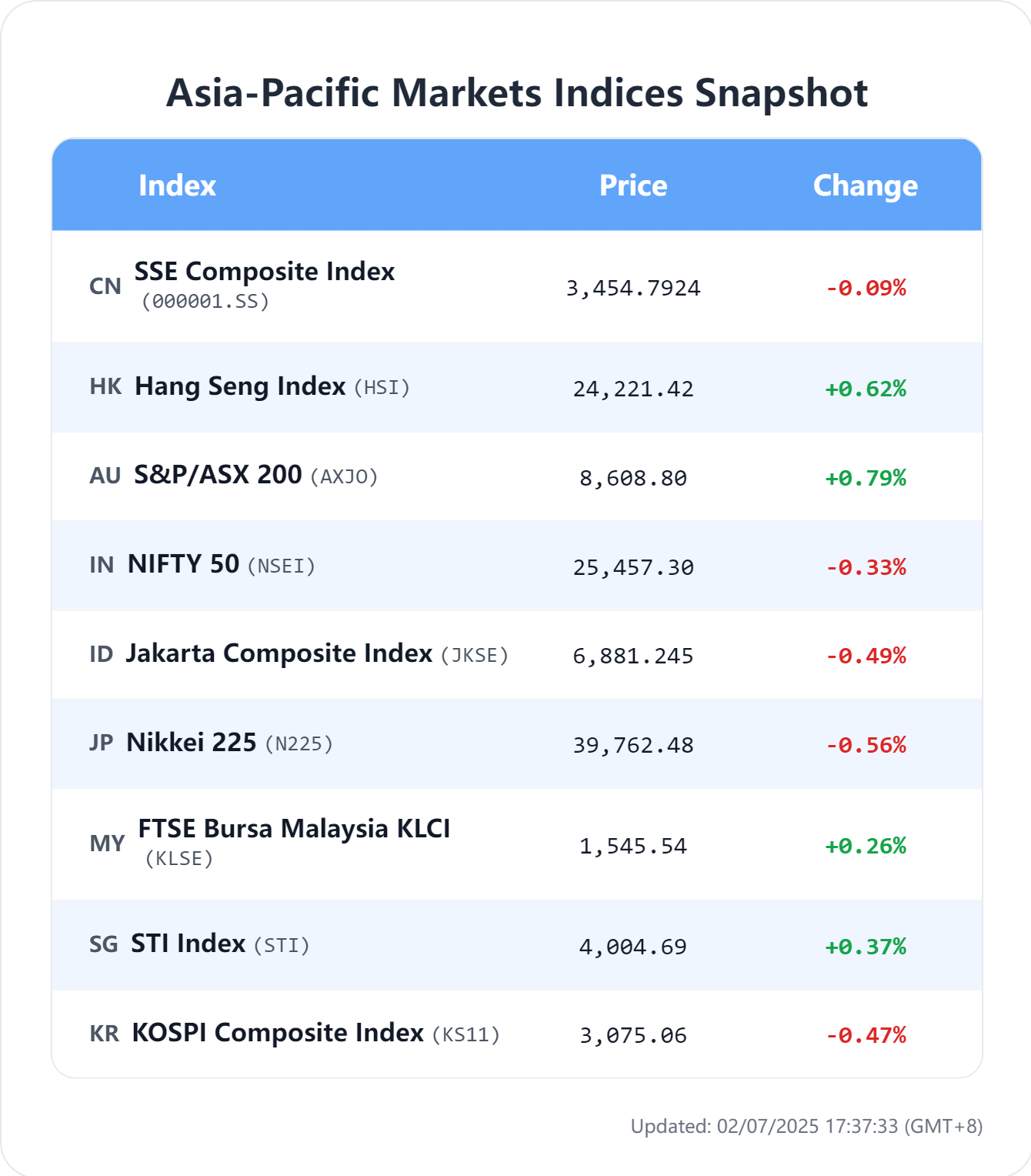
China: Markets oscillated throughout the day, with the ChiNext Index leading declines. Shanghai and Shenzhen exchanges recorded a total turnover of 1.38 trillion yuan, down 89.1 billion from the previous trading day.
Market sentiment was scattered, with more stocks declining than rising—over 3,200 stocks fell. Sectors like steel, photovoltaics, coal, and marine economy led gains, while military, brain-computer interface, CPO, and semiconductor sectors saw the largest drops. By close, the Shanghai Composite fell 0.09%, the Shenzhen Component dropped 0.61%, and the ChiNext Index declined 1.13%.
Hong Kong: The major Hang Seng indices showed mixed performance, with the Hang Seng Index up 0.62%, the Hang Seng Tech Index down 0.64%, and the State-owned Enterprises Index up 0.54%.
Sector-wise, tech stocks mostly declined, while building materials rose, casino and gaming stocks gained, photovoltaic solar stocks increased, gold stocks mostly advanced, alcoholic beverage stocks strengthened, and steel stocks surged in the afternoon.
Japan Stock Market: The Nikkei 225 continued its decline by 0.56%, closing at 39,762.48 yen, down 223.85 yen. By sector, 24 industries including real estate, aviation, pulp and paper, rubber products, and mining saw gains, while 9 industries like other products, machinery, non-ferrous metals, and precision instruments fell.
South Korea Stock Market: The KOSPI index fell 0.47% to 3,075.06. Sector-wise, steel, household appliances, biotechnology, and energy equipment services rose collectively, while internet, utilities, and oil and gas sectors experienced significant declines.
Singapore Stock Market: The Straits Times Index closed at a record high, rose 0.53%, closing at 4,010.78 points. Business services, asset management, and pharmaceutical manufacturers led gains, while diversified media, non-alcoholic beverages, and cyclical retail saw notable drops.
Key Events
Has the Advanced Node Race Been Decided? Samsung Delays 1.4nm Process
Samsung Electronics’ foundry division announced Monday a delay in mass production of its 1.4nm semiconductor, targeting 2029—two years later than planned. This major roadmap shift may signal Taiwan Semiconductor Manufacturing Company (TSMC) as the winner in the cutting-edge chip market.
Heatwave Scorches Northern Hemisphere: Record-Breaking June Confirmed
Official meteorological data from Europe and Asia confirm this year’s extreme heat arrived earlier and more intensely, shattering historical June temperature records and challenging all-time highs into early July.
In Asia, Japan’s Meteorological Agency reported on July 1 that the country experienced its hottest June since records began in 1898, with an average temperature 2.34°C above the 1991-2020 average, surpassing the previous record of 1.43°C set in 2020.
Singapore Tightens Crypto Trading Regulations
The Monetary Authority of Singapore (MAS) issued a statement on June 30, tightening crypto trading rules to curb money laundering and financial crimes. New regulations effective that date require digital token service providers serving overseas clients to obtain a license from MAS to operate in Singapore; unlicensed platforms must shut down.
Institutional Views
BofA: U.S. Stocks Hit Record Highs Amid Biggest Client Sell-Off in 10 Weeks
Bank of America data shows the S&P 500 hitting new highs coincided with the largest net selling in 10 weeks.
Strategist Jill Carey Hall noted institutional clients led the sell-off, followed by hedge funds in their second week of selling, with private clients selling for the first time in six weeks. Selling occurred across eight sectors, led by industrials and real estate, which saw outflows for four consecutive weeks.
Commerzbank: Eurozone Inflation May Ease with Falling Oil Prices
Commerzbank economist Vincent Stamer noted that despite June’s eurozone inflation hitting the European Central Bank’s 2% target, it may decline in coming months. The prior rise was driven by oil prices, which spiked over 10% due to Middle East conflict escalation.
Stamer expects inflation to fall with oil price drops, though U.S. tariff uncertainty may prompt the ECB to pause action this month. He added that tariffs could suppress European exports and commodity prices, likely leading to an ECB rate cut in autumn.
ING: UK Welfare Reform Bill Vote Looms, Pound Faces Political Risk
ING analyst Chris Turner highlighted political risks for the pound as the UK Labour government nears a vote on its welfare reform bill. Despite Prime Minister Starmer’s concessions, internal opposition remains possible. Analysts predict a bill rejection could push EUR/GBP above 0.8600.