
Decoding Report Insights | UBS's latest 98-page AI report

Over the Past Two Years, Tech Giants Like OpenAI, Meta, Google, Microsoft, and Amazon Have Been Fiercely Competing on Models While Aggressively Building Infrastructure
From chips to data centers, from training to inference, the entire AI supply chain has seen billions of dollars poured in.
But by mid-2025, another critical question has emerged: 👉 With such aggressive AI infrastructure investment, will there be enough “demand” to sustain it in the future?
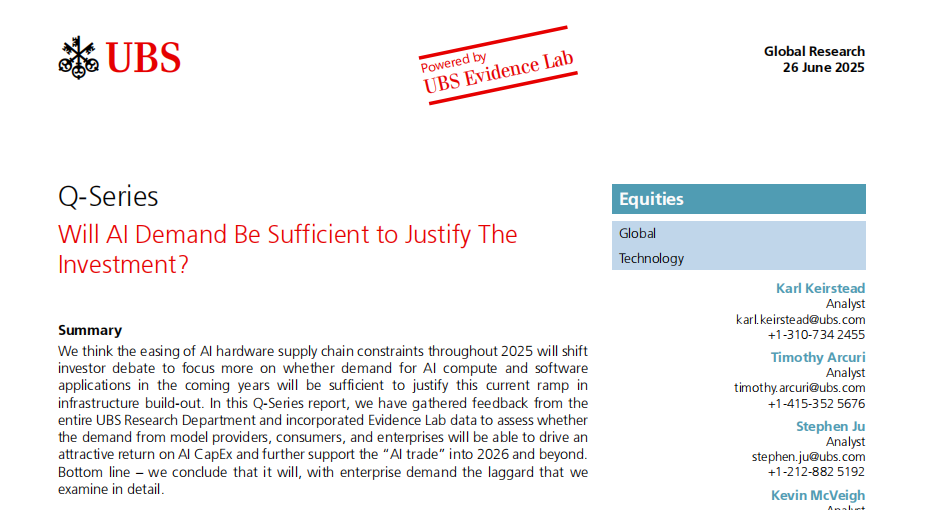
This is the core focus of UBS’s latest 98-page Q-Series report dated June 26, 2025, which seeks to answer whether the three pillars of AI demand—training, inference, and enterprise adoption—can support this unprecedented AI investment boom.
I’ve distilled the key insights to share with you.
Who Is Driving Real AI Demand?
UBS categorizes AI demand into three pillars:
Large Model Training (LLM Training)
Led by model developers like OpenAI, Anthropic, Meta, and xAI.
Features: Extremely high GPU demand with no signs of slowing—evidenced by OpenAI’s massive procurement orders with Oracle and CoreWeave.
Consumer Inference
Such as ChatGPT, Gemini, Claude, and Perplexity—these “AI end-user applications” are growing rapidly.
ChatGPT boasts over 600 million monthly active users, while Meta and Google continue to integrate AI into ads and search, ramping up GPU purchases.
Enterprise AI
Theoretically the largest potential, but currently in the “demo and small-scale pilot” phase.
UBS surveys show only 14% of large enterprises have achieved widespread AI deployment.
Conclusion: The first two pillars show robust demand, with the enterprise segment lagging but poised for a breakout in 2026.
Why Is Enterprise AI Adoption So Slow?
UBS surveyed 125 enterprise CIOs and data heads, identifying three main reasons for the delay:
- AI capabilities aren’t yet “enterprise-grade”: Model inference remains unreliable, and Agent task autonomy is still experimental.
- Data governance is complex: Enterprise data involves permissions, compliance, and security considerations, unlike consumer products that can launch directly.
- Price sensitivity and preference for “in-house” solutions: Many firms opt to build their own AI tools rather than buy SaaS AI products.
UBS estimates that the combined AI product revenue of major software firms like Adobe, Salesforce, and ServiceNow still lags behind OpenAI’s single-entity earnings.
Could There Be an “Overinvestment” Risk? UBS’s Take
UBS acknowledges a potential scenario: If model training and consumer app growth slow while enterprise AI hasn’t taken off, a short-term “investment digestion period” could emerge.
However, they deem this unlikely due to:
- Ongoing increases in training demand from model makers like OpenAI and Anthropic;
- Continued growth in consumer inference product users and engagement;
- Progress in enterprise data preparation engineering to pave the way for AI adoption;
- The Agentization trend, though not yet explosive, nearing a “tipping point.”
Conclusion: AI demand remains solid, with structural overheating risks manageable.
Which Companies Stand to Benefit?
UBS outlines its AI investment portfolio:
- Core Hardware Chain: NVIDIA (GPUs), Broadcom (networking), TSMC (manufacturing), Micron (storage)
- Cloud Infrastructure: Oracle, Snowflake
- AI Application Layer: Meta (ads + AI assistants), ServiceNow (enterprise automation)
- Edge Devices & Networking Vendors: Arista, Ciena, Quanta, Wistron
They highlight that AI-native startups like Midjourney, Cursor, and Cohere are outpacing traditional giants in revenue growth.
This report suggests AI is not a sprint but a “long war.” Training and consumer inference currently drive most GPU demand, and whether enterprise demand can take the baton in the next two years will determine if this AI infrastructure leap can hold steady.
Post-2026 will be the true test of whether “AI isn’t a bubble.”