
"Big and Beautiful" Bill Officially Takes Effect! One-Stop Guide: How Will It Impact U.S. Industries?

Local time on July 4, U.S. President Trump signed the "Big and Beautiful" tax and spending bill into effect.
Prior to this, the U.S. House of Representatives had passed the bill on the afternoon of July 3 with a vote of 218 in favor and 214 against. The bill had earlier been approved by the Senate on July 1.
The bill has sparked significant controversy due to its cuts to federal aid, increased long-term debt, and tax reductions for the wealthy and large corporations.
Many industry experts have pointed out that it steers the U.S. onto a new, more dangerous fiscal path. According to a preliminary analysis by the Congressional Budget Office, the bill is expected to increase the U.S. deficit by approximately $3.3 trillion over the next decade and reduce national tax revenue for decades to come.
It’s worth noting that the long-term ripple effects of the "Big and Beautiful" bill on various U.S. industries are also significant. The final version of the bill provides notable tax advantages to certain specific sectors while cutting incentives for others. Although Medicaid and state and local tax deductions have been central focal points of the bill, numerous industry sectors have also been affected.
Below is an industry-level analysis of potential winners and losers in the U.S. capital markets due to the "Big and Beautiful" bill:
Winners
Chip Manufacturers
The "Big and Beautiful" bill stipulates that chip manufacturers building new factories in the U.S. will see their tax credit rate increase from 25% to 35%. Eligible new projects must break ground by the end of 2026. This is part of the Trump administration’s push to localize production of key AI technologies. Industry experts anticipate that companies like Intel and Micron Technology could benefit if they expand their U.S. manufacturing footprint.
Energy Companies
The bill mandates the reopening of oil and gas lease auctions on public lands and waters in Alaska, the Gulf of Mexico, and several western states, restoring lower royalty rates and increasing subsidies for carbon capture and utilization in oil recovery projects. Oil and gas producers will also be able to deduct certain drilling and development costs. Lobbying groups in the oil and gas sector have dubbed this bill a “home run” (major victory).
Airlines
The bill includes $12.5 billion in funding to modernize the U.S. air traffic control system. Airline executives widely support the plan, having previously cited outdated facilities as a root cause of flight delays. Industry groups view this as an important initial investment but emphasize that billions more will be needed for a full system overhaul.
Real Estate Developers
The bill retains and expands existing tax incentives for commercial real estate investors and developers, including a “bonus depreciation” policy—a hallmark of the 2017 tax cuts—allowing 100% deduction of various property improvement costs. It also permanently incorporates tax deferral benefits for “opportunity zone” real estate investments into the tax code. Affordable housing construction is expected to receive a boost, with the bill expanding the Low-Income Housing Tax Credit program by 12%, supporting the development of approximately 50,000 new housing units annually.
Defense and Aerospace Companies
Under the "Big and Beautiful" bill, the Pentagon will allocate approximately $150 billion over the next five years for major projects, including shipbuilding, ammunition production, and missile defense systems, with an initial $25 billion payment for the planned “Golden Dome” missile defense system. Companies like Lockheed Martin and Palantir Technologies are likely to benefit.
Private Student Loan Providers
The bill could benefit private student loan providers like SoFi due to a reduction in federal student loan caps. The new rules lower the federal loan limit for graduate students to $100,000 (previously up to $138,500) and for medical or specialized programs to $200,000 (previously up to $224,000). This reduction may push more students toward private lenders to fill funding gaps.
Manufacturers
The bill offers a series of tax breaks to stimulate U.S. domestic manufacturing, including full tax deductions for factory construction costs if projects begin after January 19, 2025 (the day before Trump’s inauguration) and are operational by 2031. It also provides more permanent and accelerated deductions for equipment purchases and R&D costs.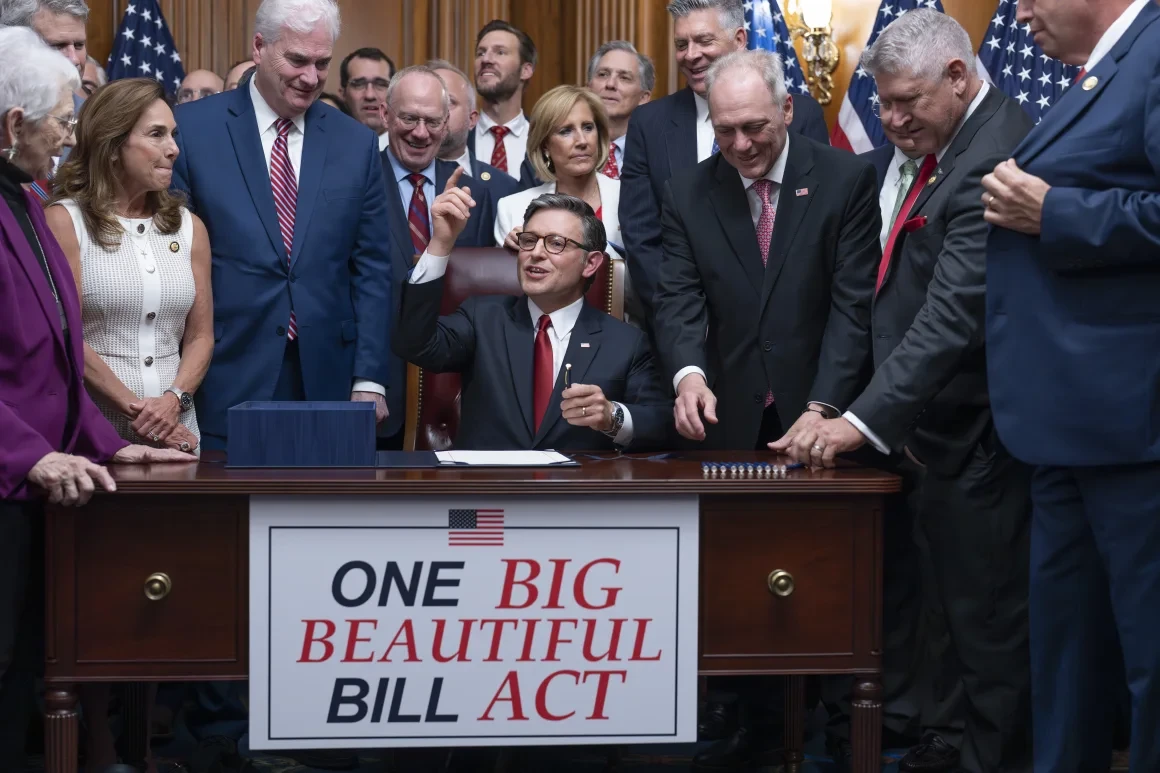
Losers
Electric Vehicle Manufacturers
The bill accelerates the end of the $7,500 subsidy for purchasing or leasing electric vehicles, with no eligibility for vehicles bought after September 30. This poses a challenge for manufacturers like Tesla, Ford, and BMW, who already struggle to promote EVs in the U.S., where the market share remains around 8% of new car sales. Notably, an earlier version of the bill had proposed extending EV subsidies through 2026.
Solar and Wind Energy Companies
After a 12-month window for new renewable energy projects ends, developers will no longer qualify for specific tax credits. U.S. factories producing solar panels and other renewable energy equipment may see a short-term order surge as developers rush to meet the deadline, but they will face significant concerns about losing clients afterward. John Gimigliano of KPMG stated, “Renewable energy companies are the biggest losers, with billions in Biden-era subsidies likely gone for good.”
AI Companies
A provision that would have paused state-level AI regulations for 10 years (later reduced to 5) was removed from the "Big and Beautiful" bill earlier this week. AI companies had lobbied hard for this ban, arguing that complying with fragmented state regulations could hinder innovation in high-risk AI fields.
Certain Universities
A clause in the bill proposes a tiered tax rate on the annual investment income of private colleges and universities based on their wealth: 8%, 4%, and 1.4%, up from the current uniform 1.4%. Small colleges with fewer than 3,000 students may be exempt and thus benefit, while major Ivy League schools like Harvard, Yale, and Princeton are expected to face the highest 8% rate.
Food Companies
The bill cuts the U.S. Supplemental Nutrition Assistance Program (SNAP), delivering a blow to packaged food companies. In recent years, large food firms have relied heavily on SNAP beneficiaries’ spending, and many now cite these reductions as a potential cause of declining sales. Bernstein analysts estimate SNAP beneficiaries account for nearly 9% of grocery spending, putting companies like Kraft Heinz and General Mills at risk.
Logistics Companies
The bill eliminates the de minimis tax exemption for small packages. In recent years, freight carriers like FedEx, UPS, and DHL have benefited from the e-commerce boom in small parcels. If rising costs dampen consumer demand, these companies could see a drop in parcel volumes. U.S. Customs and Border Protection data shows they processed about 4 million exempt parcels daily in 2024.