
Global Highlights This Week: Tariff Negotiation Deadline Looms, U.S. Stock Market Faces Critical Test

Last week, the U.S. stock market continued its upward trend, with all three major indices recording gains. The S&P 500 rose 1.72% cumulatively, the Nasdaq gained 1.62%, and the Dow increased by 2.3%.
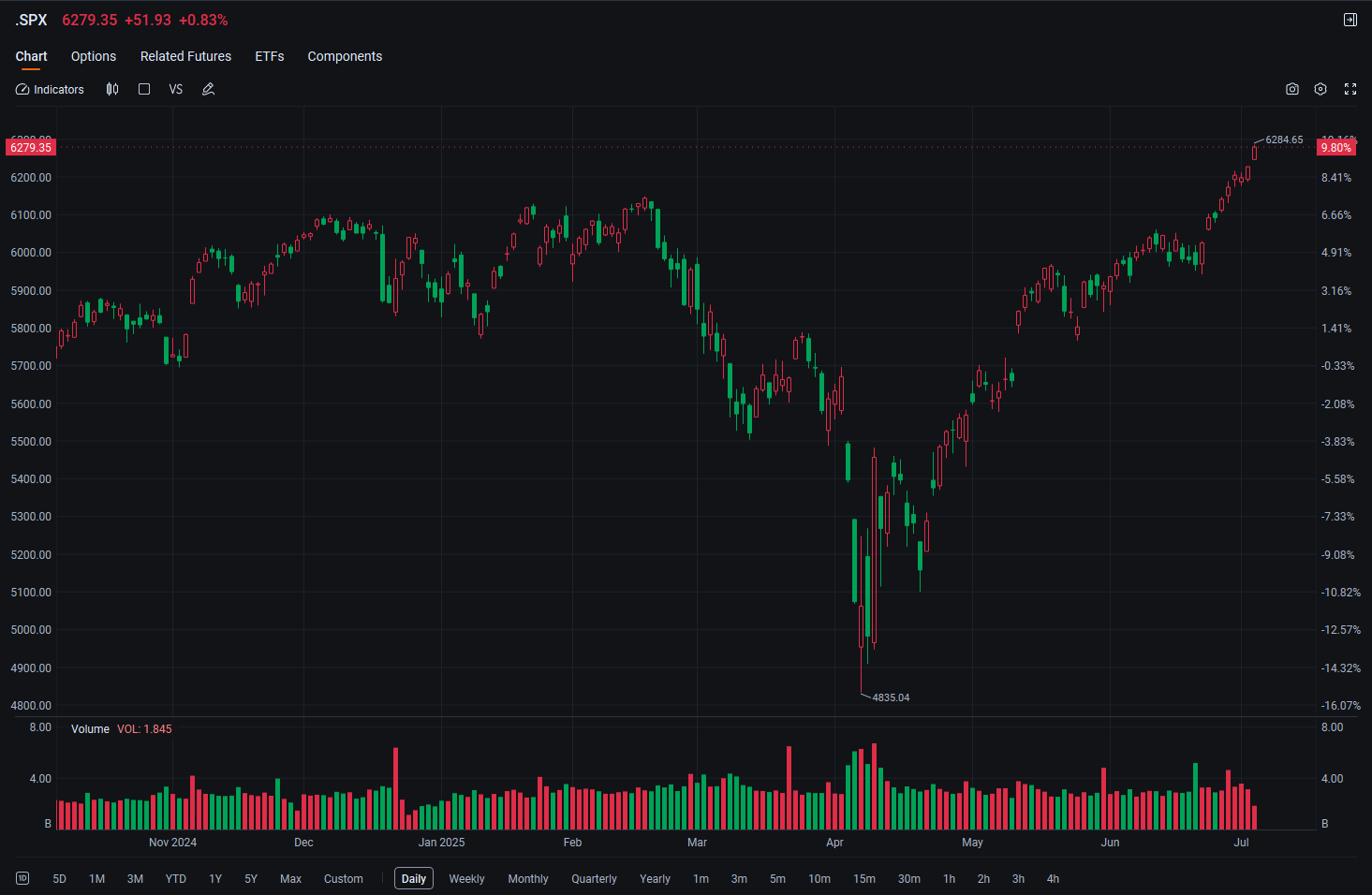
The S&P 500 and Nasdaq hit multiple new highs last week, with the two major indices refreshing their historical closing highs seven and four times this year, respectively. However, the market is set to face a significant test, as the tariff negotiation deadline set by President Trump will expire this Wednesday, July 9.
Trump introduced the so-called "reciprocal tariffs" in early April but paused their implementation for 90 days to allow negotiation time, imposing a 10% transitional tax rate during this period. July 9 marks the tariff negotiation deadline set by Trump.
So far, the U.S. has only reached trade agreements with the UK and Vietnam. Trump stated this week that he will not extend the tariff negotiation period and will notify countries of the latest tariff rates via letter, with the new tariffs taking effect from August 1.
Trump also noted, "These tariffs will range from 10%, 20% to 60%, 70%."
When Trump announced the reciprocal tariffs in early April, the U.S. stock market experienced a sharp decline. However, the S&P 500 has since risen approximately 26% from its low on April 8. During this period, U.S. corporate earnings and overall economic performance have exceeded many expectations, despite significant policy shifts.
Nevertheless, this rally has been driven more by retail investors and corporate buybacks, with institutional investors remaining relatively cautious.
Deutsche Bank estimates that although the S&P 500 has hit new highs, the current stock allocation level is still far below the February peak, indicating that investors are overall underweight in stocks.
"This is indeed a 'lower quality,' more speculative rebound," said Lisa Shalett, Chief Investment Officer at Morgan Stanley Wealth Management. "In the last one or two weeks, the rally has been driven more by retail investors than institutions. Institutional positioning is currently only at a neutral level."
Analysts note that while investors remain wary of factors such as U.S. economic slowdown and high stock valuations, a smooth transition of the tariff exemption period without new conflicts would eliminate a major risk factor.
However, investors do not believe this tariff deadline will completely end trade tensions.
"I don’t see it as a 'hard' deadline," said Julian McManus, portfolio manager at Janus Henderson. "The 90-day pause was set initially because the market was crashing, and policymakers needed breathing room to negotiate or find some kind of 'buffer solution.'"
After a turbulent first half, the S&P 500 is entering what has historically been its strongest month. Data shows that July has been the month with the highest average return for the S&P 500 over the past 20 years, at approximately 2.5%.
Overview of Key Overseas Economic Events This Week:
Monday: U.S. June Global Supply Chain Pressure Index, Eurozone July Sentix Investor Confidence Index, Germany May Seasonally Adjusted Industrial Production
Tuesday: Japan May Trade Balance, RBA Interest Rate Decision, U.S. June New York Fed 1-Year Inflation Expectations, Germany May Seasonally Adjusted Trade Balance, France May Trade Balance
Wednesday: U.S. May Wholesale Sales, EIA Monthly Short-Term Energy Outlook Report, RBNZ Interest Rate Decision and Monetary Policy Assessment Report
Thursday: U.S. 10-Year Treasury Auction to July 9, Fed Releases Monetary Policy Meeting Minutes
Friday: Germany/France June CPI Final Value, IEA Monthly Crude Oil Market Report, Switzerland June Consumer Confidence Index