
Has the U.S. Stock Market Hit a New High—Should You Still Hold?

Recently, many friends have raised concerns about U.S. stock risks, asking if they should sell off their holdings.
Today, let’s review the major drawdowns of the Nasdaq 100 over the past thirty years and discuss whether holding U.S. stocks is still a good idea.
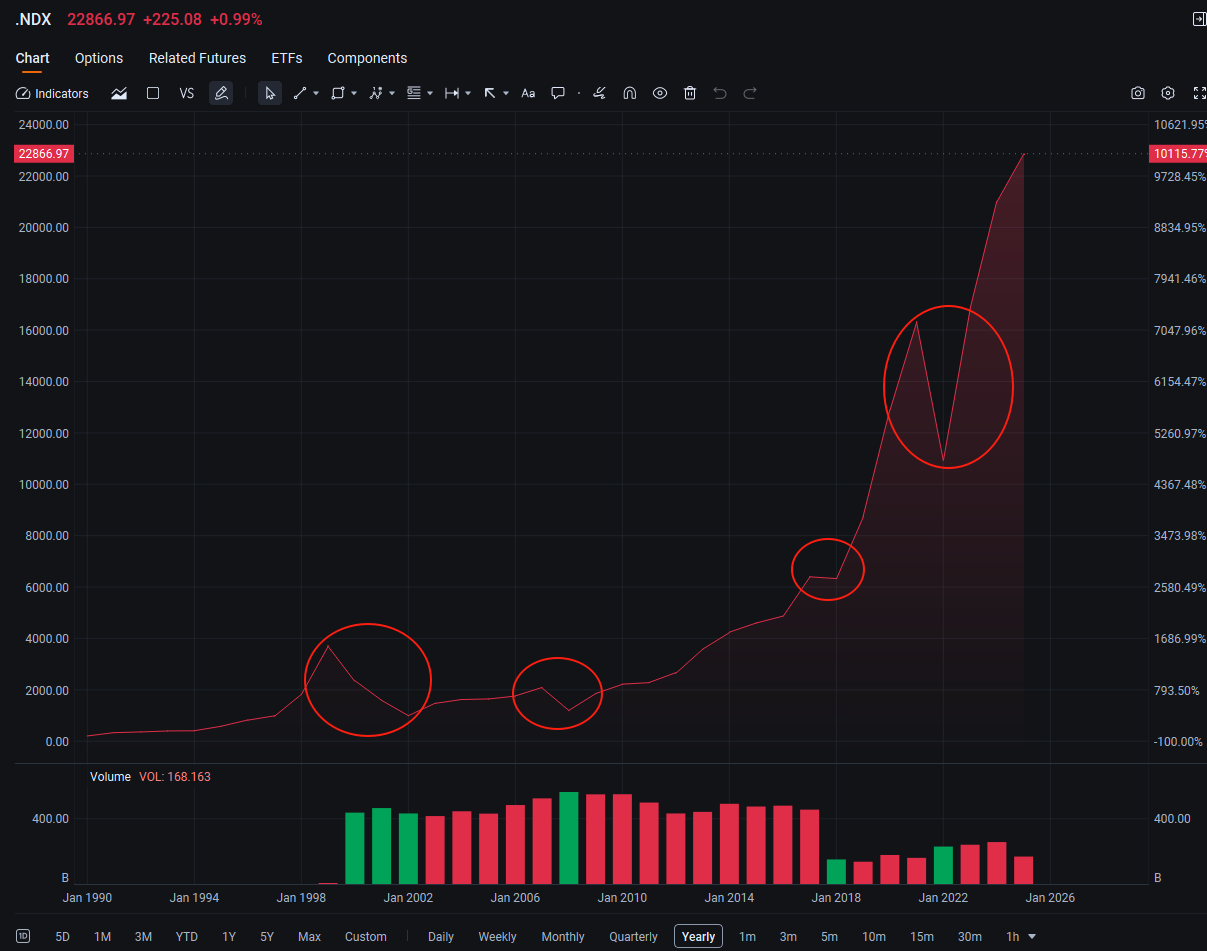
Historical Summary
First Drawdown: 2000-2002
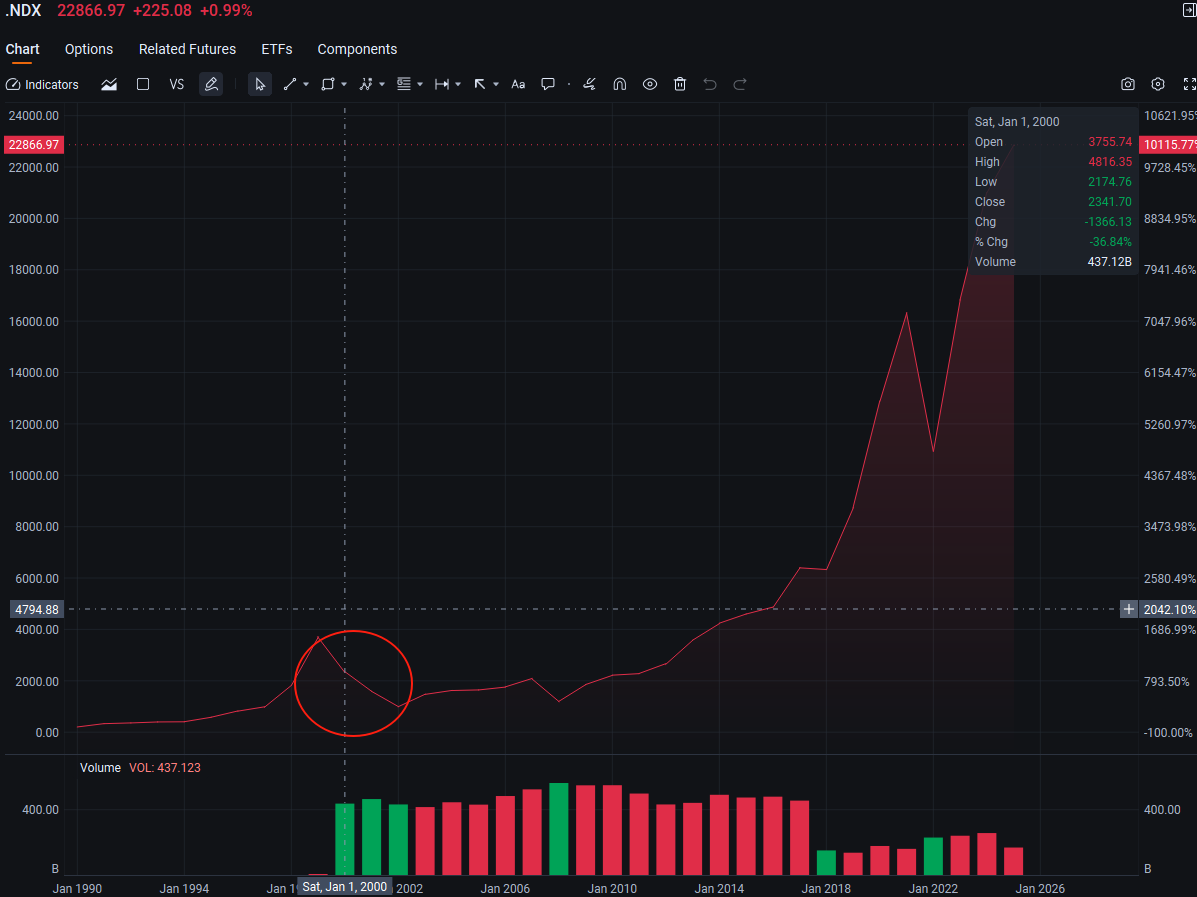
Cause: While interest rate hikes played a role, the primary reason was excessively high valuations, with many listed companies lacking profitable business models. Before the bubble burst, the Nasdaq’s P/E ratio once exceeded 100.
Impact: This was the worst crash in Nasdaq history, with a maximum drawdown of 70%.
Likelihood of Recurrence: Unlikely. Post-crash, the market imposed stricter business and financial requirements on listed companies, especially top firms. The Nasdaq 100’s current overall P/E is 30-35, and even giants like the Magnificent 7 face sharp sell-offs if earnings disappoint.
Second and Third Drawdowns: 2008 Financial Crisis and 2020 Pandemic Shock

Cause: Both were triggered by sudden liquidity crunches—2008 due to Lehman Brothers’ collapse (a $600 billion balance sheet failure, a massive figure then, freezing market liquidity as trust in balance sheets evaporated), and 2020 from bank trading desks shutting down due to COVID-19, causing a rare across-the-board drop in stocks, bonds, and precious metals.
Likelihood of Recurrence: The 2008 scenario is improbable, as post-crisis U.S. regulations reverted to separating commercial and investment banking, halting proprietary trading. The 2020 case requires another severe pathogen outbreak, but the Fed would likely intervene again.
Fourth Drawdown: 2022 Full Year
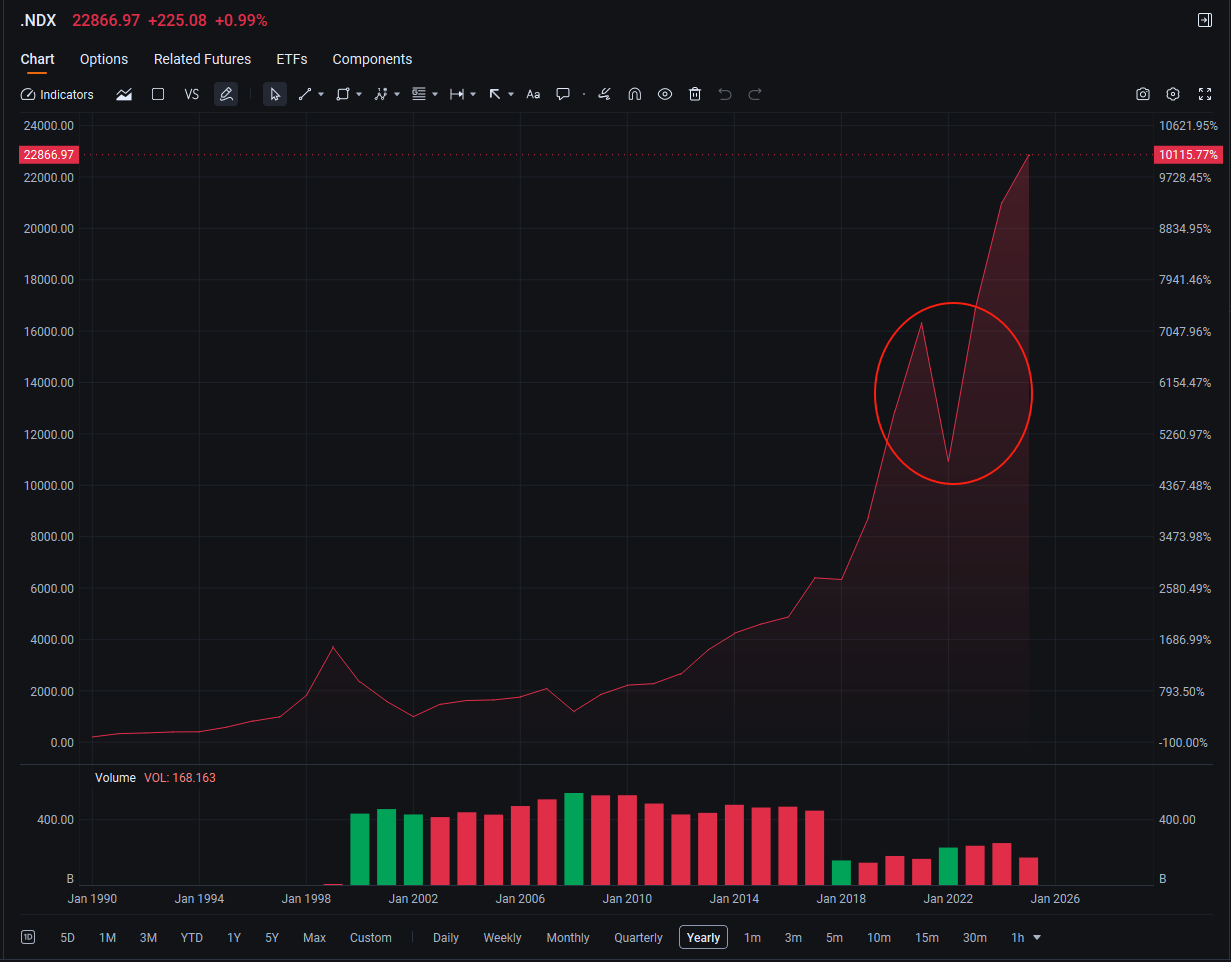
Cause: Severe inflation and aggressive rate hikes, fueled by post-pandemic fiscal stimulus like the American Rescue Plan, which provided massive cash aid (thousands of dollars per adult and child based on income levels), combined with the Fed slashing rates to 0-0.25% in 2020-2021. This drove 2022 inflation to a 40-year high of 9%.
The Fed responded with steep rate hikes, raising the federal funds rate from 0-0.25% at the start of 2022 to 4.25%-4.5% by year-end. For those familiar with discounted cash flow, this rapid rate hike was devastating to long-duration assets like bonds and stocks, leading to a 30% Nasdaq 100 drawdown.
Global Impact: As the U.S. rate anchor, this hike drew capital to U.S. short-term bonds, dragging global equity markets, including China’s, into a slump—making 2022 a tough year for A-share quantitative strategies.
Likelihood of Recurrence: Possible. Macro analysts like me are most concerned about the tight link between inflation and rates, with the latter being the market’s key variable.
Should You Still Hold U.S. Stocks?
My Conclusion: You can retain a 20-30% position in U.S. stocks now. If there’s a downturn, consider adding to your holdings, but avoid going overweight at current levels.
This week, U.S. stocks will face multiple disruptions, including the tariff negotiation deadline, a potential decoupling of Trump and Musk’s relationship, and the Fed’s interest rate decision, likely causing significant volatility.
Notice how the tariff war black swan event in early April triggered a month of global market turbulence, especially wild swings in U.S. stocks. However, since mid-May, after breaking above the yearly trendline and stabilizing, U.S. stocks have regained their former steady state, with the tariff war’s impact now minimal.
As long as U.S. stocks remain stable, minor negatives have limited disturbance, while any small positive news fuels steady gains. This has been the U.S. stock market’s DNA since before February—recently, it’s just returned to that rhythm.
Given this restored stability, it’s unwise to be overly bearish or sell off easily. In a stable state, U.S. stocks can keep hitting new highs, even if you think they’ve risen too much—can they still go higher? Yes, they have for the past decade, and that’s undeniable.
The last tariff war caused a short-term crash because it was Trump’s first proposal, catching markets off guard and sparking panic. This time, I believe the drop won’t be as severe, as the market has anticipated it. Even if Trump takes a hard stance and implements tariffs, the impact should be muted.
I think the Nasdaq, even with a potential pullback recently, is unlikely to break its yearly trendline, let alone the 60-day moving average.
So, hold your positions, avoid selling rashly, and if there’s a slight dip, seize the opportunity to add significantly to your holdings.