
Stock Market Rallies from Panic to Goldilocks But Is the Rally Getting Ahead of Itself in 2025?

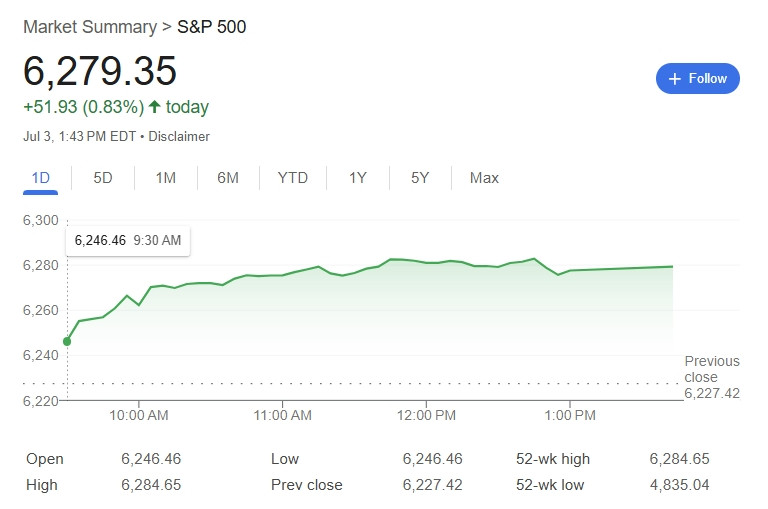
Just three months ago, President Trump’s announcement of sweeping new tariffs on several trade partners sent the market into a panic, with the S&P 500 nearly slipping into a technical bear market. But now, the S&P and Nasdaq have not only bounced back—they’ve hit record highs. So what’s behind this sharp shift from panic selling to a buying frenzy? Is this a genuine return of confidence or is the market moving too fast?
Pause on Tariffs and Tax Reform Spark a Swift Market Turnaround
Back in early April, the “liberation day tariffs” triggered a nearly 19% drop in the S&P 500, casting a shadow of trade war fears over the market. But in June, Trump announced a pause on those tariffs, giving investors a much-needed breather. That was followed by three major positive developments:
-
A preliminary trade framework with China eased US-China tensions;
-
The passing of Trump’s massive tax and spending bill expanded tax cuts and government stimulus;
-
The Federal Reserve signaled possible interest rate cuts, supporting risk assets with looser monetary policy.
With these tailwinds stacking up, investor sentiment quickly shifted from deep fear to high optimism.
The Goldilocks Scenario Returns But It’s Built on Shaky Ground
The “Goldilocks scenario”—where the economy is neither too hot nor too cold, inflation is moderate, interest rates are balanced, and policy supports growth—is what many see unfolding in the second half of 2025:
-
Inflation has eased, with June’s jobs report beating expectations and unemployment dropping to 4.1%;
-
Fiscal stimulus is boosting supply, cutting taxes, and encouraging investment;
-
Trade talks progress, lowering geopolitical risks;
-
The Fed is expected to cut rates 1-2 times this year, easing liquidity.
Yet beneath this seemingly ideal setup lies fragility. Trump’s tax and spending plan is projected to add $3.4 trillion to the deficit over the next decade—and that figure doesn’t even count potential tariff revenues. The long-term struggle between rising debt, deficits, and interest rates is far from over.
Technical Rally Shows “Strength Begets Strength”
Since bottoming on April 8, the S&P 500 has surged nearly 20% over 50 trading days—one of the strongest short-term rallies since 1950. Historically, rallies like this often signal continued gains over the following 3 to 12 months.
However, this strong rebound also risks overheating—especially in small caps, industrials, and consumer discretionary sectors, which have seen valuations spike noticeably.
Is the Market Getting Ahead of Itself? Wall Street Divides
While the broader trend remains positive, some strategists are sounding caution. Scott Wren, a strategist at Wells Fargo, argues the market is too optimistic about tariffs and their impact on economic growth in the second half of 2025.
He warns that if tariffs take full effect, higher costs for businesses, weaker consumer spending, and rising unemployment will slow growth. Wren recommends trimming positions in sectors that have run up and reallocating to more reasonably valued areas like financials, energy, tech, and utilities—or even holding cash and waiting for volatility.
My Take
This rally is clearly fueled by both fundamentals and policy, but its speed and magnitude have outpaced the actual economic improvement. The market’s faith that fiscal stimulus will fully offset tariff shocks may be somewhat optimistic.
More importantly, fiscal stimulus is a one-off boost, while trade tensions and debt challenges are ongoing. Once investors realize the deficit will keep growing and fiscal policy space narrows, stock gains may slow or face volatility.
That said, in the near term, momentum could carry the market higher as good news piles up. But I’m keeping a close eye on:
-
Whether the Fed follows through with actual rate cuts;
-
If corporate earnings genuinely improve in the second half.
If these key factors disappoint, the market’s quick shift from fear to greed could reverse just as fast.